Bearman fortunately escaped injury after his collision at Suzuka. However, Gary Anderson, former technical director for Jordan Grand Prix and Jaguar Racing, warns that without changes, Formula 1 (F1) could face a real tragedy in the near future.
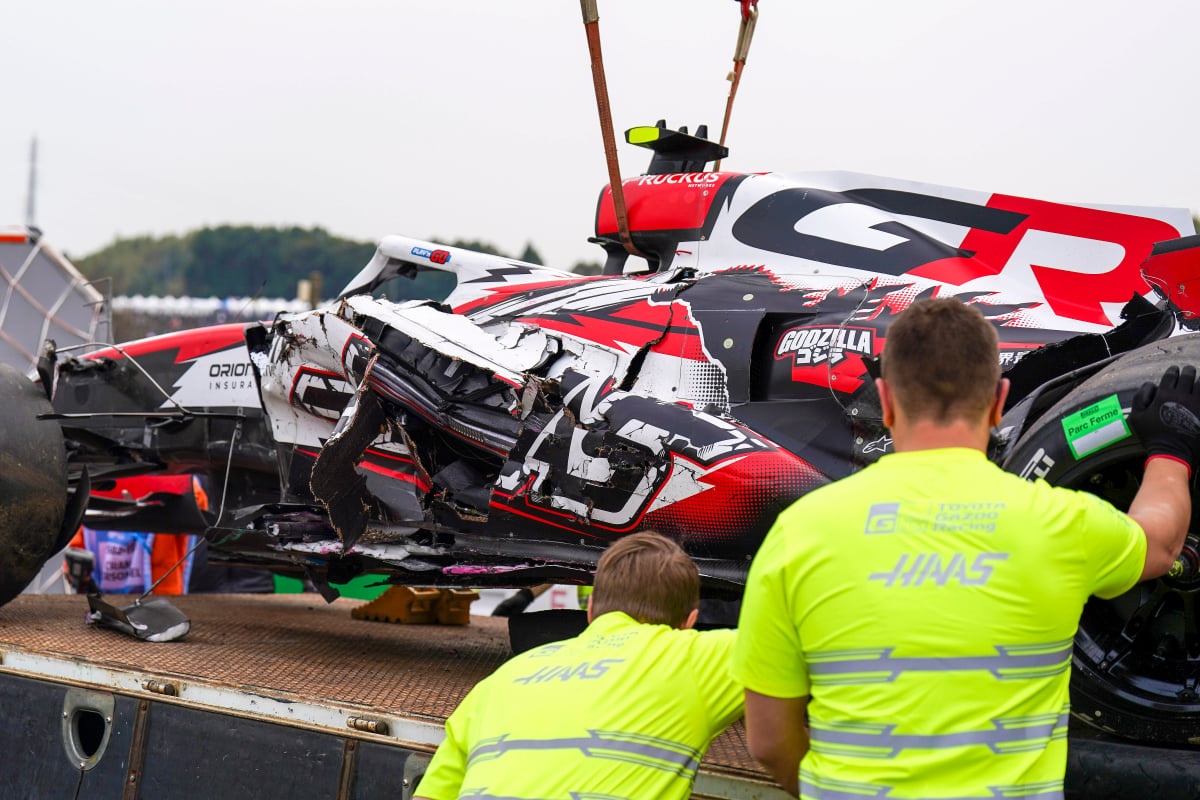 |
Bearman's car after the accident at Suzuka, Japan on 29/3. Photo: Imago |
The core issue lies with the new regulations from the Federation Internationale de l'Automobile (FIA). The 2026 F1 cars will operate as high-performance hybrid systems, combining a gasoline engine and an electric motor. The electric component provides significant power but only for short durations, compelling drivers to constantly regenerate energy during the race by decelerating.
Due to insufficient braking time, drivers must actively slow down in certain sections to accumulate electrical energy. This can lead to cars on the same track being in completely opposite states: one car accelerating at full speed while another is unusually slow. This sudden, unpredictable speed difference poses a significant risk.
In Bearman's situation, he could not anticipate Franco Colapinto decelerating to charge the battery while entering the high-speed Spoon corner. By the time Bearman realized this, it was too late. His only option was to run onto the grass, making the accident unavoidable.
Anderson believes this was not a personal error by the driver. "This accident was bound to happen", he stated. "The responsibility lies with the regulatory system itself".
A concerning aspect is that a similar scenario could recur in even more dangerous situations, particularly when drivers are battling for position. During sharp braking into corner 1, where cars run closely at extremely high speeds, a car unexpectedly slowing due to depleted electrical energy could trigger a chain collision. Anderson even compares this risk to aviation disasters.
With individual errors, as in the past, drivers could often sense and prepare for a collision. However, current situations can take anyone by surprise. The driver behind receives no signal to react in time.
A major paradox in current F1 is that drivers can be penalized for intentionally driving slowly in qualifying, yet are compelled to do so during the race due to technical requirements. To achieve the best lap times, they need to maximize electrical energy. This means choosing less critical sections to decelerate and recharge batteries. As a result, sudden decelerations are becoming more frequent, which is the root cause of dangerous speed differences.
In the Suzuka incident, no penalties were issued to the Alpine F1 team or Colapinto, as they were operating within the rules.
These changes also distort the very nature of F1. Anderson argues that while overtakes are now numerous, they lack genuine competitiveness. At Suzuka's famous 130R corner, which once demanded skill and bravery, energy harvesting has removed the challenge. In return, drivers gain extra electrical power to accelerate and overtake at the end of a straight, only to lose the position shortly after when their opponent recovers energy.
Spectators may see many overtakes, but these are not true duels. "You just press a button and overtake", Anderson said. "Previously, the drag reduction system (DRS) required drivers to stay within one second of their opponent before activating it. Now, everything is much easier".
Another consequence is that the demanding nature of races is gradually disappearing. In the past, drivers like Nigel Mansell often emerged from their cars completely exhausted. Today, with continuous energy management, they no longer push the car to its limits as before. Especially at traditional circuits like Spa-Francorchamps or Silverstone, the power difference between cars becomes even more pronounced.
Even high-performing drivers are starting to speak out. According to Anderson, most current drivers believe this system is problematic. Technically, drivers have 350 kW of electrical power, equivalent to about 11,5 seconds of maximum usage. However, at Suzuka, they need approximately 60 seconds of full throttle per lap. This means they must recharge energy up to five times per lap.
The issue is that the braking time available for energy recovery is only about 11 seconds per lap. This deficit forces them to sacrifice speed in other sections, leading to significant differences between cars. Compared to last season, when electrical power was only about 120 kW, the current 350 kW is too large a jump, especially with one energy recovery system (MGU-H) having been eliminated. While deceleration phenomena existed previously, they were never as severe as they are now.
According to Anderson, the solution is not simple but clear: reduce electrical power to a reasonable level, perhaps around 200 kW, to limit the reliance on in-lap energy regeneration. More importantly, F1 needs to re-evaluate its regulatory philosophy. A system that causes cars to run simultaneously with large speed differences not only diminishes race quality but also places drivers in dangerous situations.
Bearman's accident serves as a warning. Without timely adjustments from the FIA, that warning could soon become a painful reality.
Xuan Binh (according to Telegraph)