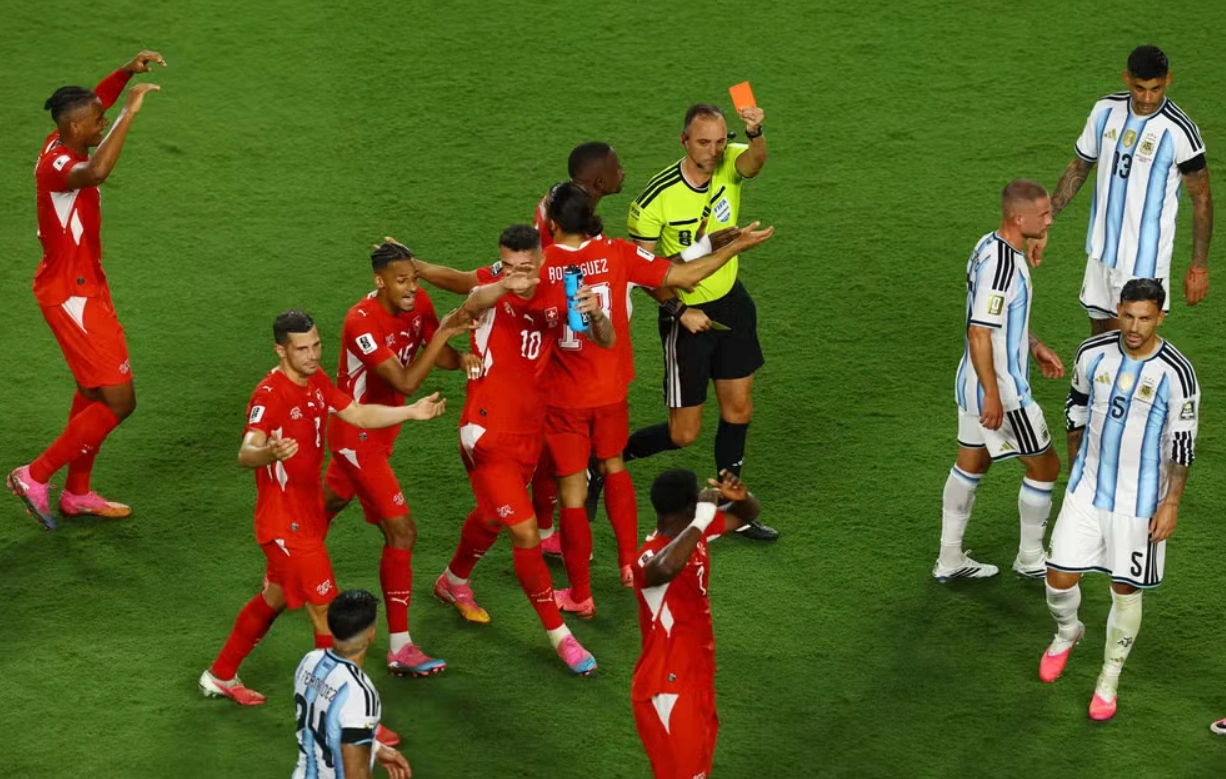
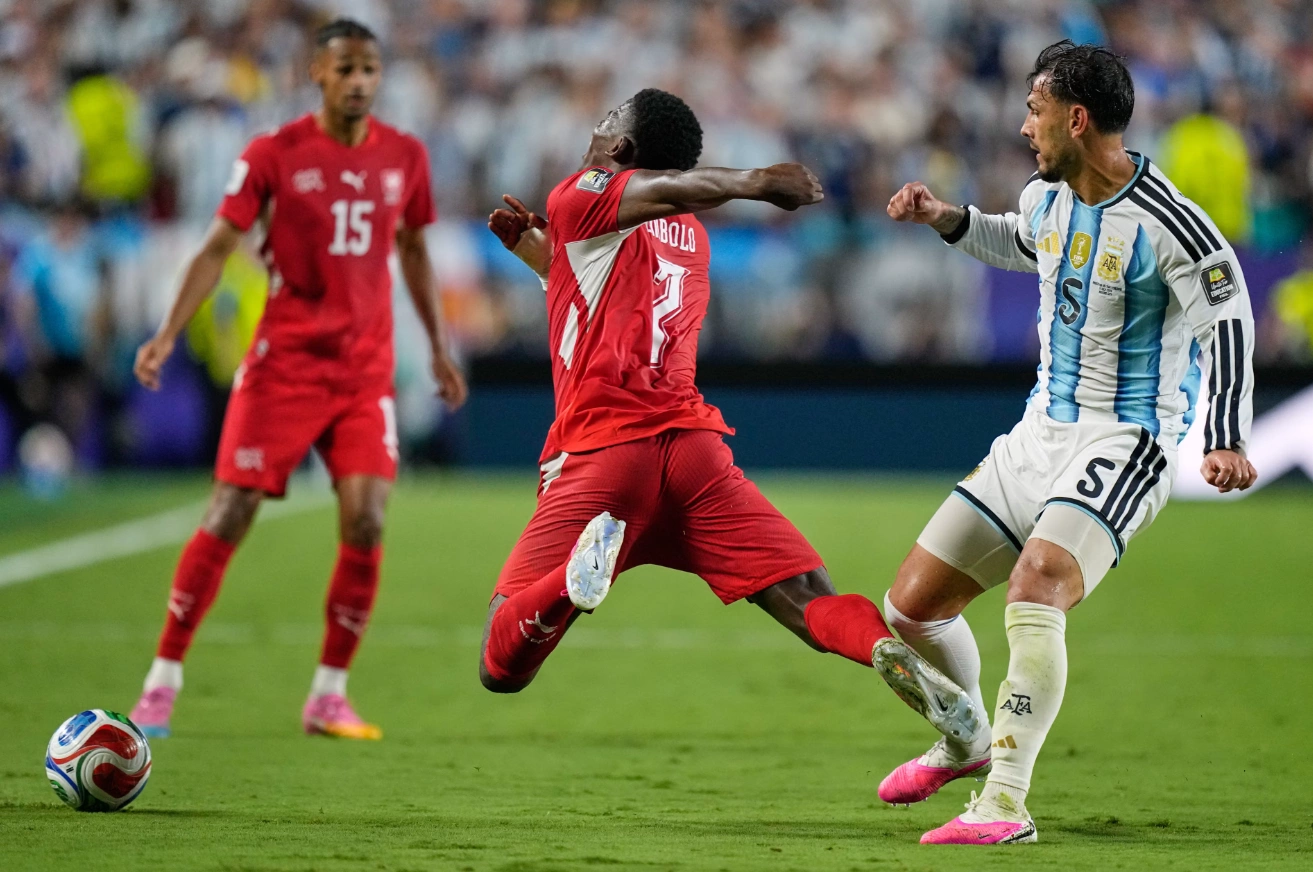
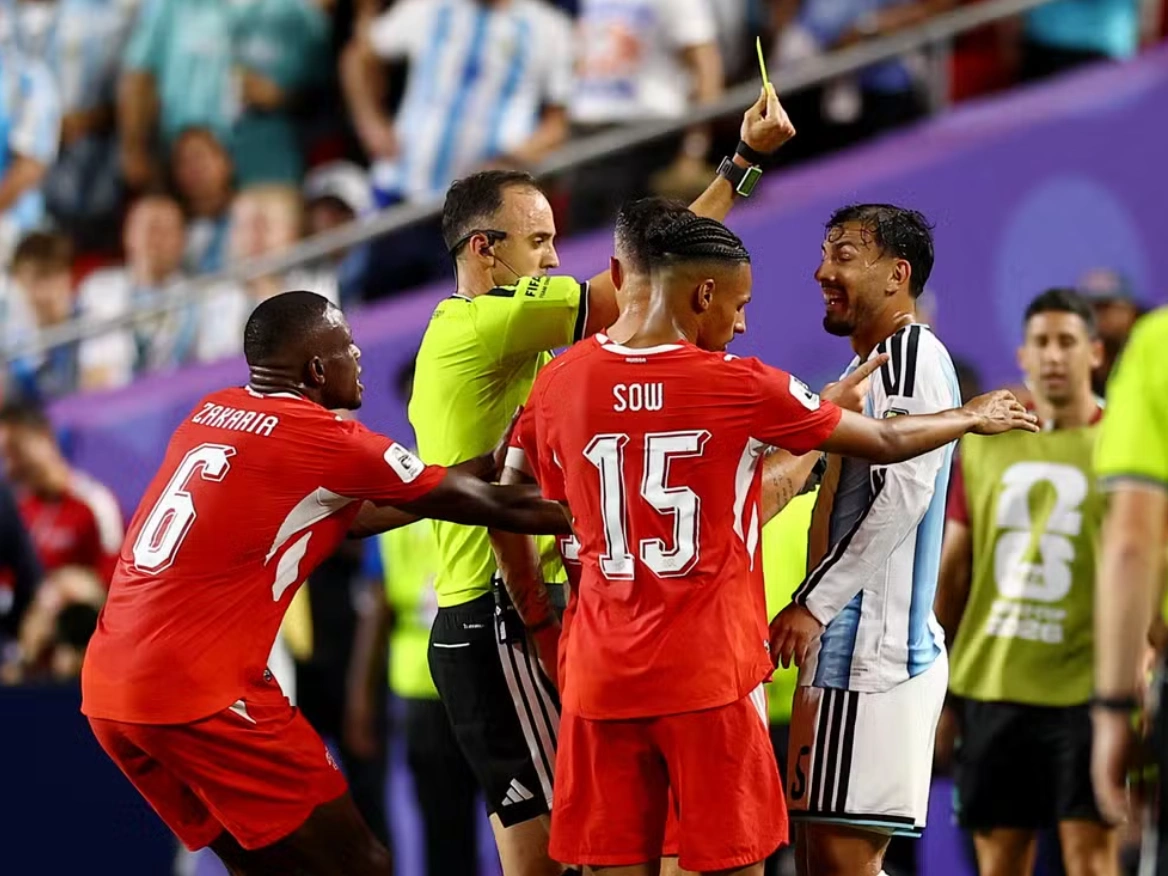
In the 69th minute, five minutes after Switzerland equalized one-one, Breel Embolo fell near the touchline following a challenge with Leandro Paredes, initially earning the Argentina midfielder a yellow card. After consultation with the video assistant referee (VAR), referee Joao Pinheiro reviewed the footage. During the stoppage, the Arrowhead Stadium screen displayed "VAR check - mistaken identity", indicating the VAR team was applying a protocol for identifying the wrong player who committed the foul.
Upon reviewing the incident, Pinheiro concluded that Paredes did not commit a foul and Embolo had simulated. Consequently, Paredes' penalty was canceled, and the Swiss forward received a second yellow card. This decision allowed Argentina to play with an extra man, ultimately winning three-one in extra time.
 |
Paredes (right) collides with Breel Embolo... |
 |
... and receives a yellow card during the Argentina vs. Switzerland match in the 2026 World Cup quarterfinals at Arrowhead Stadium, Missouri, United States on 11/7. Photo: Reuters, AP |
In an announcement published on 27/7, IFAB stated that the VAR protocol for "mistaken identity" was not permitted for situations like Embolo's at the 2026 World Cup, even though it is currently under review for potential future inclusion.
"However, this regulation cannot be applied until the review process is complete", IFAB, headquartered in Zurich, Switzerland, said in its statement.
According to IFAB, Embolo's dismissal was not a correct application of the "mistaken identity" rule. This provision aims only to correct an error when a referee penalizes the wrong player for an identified foul; it does not permit a re-evaluation of the nature of the foul itself.
IFAB emphasized that a card "can only be reviewed to identify the correct player who committed the sanctioned offense; the offense itself cannot be reviewed or changed".
 |
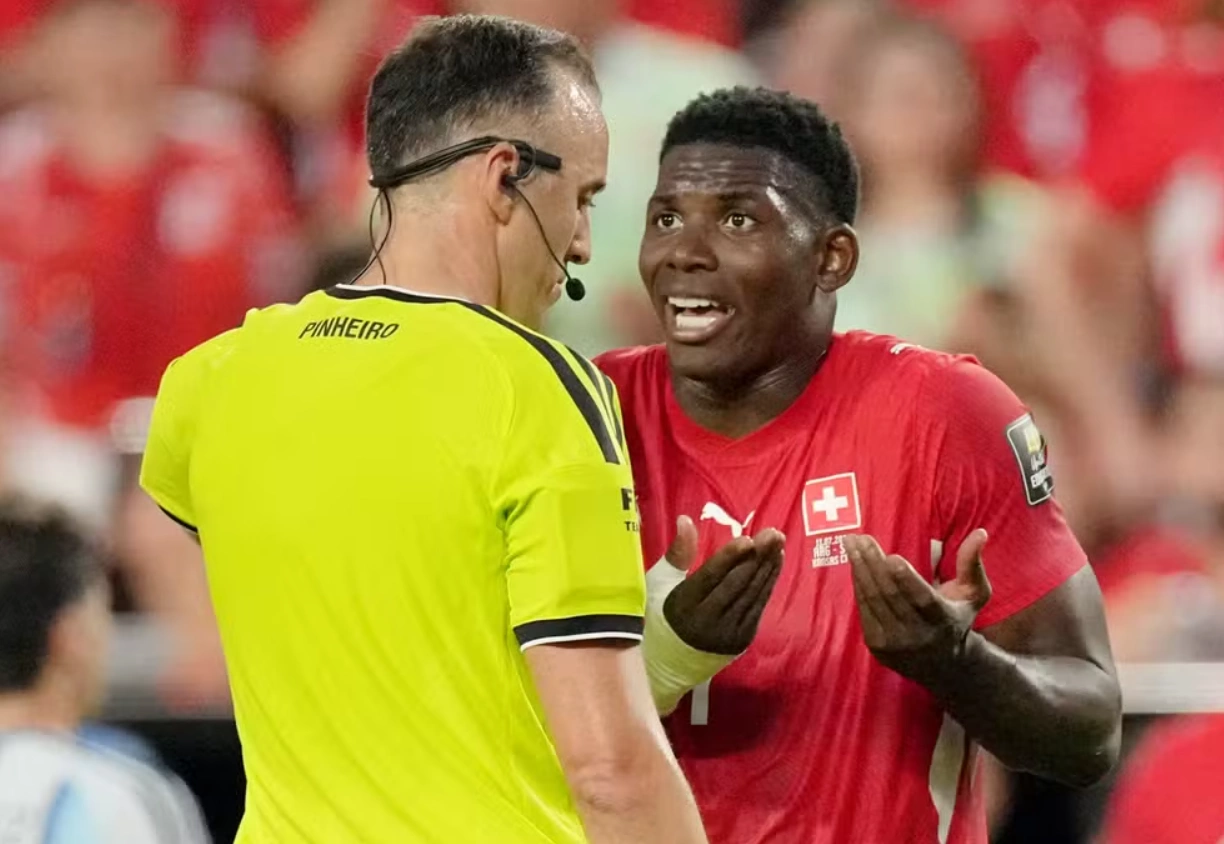
After reviewing the footage, referee Joao Pinheiro dismissed Breel Embolo. Photo: Reuters
 |
Embolo protests to the referee. Photo: Reuters
 |
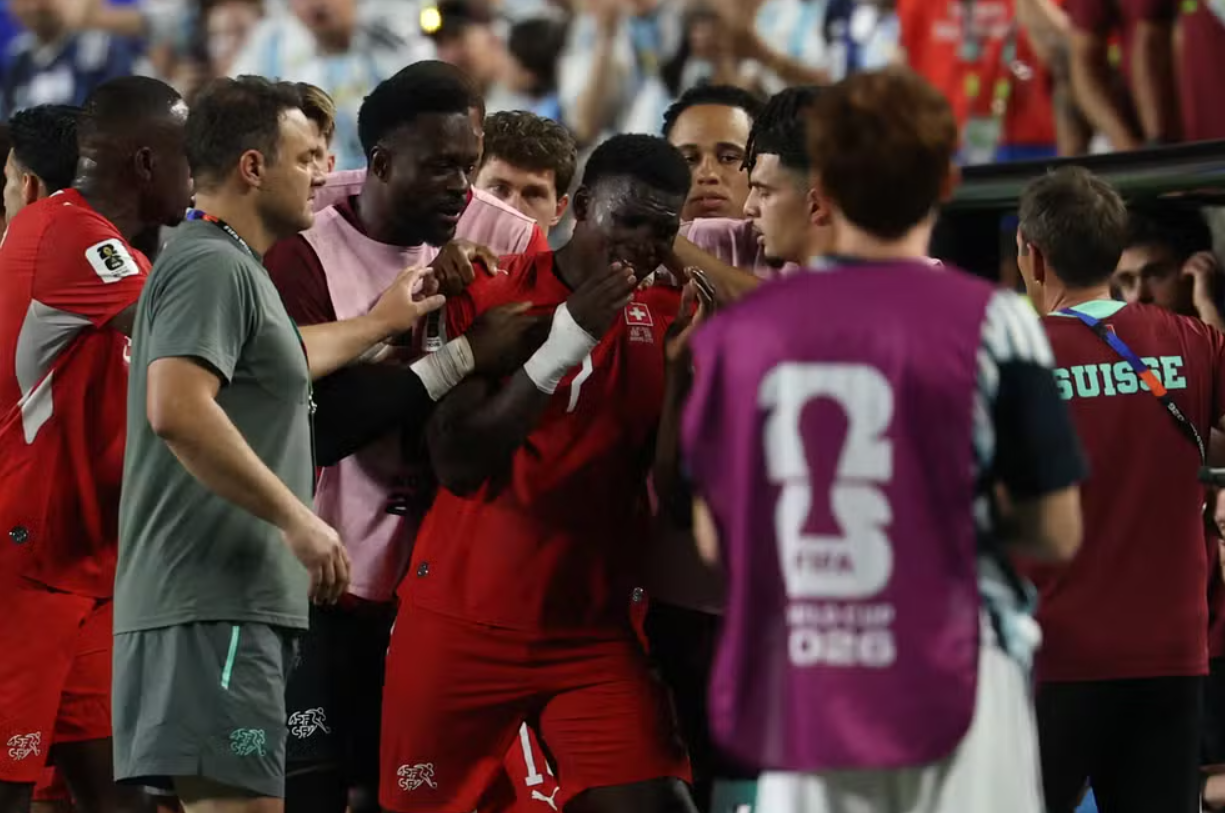
Embolo cries as he leaves the field and is comforted by teammates. Photo: AFP
The organization noted that the VAR protocol review process began in march, and situations like Embolo's are within its scope. "The use of the 'mistaken identity' provision to address simulation incidents at the FIFA World Cup 2026 has received positive feedback", IFAB reported.
In addition to Embolo's dismissal, referees applied a similar rule in the United States' four-one victory over Paraguay in the first match of Group D at the 2026 World Cup. In that game, Tim Ream received a yellow card after colliding with Miguel Almiron. But after consulting VAR, the referee rescinded Ream's yellow card and issued a yellow card to Almiron for simulation.
IFAB is an independent body responsible for developing, managing, and amending the Laws of the Game – the rules governing football matches worldwide. This body meets annually in february or march to approve amendments to the Laws of the Game, which apply to major tournaments or the following season.
Established in 1886 to unify the rules for international matches, IFAB has since served as the "guardian" of the Laws of the Game. The organization comprises FIFA – the world governing body for football – along with the four football associations of England, Scotland, Wales, and Northern Ireland. FIFA officially recognized IFAB's authority over the Laws of the Game in 1904.
Currently, FIFA holds 50% of the voting power at IFAB. All amendments to the Laws of the Game require at least three-quarters of the votes in favor. This means FIFA's support is a necessary condition, but a proposal passes only with additional consent from the remaining member associations.
Hong Duy (via ESPN)