The winter break offers many European-based footballers a chance to relax in sunny resorts or return home to spend time with family. This year, Raphinha did the same, but he, along with his wife Natalia Belloli and their charity foundation, organized a special event on 25/12: distributing essential necessities to those facing hardship.
Brazilian newspaper GE Globo reported that thousands of residents in Restinga, a neighborhood in Porto Alegre, Brazil, attended the event. In addition to distributing charity gifts, Raphinha and his family also organized music and art performances, combined with an outdoor barbecue for those present. He and his wife were also willing to interact, take photos, sign autographs, and greet fans.
The Rio de Janeiro-based sports newspaper described this as Raphinha's way of giving back to his hometown. "The gesture by the Brazilian international and his wife clearly demonstrates their humanity and compassion—individuals who have not only won the hearts of Barca fans but are also honored as compassionate souls in their homeland, always thinking of those in difficult circumstances," GE Globo wrote.
Raphinha and his wife distributed gifts in Restinga on 25/12.
Like many other Brazilian footballers, Raphinha's childhood was spent in slums plagued by vice and poverty. Restinga, which has among the highest unemployment and crime rates in Brazil, is where the 29-year-old winger was born and raised.
"You quickly realize that you cannot live alone," Raphinha once said in 2021 on The Players’ Tribune. "Your friends become your second family. You know that sooner or later they will need your help, and you will need theirs. I am not talking about saving each other from death or drug gangs. Sometimes it's just small things."
The "small things" the player born in 1996 referred to included sharing food or offering rides to football matches. Because Restinga is far from Porto Alegre city center, Raphinha often had to leave home early in the morning for a match and return after dark.
"My friends and I barely had time to eat," Raphinha recounted. "If someone in the group was better off, they would often share some food after the match, so you didn't have to go home hungry. Sometimes I didn't have enough money for the bus fare, and I would just cry because I yearned to play football. But luckily, one of my friends had a family that could afford a monthly bus pass, so I got to ride along."
However, the journey to play varzea (amateur) football during his childhood was not always smooth for Raphinha. Many times, he and his friends had nothing left to eat, and they had to beg strangers on the street.
"I had to be truly desperate to do that, but hunger left us with no choice," Raphinha continued to reminisce. "The problem was that people were afraid of us. Simply because after playing football, we were dirty, sweaty, sometimes with a few scars or bruises, so people thought we were going to rob them. Back then, I was very sad, because we just wanted a biscuit, a piece of bread... anything."
Compared to many other children his age in Restinga, Raphinha still felt fortunate. The former Leeds Utd player said that even though his family was not wealthy, his parents worked hard to ensure there was always food at home. Raphinha's house was so small that he had to sleep with his parents, younger brother, and even dogs and cats—pets he considered companions because "they always made me happy."
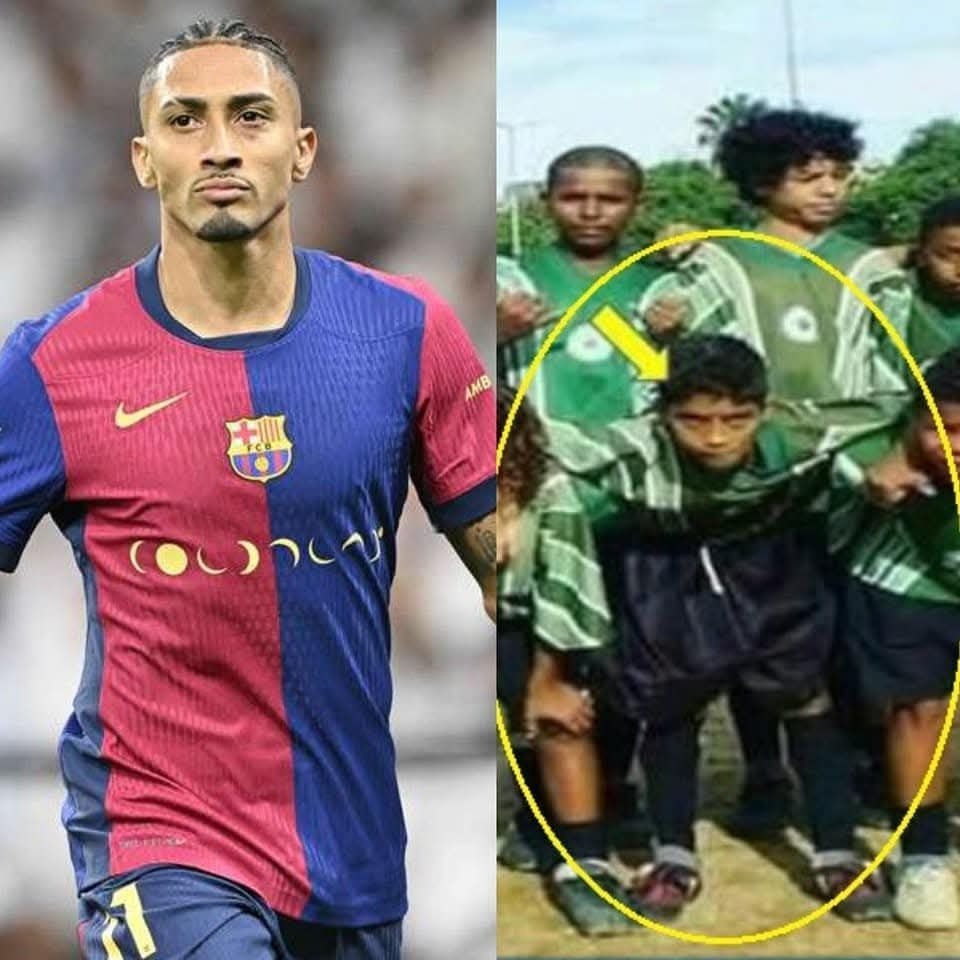 |
Before becoming a superstar for Barca and the Brazilian national team, Raphinha also came from the slums, playing street football in Restinga.
Raphinha's fortune also included the constant protection and guidance from his family, which prevented him from straying or falling into vice. Until he was 17 years old, the Barca vice-captain was still playing in amateur football leagues, incurring too many travel expenses for his family's means. His goal was to receive monthly financial support from a football academy to help his family, but that did not happen.
Porto Alegre is home to the famous Brazilian football club Gremio, the starting point for Ronaldinho, who was also Raphinha's idol. From a young age, he had the chance to meet Ronaldinho in person at a former Barca star's birthday party, thanks to his father, a samba musician hired to perform.
Wanting to follow in his idol's footsteps, Raphinha applied to Gremio's academy, but time and again, after a week of trials, he was rejected, primarily because he was deemed too small and weak. Another club in Porto Alegre, Internacional, also did not accept him for similar reasons.
"Therefore, the thought of 'other' easy ways to make money sometimes crossed my mind," Raphinha recalled. "But in that world, there is no peace. I lost too many friends to drugs to understand that. Alive one day, dead the next. My parents knew it well. Relatives in my family had gone down that path and did not end well."
"I was lucky to have a family to advise me. In the community where I lived, many people were raised only by single mothers, siblings, or neighbors and friends. If I counted the number of my friends who had both parents, I would not even need one hand," Raphinha concluded about his circumstances compared to many other children in Restinga.
To pursue his football dream, hoping to secure a contract, Raphinha had to travel to Imbituba, located about 380 km north of Porto Alegre, to find an opportunity. Each trip took him 6 hours.
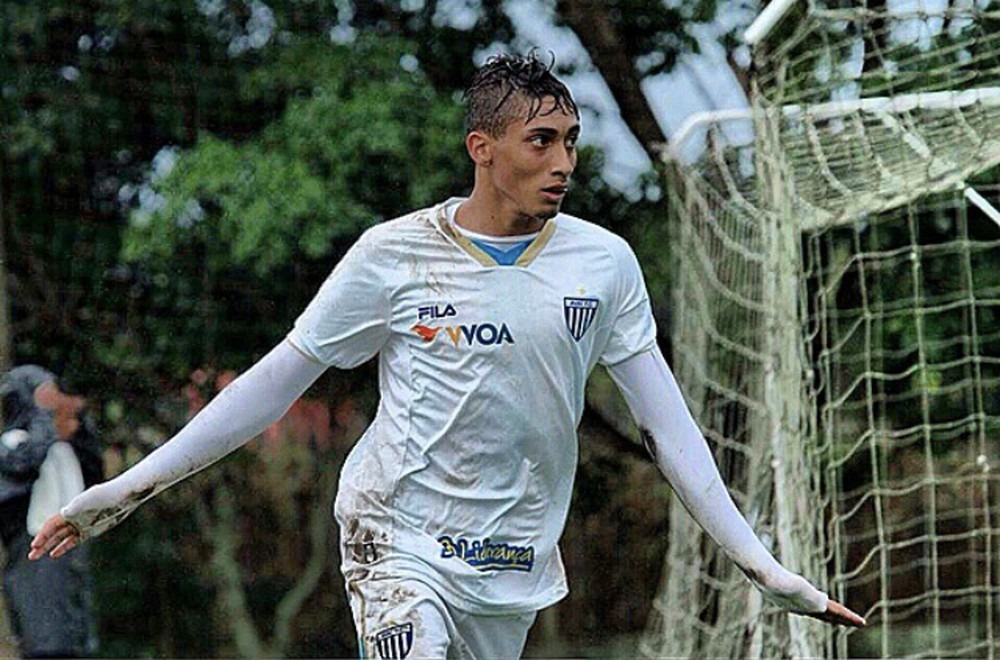 |
Raphinha during his time with Avai Club—the first stepping stone in his professional career. Photo: GE Globo
There, his fate was changed by Diogo Fernandes, a scout and youth coach for Avai, a second-division Brazilian club, who came to observe Imbituba players. At 18 years old, Raphinha finally joined a professional football club, albeit only playing for Avai's U20 team.
His time at Avai was not always smooth. After an injury and losing his starting spot on the U20 team, Raphinha considered returning to Restinga for good. His family did not object, but his mother reminded him that if he did not play football, he would have to find another ordinary job, at a supermarket or a barbershop.
"I understood how harsh life was out there, not just because I came from the slums, but also because my mother had to do one job after another," Raphinha added. "If my mother wrote her resume, you would see a long list of jobs she had done: hairdresser, nail technician, perfume saleswoman, clothing saleswoman, receptionist, waitress... My mother did everything to support our family, and even saved up to get a degree."
It was his mother's example that motivated Raphinha not to give up. Two years after joining Avai, despite never playing for the first team, he was signed by Vitoria Guimaraes of Portugal. The rest is Raphinha's journey of advancement over time in Europe: moving to Sporting, then Rennes, Leeds Utd, and currently Barca, where he has won the affection of the entire team and fans not only for his talent but also for his dedication.
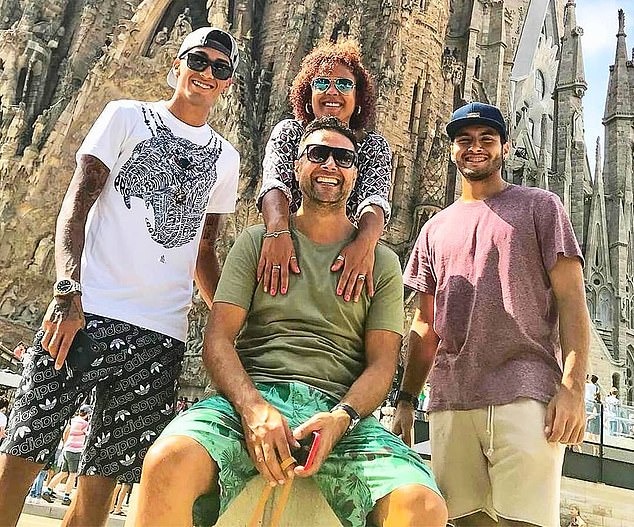 |
Raphinha (in white) with his parents (center) and younger brother during a trip to Barcelona.
After achieving success, Raphinha established a charity project in his hometown of Restinga called Projeto Vencedor, aiming not only to provide football training but also to help change the lives and destinies of disadvantaged children, just like he once was.
Hoang Thong compiled