Barefoot running on marathon courses remains an intriguing sight. In an era dominated by advanced running shoes, shoeless feet present a striking contrast, symbolizing the simplicity and primal resilience of the sport.
From a sports science perspective, running without shoes offers unique neurological benefits but carries a potential risk of bone injury if done incorrectly.
Barefoot running compels the brain to work harder
A significant difference between barefoot and shod running lies in the amount of sensory information the brain processes. The soles of the feet have a dense concentration of nerve receptors. Direct contact with the ground sends continuous tactile signals to the brain, requiring the nervous system to engage more deeply in motor control.
Research by Alloway's team (2016), published in the journal Perceptual and Motor Skills, indicated that individuals who ran barefoot for short periods showed a significant improvement in working memory compared to those who ran with shoes. Scientists suggest that the need to continuously adjust one's stride to adapt to the surface activates the brain more, akin to a "cognitive exercise".
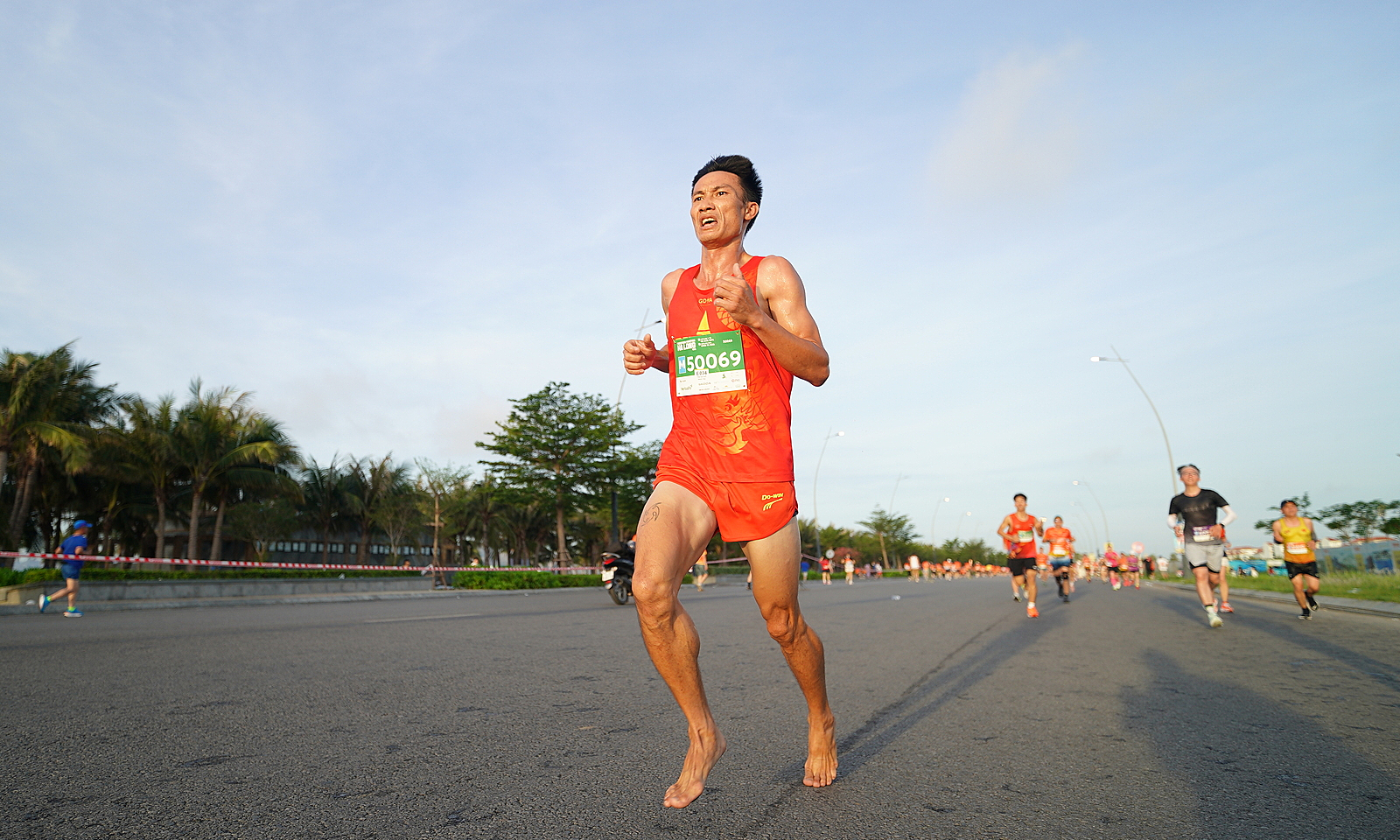 |
Runner Le Trong Phu runs barefoot for 5km at VnExpress Marathon Ha Long 2025. Photo: VnExpress Marathon
Le Trong Phu, a well-known runner frequently seen barefoot at many VnExpress Marathon events, shared his practical experience: "When I take off my shoes, I feel a sense of lightness and authenticity. I am forced to be more alert to control my foot strike and pace".
Caution required for barefoot running
From a biomechanical perspective, running without shoes often leads to changes in foot strike technique. Most barefoot runners tend to land on their forefoot or midfoot instead of the heel. This natural adjustment helps reduce direct impact forces on the knee joint, a common cause of pain for amateur runners.
This, however, is a trade-off. Review studies confirm that reducing pressure on the knee joint increases the load on the Achilles tendon and calf muscles.
Phu exemplifies this "self-adjustment" mechanism. He turned to barefoot running as a rehabilitation therapy after an anterior cruciate ligament tear, using beach sand as a training surface to reduce knee strain. However, the Hue runner is aware of safety limits: "With a previously damaged knee, I only run barefoot for short distances, about 5 km, for recovery. For long runs or main workouts, shoes remain indispensable".
Given that benefits come with risks, sports medicine views barefoot running more as a supplementary exercise than a primary training method. While it can improve balance and foot strength, it is not recommended for sustained high-intensity use.
Barefoot running not recommended for long distances
For long distances, as muscles fatigue in the later half of a race, the ability to maintain the arch of the foot diminishes. At this point, pressure shifts directly to the metatarsal heads—an area not "designed" to withstand continuous heavy loads for hours.
A classic study by Nagel et al. (2008), published in the journal Gait & Posture, warns that after long-distance running, pressure under the metatarsal heads spikes, increasing the risk of stress fractures if protective cushioning is absent. This is why sports medicine discourages amateur runners from long-distance barefoot running.
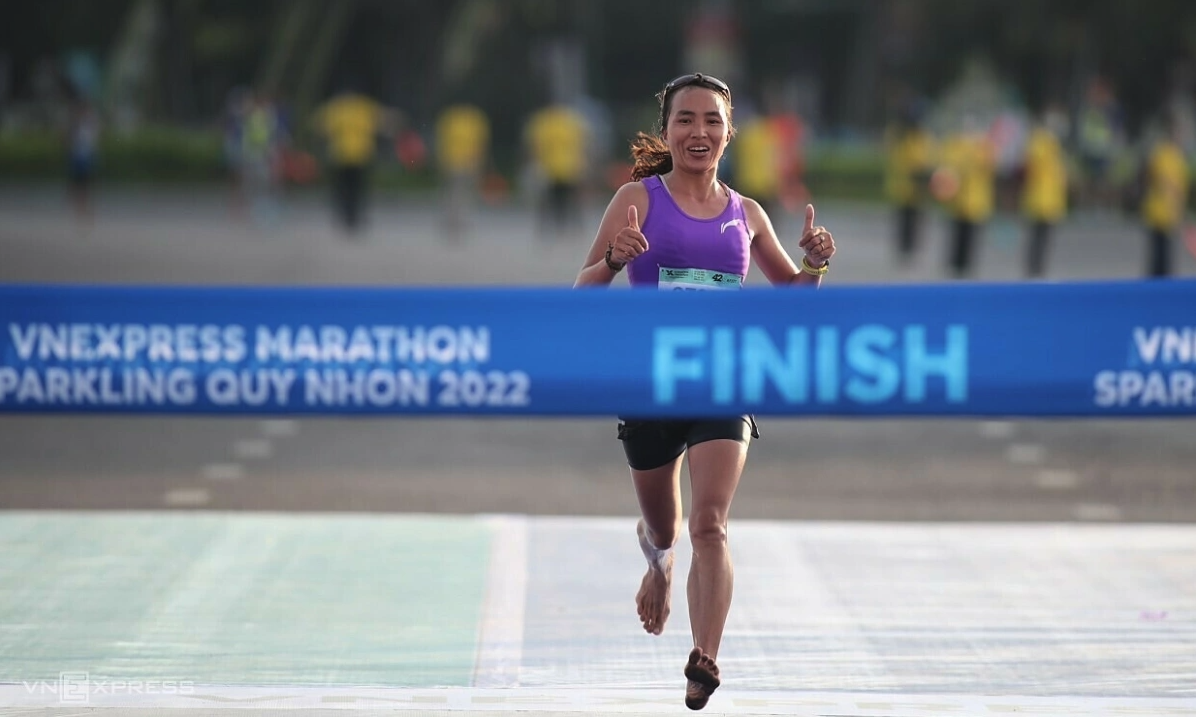 |
Pham Thi Binh ran barefoot to win the 42km VnExpress Marathon Quy Nhon 2022. Photo: VnExpress Marathon
The case of "barefoot queen" Pham Thi Binh is considered a rare exception, attributed to her natural constitution and rigorous adaptation process from childhood. However, she also offers cautious advice: "The body needs to learn how to distribute force and get used to the road surface. This adaptation does not happen overnight. If applied hastily, runners will face plantar fasciitis, Achilles tendon damage, or metatarsal overload".
A common consensus among scientific studies and elite runners is not to "mythologize" barefoot running. Systematic reviews by Hollander (2017) in Sports Medicine and Kaplan (2014) confirm that there is no evidence barefoot running reduces injury rates or improves long-term performance compared to shod running.
Instead, barefoot running should be viewed as a supplementary exercise. Runners can practice barefoot for short distances on grass or sand to strengthen small foot muscles and improve balance. However, when stepping onto a demanding marathon course, shoes remain essential protective gear to sustain a long running journey.
Nguyen Ky