 |
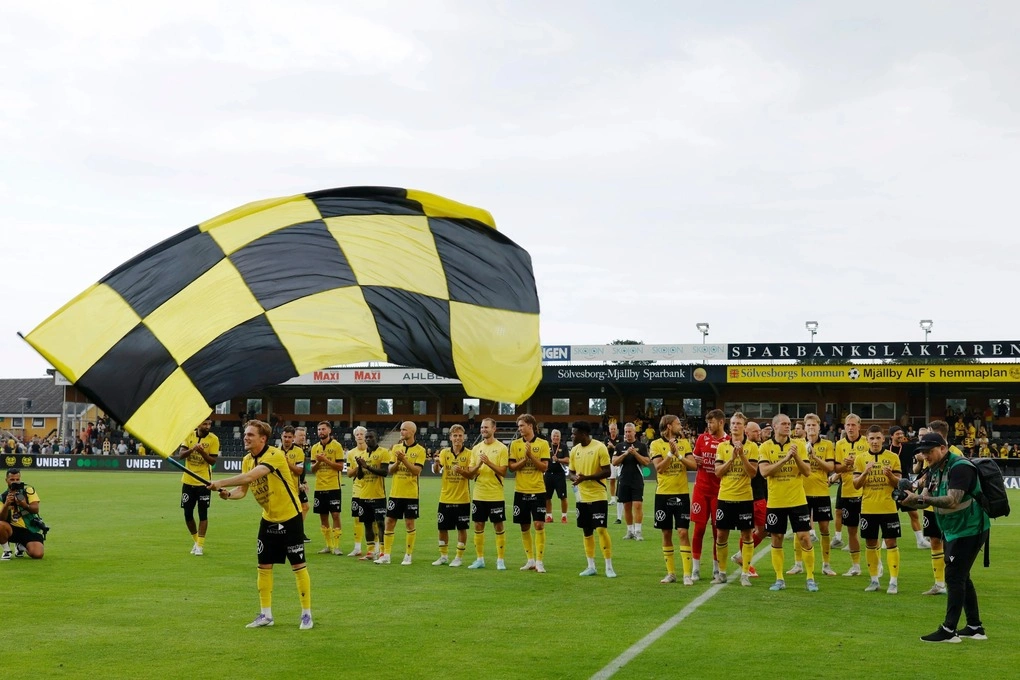
Mjallby players celebrate their victory at Strandvallen in 7/2025. Photo: AP
In late 2025, one of Europe's most aesthetically pleasing football teams won their national league title for the first time in history. This was Mjallby AIF, a club from a small fishing village in southern Sweden. A shared characteristic between Mjallby at that time and the Argentina captain is a passion for the pattern of diagonal passes.
"It is the most essential attacking concept that should be taught and applied at all levels," affirmed Karl Marius Aksum, who was an assistant coach last year and now leads Mjallby. Aksum, only 36 years old, had no prior professional coaching experience but holds a doctorate in "visual perception in football."
In 2024, when he joined Mjallby's coaching staff, he introduced radical ideas to reform their playing style. From a typical Nordic football team known for long and direct play, Mjallby gradually transitioned to building from the back and exploding in attack. If "relationism" football is used as a benchmark, Mjallby's style bears similarities to Lionel Scaloni's Argentina.
Unlike Pep Guardiola's positional play, where players are fixed in specific areas and roles on the field, relationism football does not restrict space during the attacking phase. Visually, it is evident that many players converge closer to the ball. In essence, this philosophy is defined by cooperative patterns such as "escadinha" (a metaphor for diagonal passing combinations that advance vertically, like steps), "toco y me voy" (I pass and I move – players perform one-touch passes and attack vertically), or "tabela" (meaning "the table," referring to players gathering around the ball).
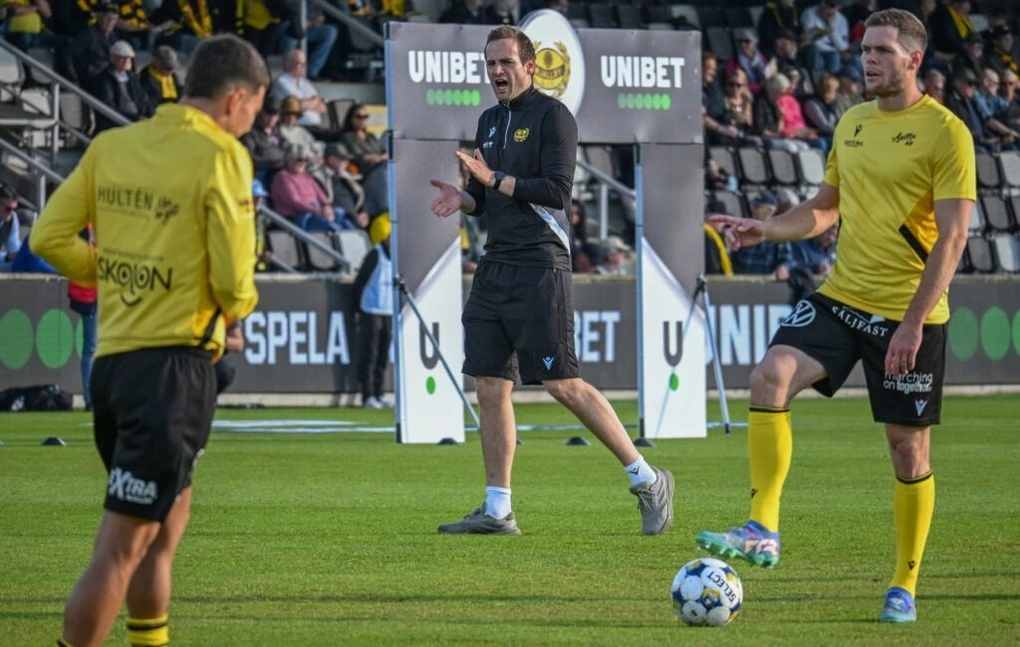 |
Karl Marius Aksum (in black) instructs Mjallby players during warm-ups before a match in 2025. Photo: fotballtreneren.no
In "Inverting the Pyramid: The History of Football Tactics" by football tactical historian Jonathan Wilson, the "escadinha" model was depicted through the term "diagonal," pioneered by Flavio Costa, a tactical master of Brazilian football in the 1940s and 1950s. He was among the first coaches to create the 4-2-4 system in world football, a modification of the earlier 3-2-2-3 (or W-M) formation, by arranging central midfielders offset from each other, forming "steps" for diagonal ball progression.
Returning to Mjallby, the tiny Swedish team prefers to concentrate a large number of players around the ball, moving freely to connect and execute one-two passes, rather than adhering to fixed positions. In this formation, they play similarly to how "La Albiceleste" (Argentina's national team) performs one-two passes in the central axis, with central midfielders and Scaloni's number 10s playing close to each other for easy "pass and move" actions. "It's not like coaching a PlayStation game; we provide principles but never give exact solutions. Players make their own decisions and find solutions," Aksum told the BBC in late 2025.
It is within such a "human-centric" system that diagonal passing patterns are maximally exploited, perfectly suited for the continuous creation of circulating triangles through individual positional interchanges. This has also been a weapon Messi has favored throughout his peak years, not simply because he often operates on the right wing to play on his dominant left foot.
"Aksum has a doctorate in visual perception, so he is obsessed with players' vision and awareness on the field," shared Jamie Hamilton, a UEFA A licensed coach and tactical analyst who coined the term "relationism football." Hamilton explained that a player's vision is optimized when they stand in a rotated, open body position at a "three-quarter angle," meaning still facing the opponent's goal but not directly confronting it.
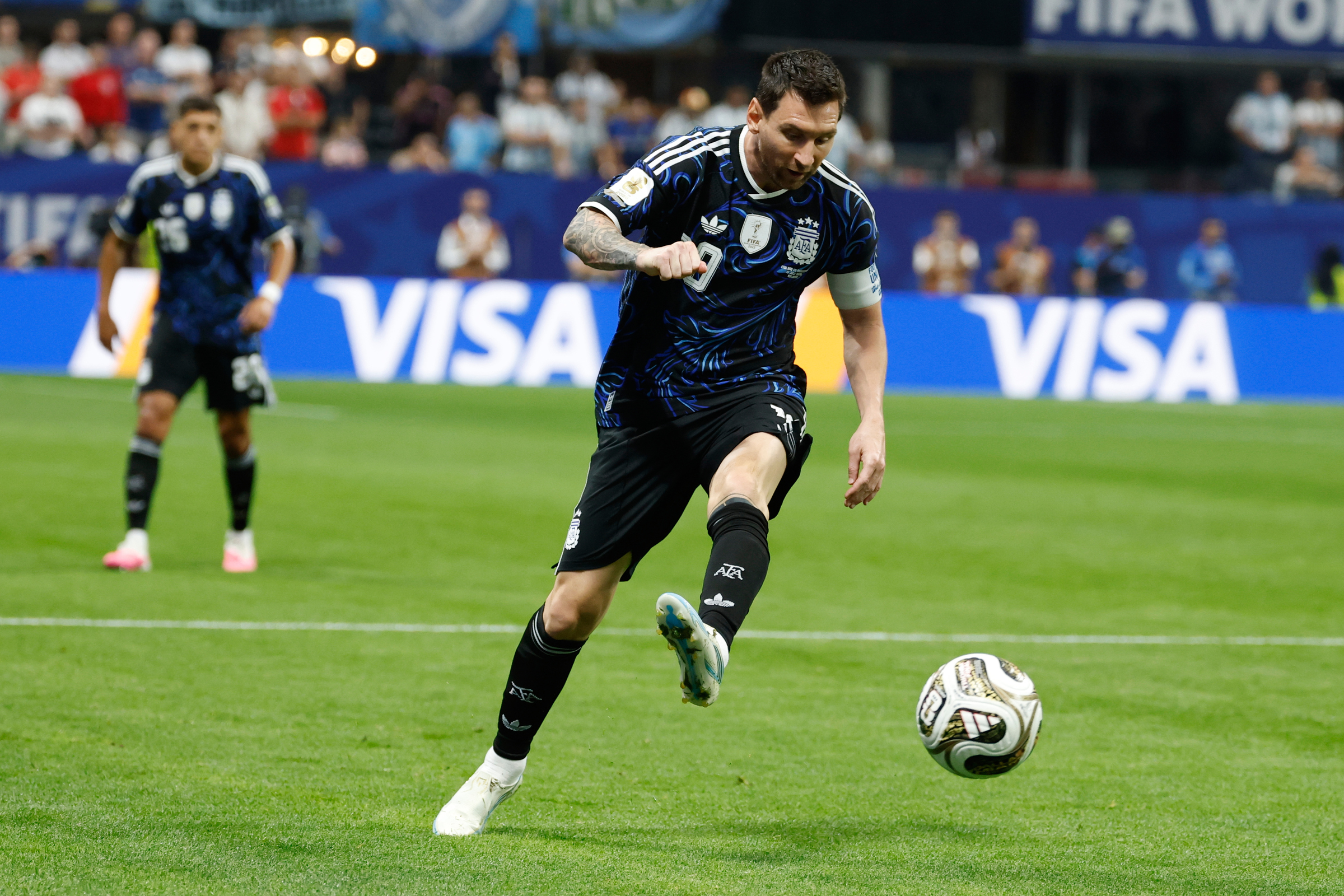 |
Forward Lionel Messi (10) moves wide to pass the ball during Argentina's 2-1 victory over England in the World Cup 2026 semifinals at Atlanta on 15/7. Photo: AP
"As for Messi, he frequently plays by executing a pass and then immediately moving diagonally inwards," Hamilton explained. "Messi also often uses this diagonal trajectory to dribble or cross. I think he does it both intuitively and with clear intent. Messi has often revealed that one of the secrets to his playing style is using deceptive flank breaks to mislead opponents' movements through passes."
Why are diagonal passes particularly effective? Simply put, this trajectory is harder to defend than direct vertical or horizontal passes. There are at least three reasons.
First, diagonal passes allow a player to play against the movement and momentum of the opposing defense. This gives the player an opportunity to attack behind the defensive line.
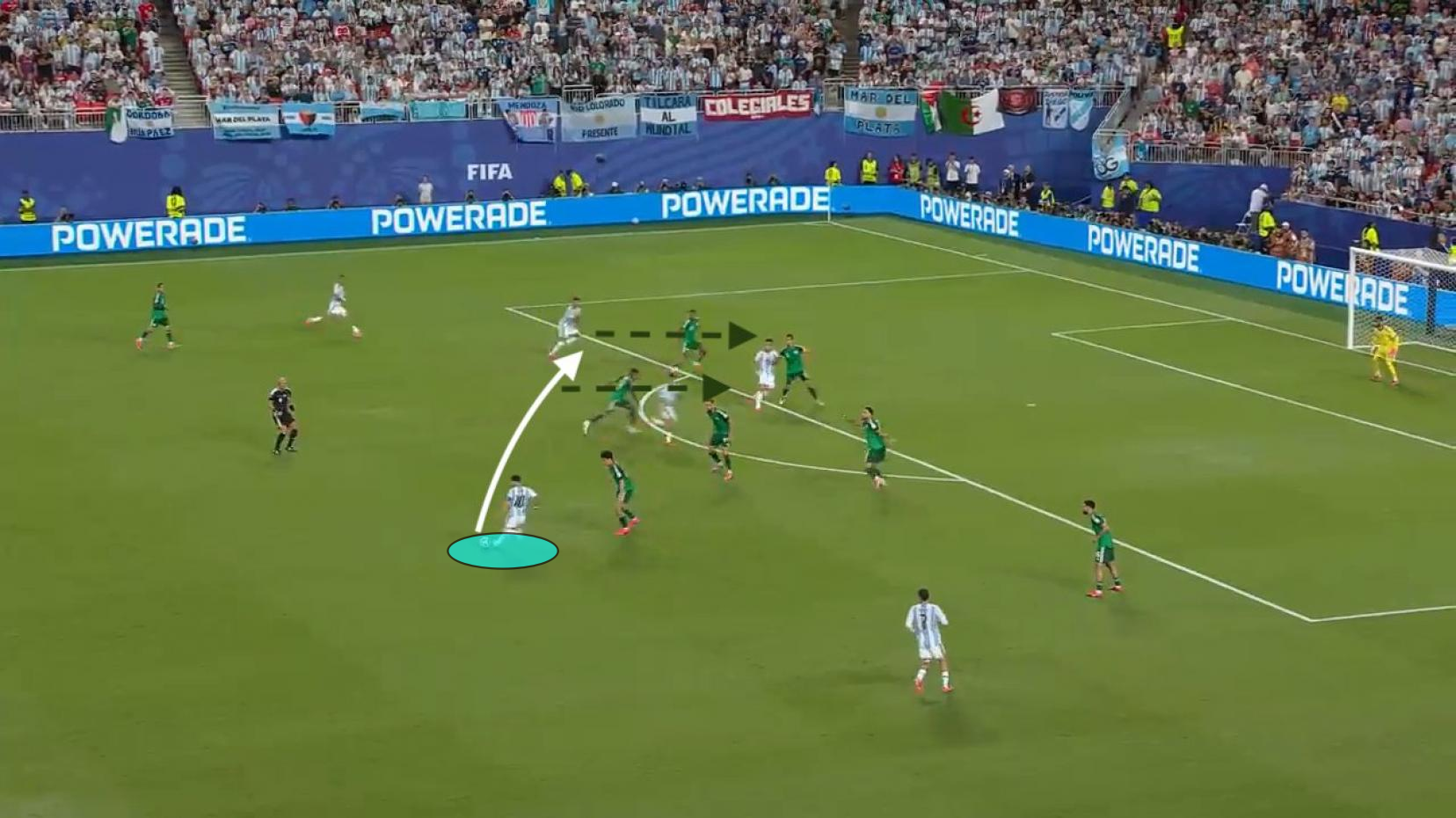 |
In a situation from the Argentina – Algeria match, the blue-shirted defenders are moving in the opposite direction to Messi's impending pass. Meanwhile, two of Messi's teammates are running in the correct direction and are both capable of receiving the upcoming pass. Screenshot
Second, the ball's trajectory in diagonal passes also has more opportunities to intersect a teammate's run. Multiple players can even receive the ball along the same passing trajectory.
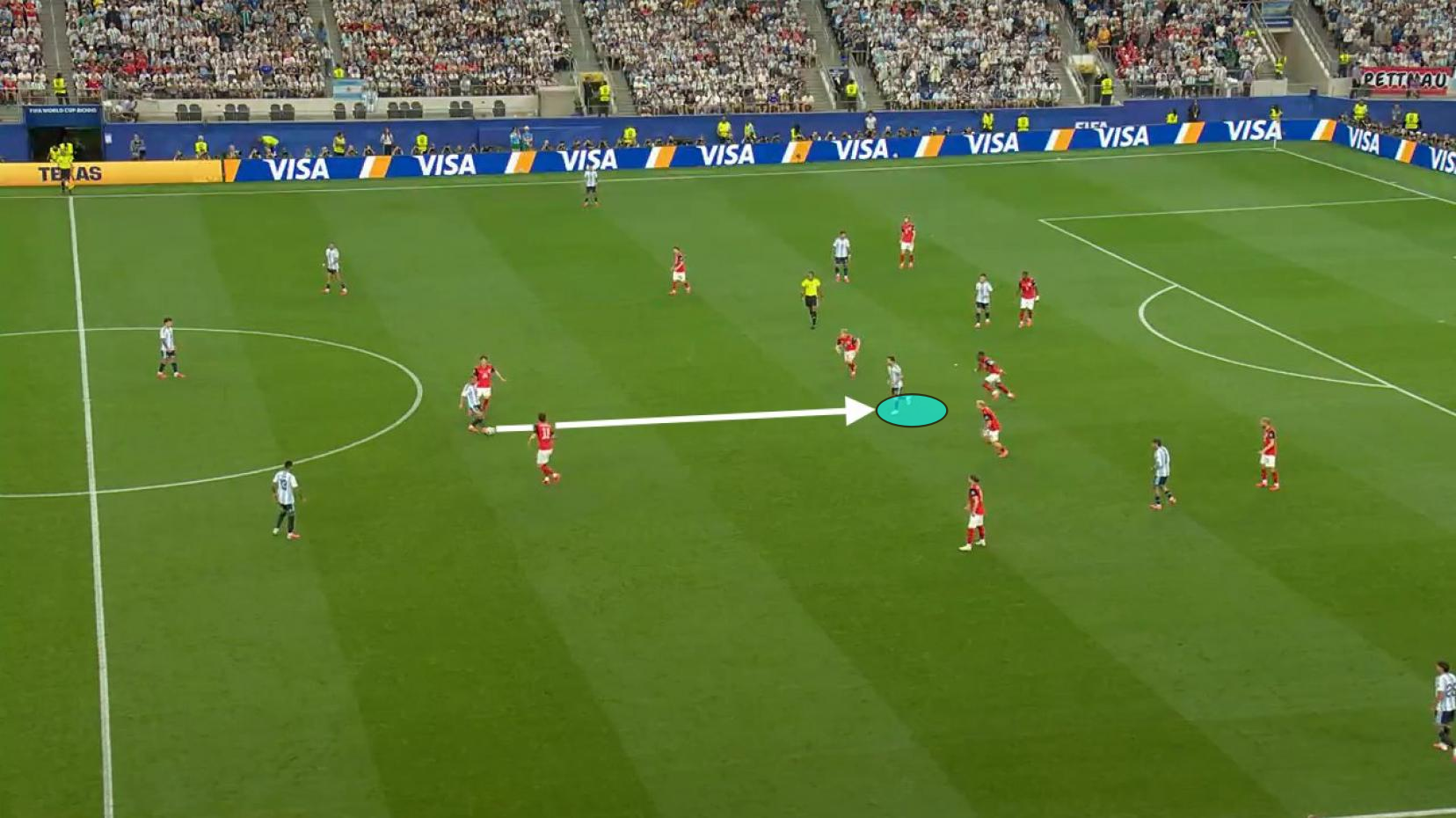 |
In a situation from the Argentina – Austria match, Messi prepares to receive a direct vertical pass from Alexis MacAllister. The red-shirted players charge directly, pressing Argentina's number 10... Screenshot
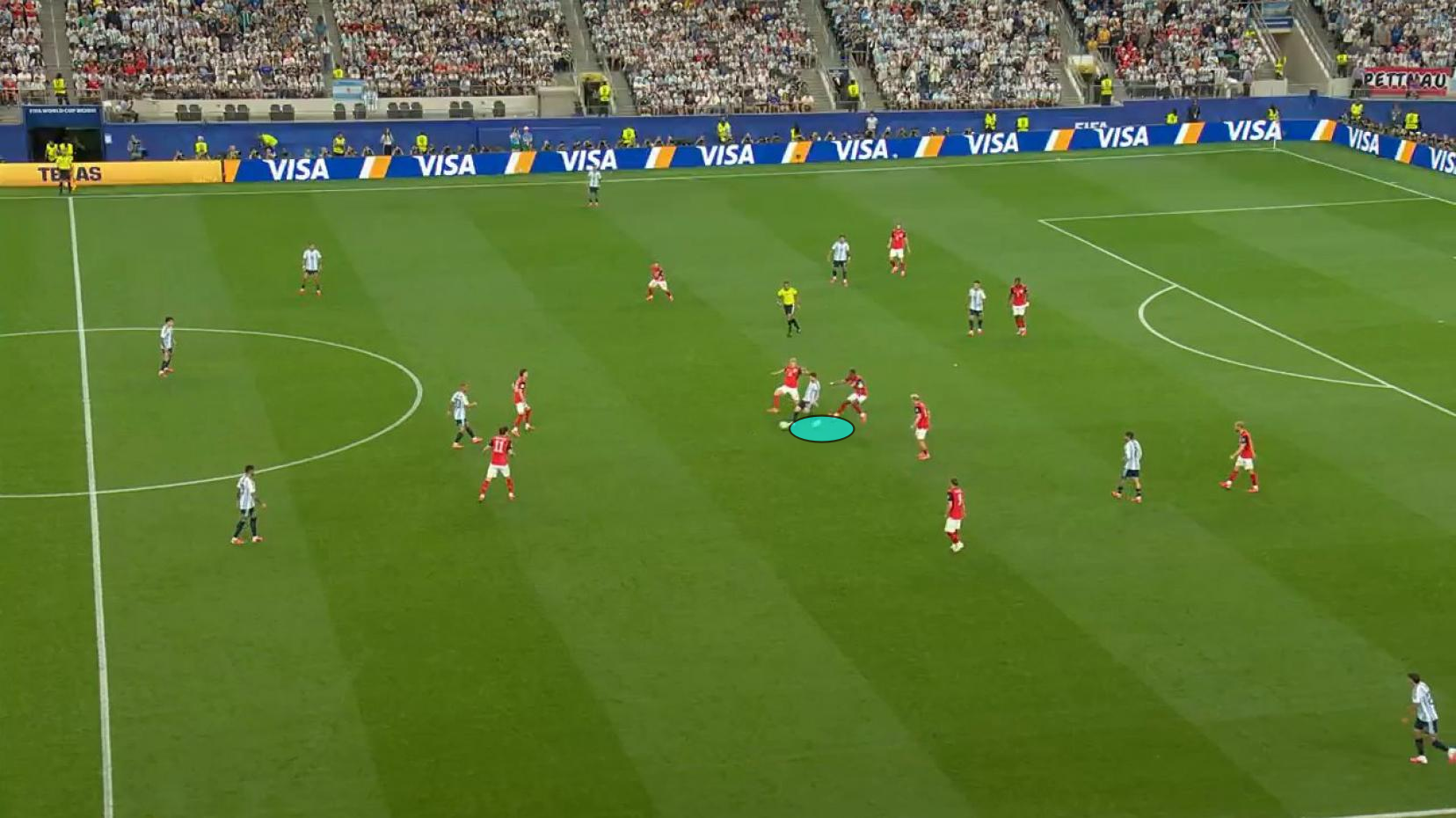 |
Immediately upon receiving the ball, Messi is easily surrounded, forced to pass backward. Screenshot
And third, when standing at a three-quarter angle facing forward, the attacking player actively controls the situation, while the opponent is in a passive position. For defenders in this situation, containing a vertical pass is much easier, as they only need to press the receiver directly. The receiving player then has fewer passing angles compared to receiving a diagonal pass across the field.
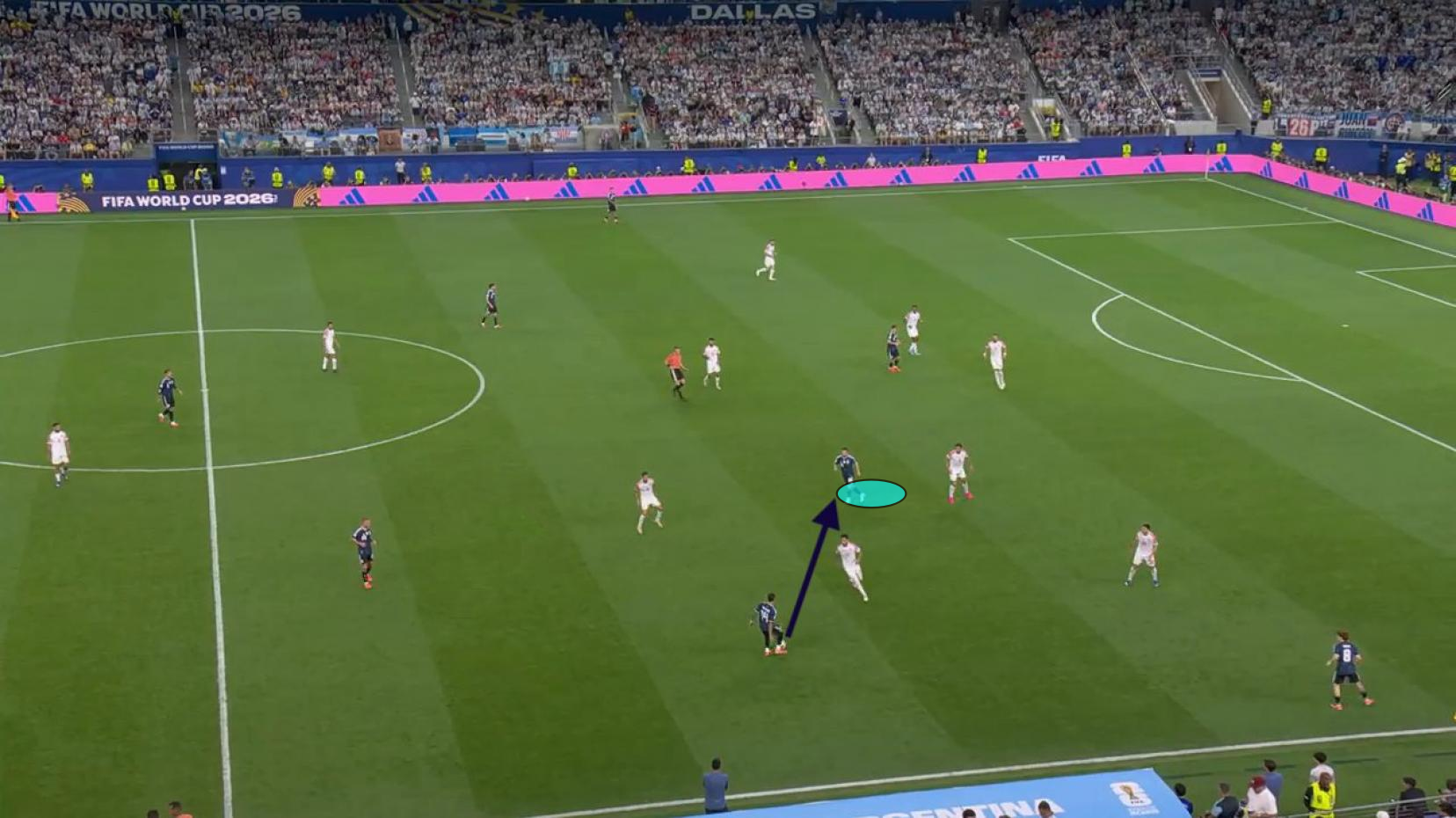 |
In a situation from the Argentina - Jordan match, the winner of 8 Ballons d'Or prepares to receive a diagonal pass and is not entirely facing away from the opponent's goal... Screenshot
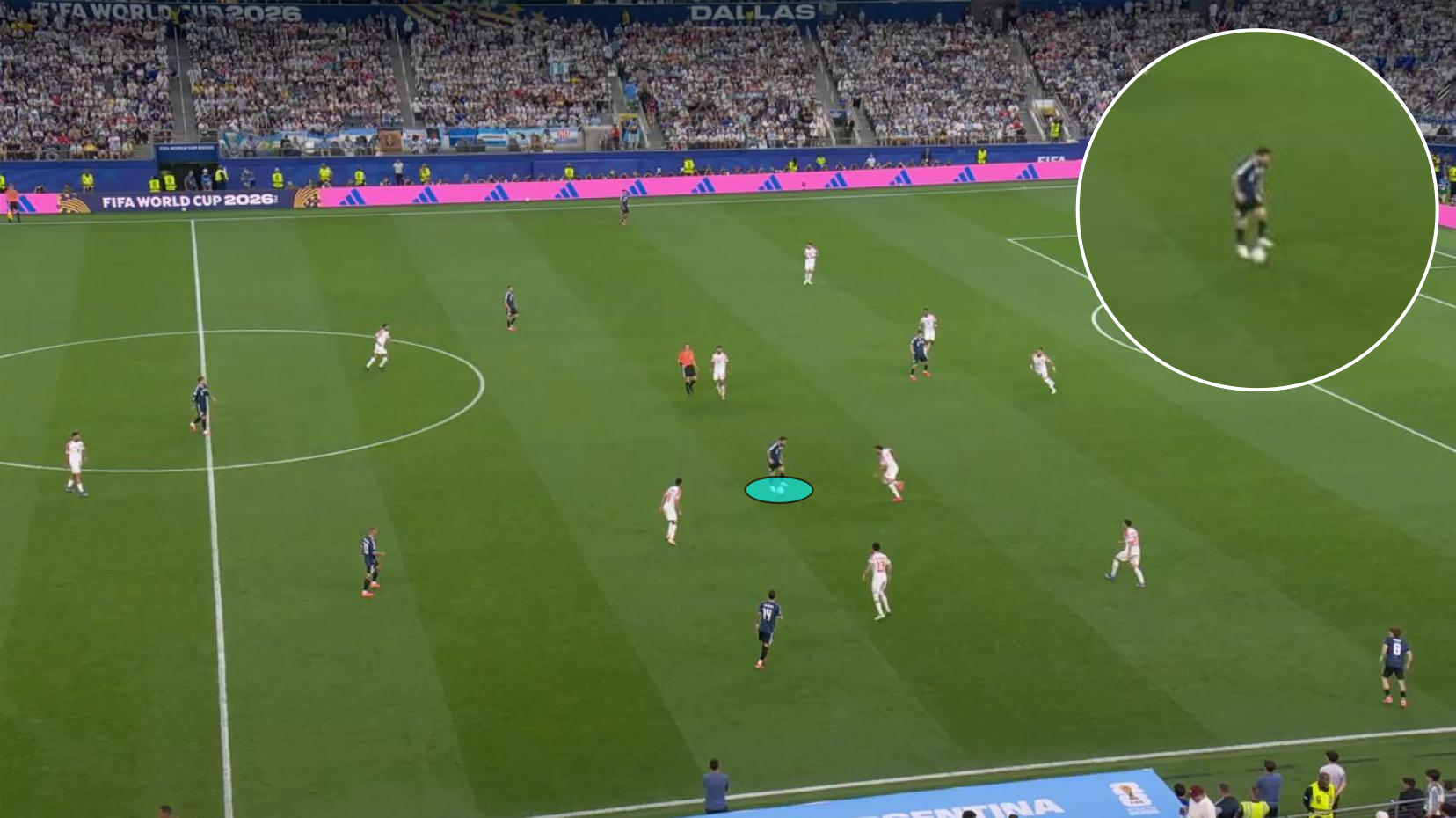 |
Due to loose marking, Messi doesn't even need to use his first touch to shield the ball but can immediately turn towards the attacking direction from the initial touch. More importantly, he has the opportunity to continue playing the ball diagonally to the opposite wing... Screenshot
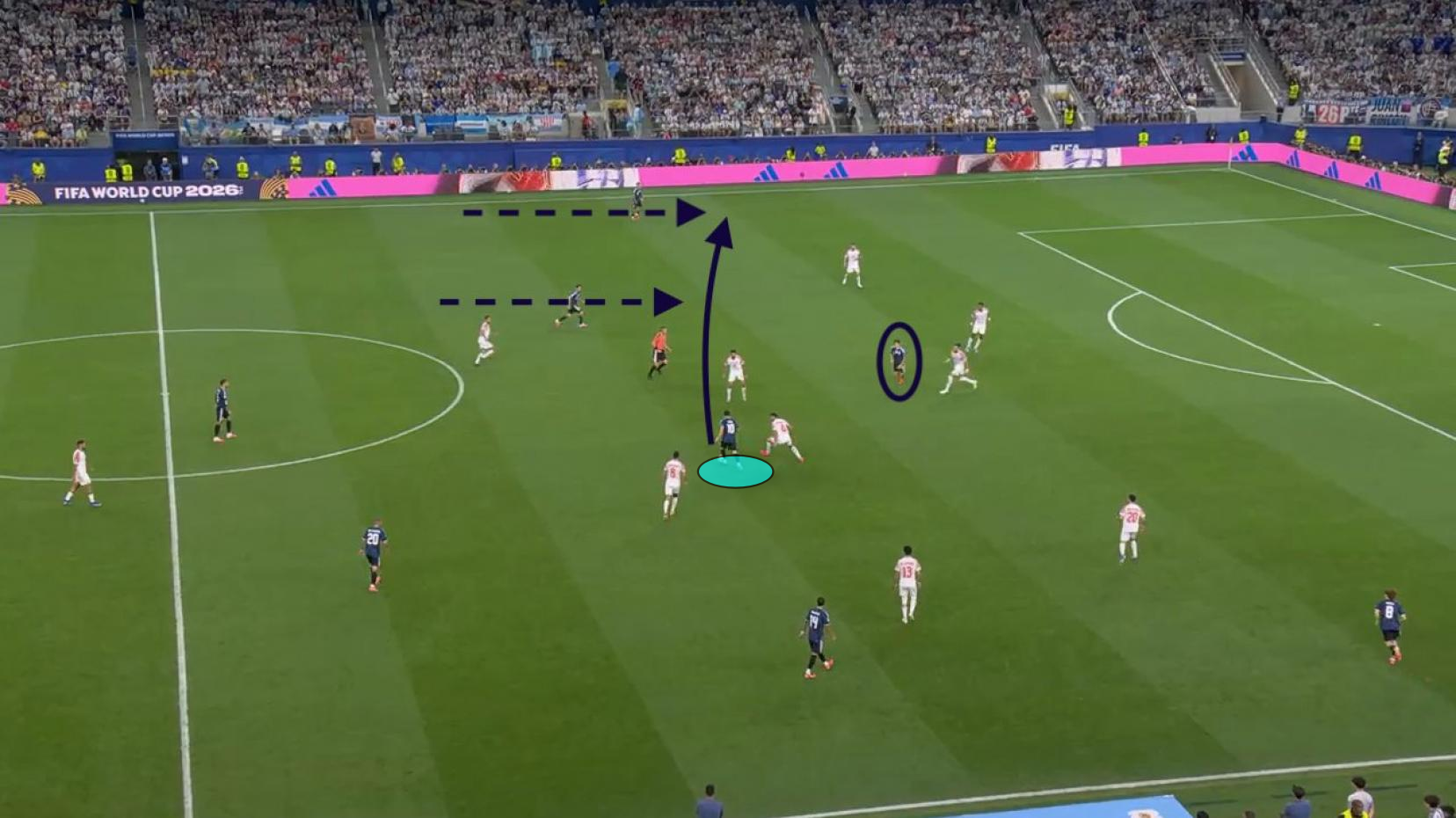 |
Argentina, through Messi, can continue to develop play diagonally. Two of his teammates are capable of being on the number 10's passing trajectory. Messi can even execute a short diagonal pass to Julian Alvarez (circled) for a quick one-two. Screenshot
Statistics from Opta show that since the start of the 2026 World Cup, most of Messi's attacking passes have gone from right to left, along a diagonal line. A similar trend is observed for the chances created by "La Pulga" in this tournament.
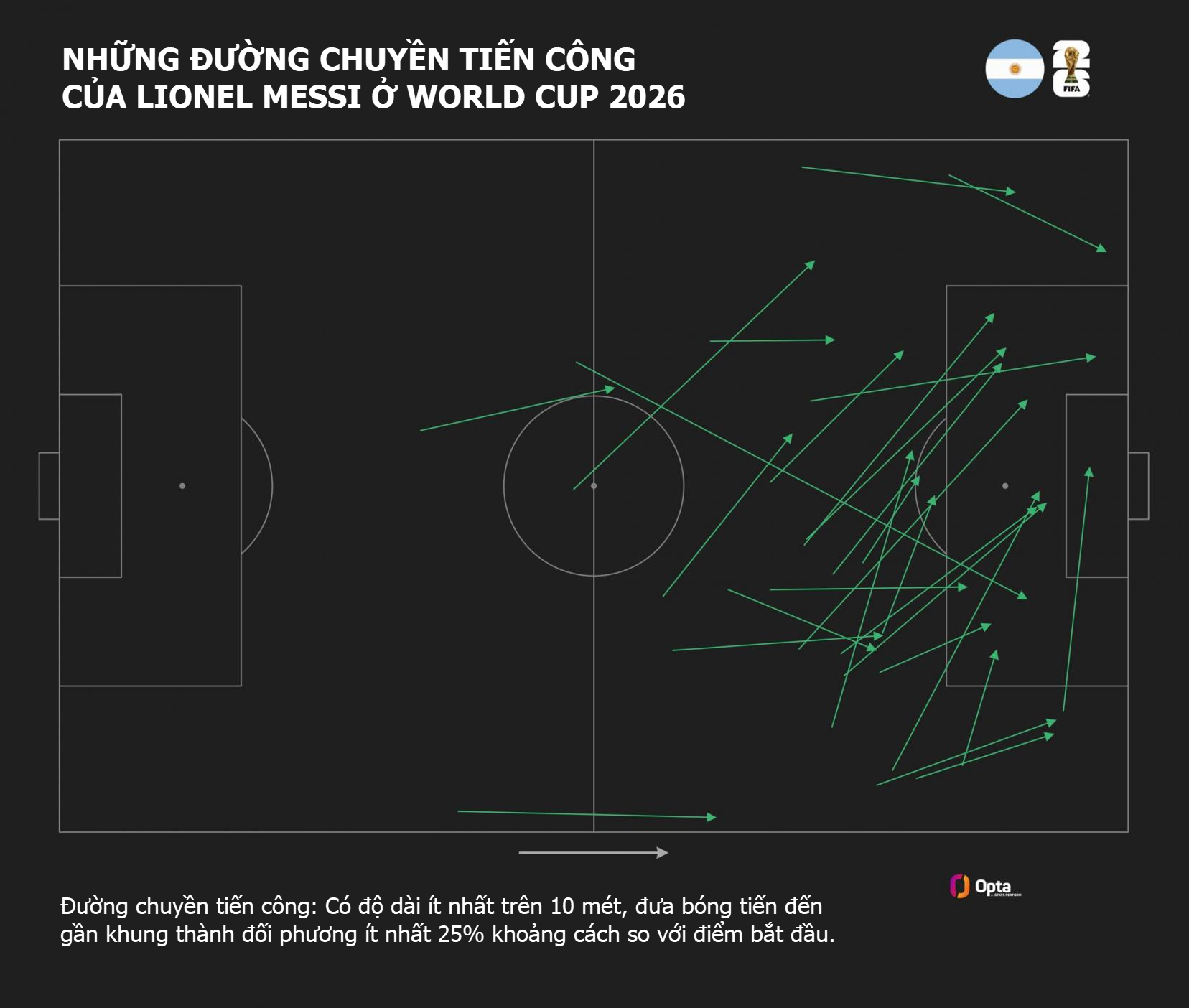 |
Map of Lionel Messi's attacking passes at the 2026 World Cup. Photo: Opta
Aside from the comeback victory against Egypt in the round of 16, the 39-year-old superstar often drifts wide to the right wing late in matches when Argentina needs a goal, notably in the semifinal against England. Is this Messi's way of utilizing his favored diagonal passes? Or is it simply to escape the crowded central area, finding the comfort zone of his early peak years?
Martin Rafelt, a professional coach and co-founder of the renowned football tactics website Spielverlagerung, believes the answer is both. "Dribbling and shielding the ball when cutting inside from the wing is easier than staying in the central area," Rafelt said. "From that position, Messi can bypass opponents by driving straight into the center or at least free up his passing angles."
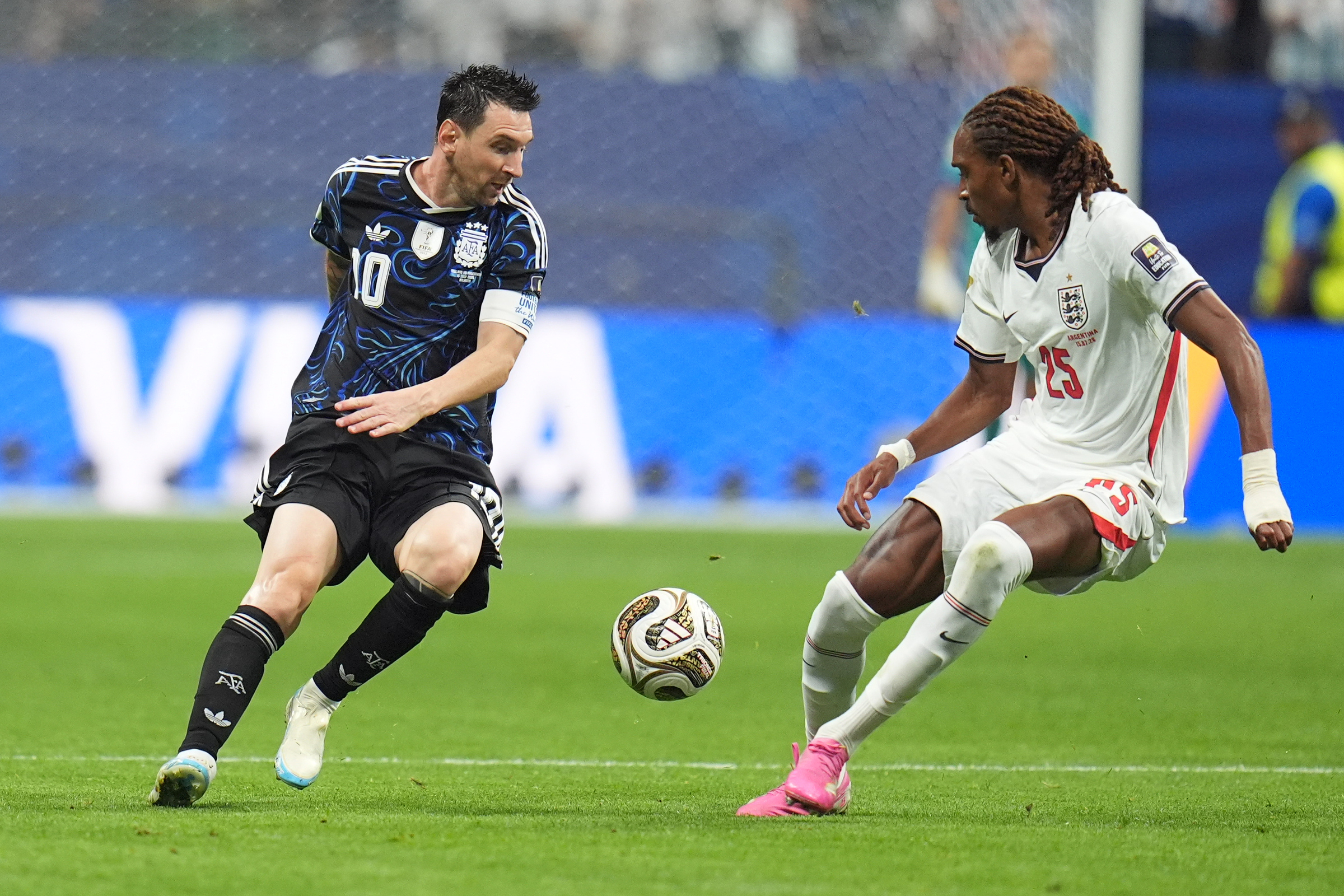 |
Lionel Messi (left) dribbles past Djed Spence during Argentina's 2-1 victory over England in the World Cup 2026 semifinals at Atlanta, USA, on 15/7. Photo: AP
According to this expert, the space on the right wing remains perfectly suited to Messi's current qualities. While he no longer has the energy for rapid, intricate dribbling to continuously beat opponents, he remains an unstoppable force "with cut-ins from right to left, then assisting a forward or switching the play to the opposite wing, towards the most open channel."
Rafelt also highlighted the advantage of the Argentina captain's diagonal passing trajectories. This expert explained: "Defenders all look towards Messi, while the passing options he sees are behind them, out of their line of sight. Most of the time, they cannot simultaneously watch Messi and keep an eye on his available options."
If Messi's touch map at this 2026 World Cup is divided into two parts – the first up to the 75th minute, and the second from after the 75th minute – a clear difference emerges. Before the 75th minute of matches, Messi shows a particular preference for "Zone 14" (the critical attacking area directly in front of the penalty box).
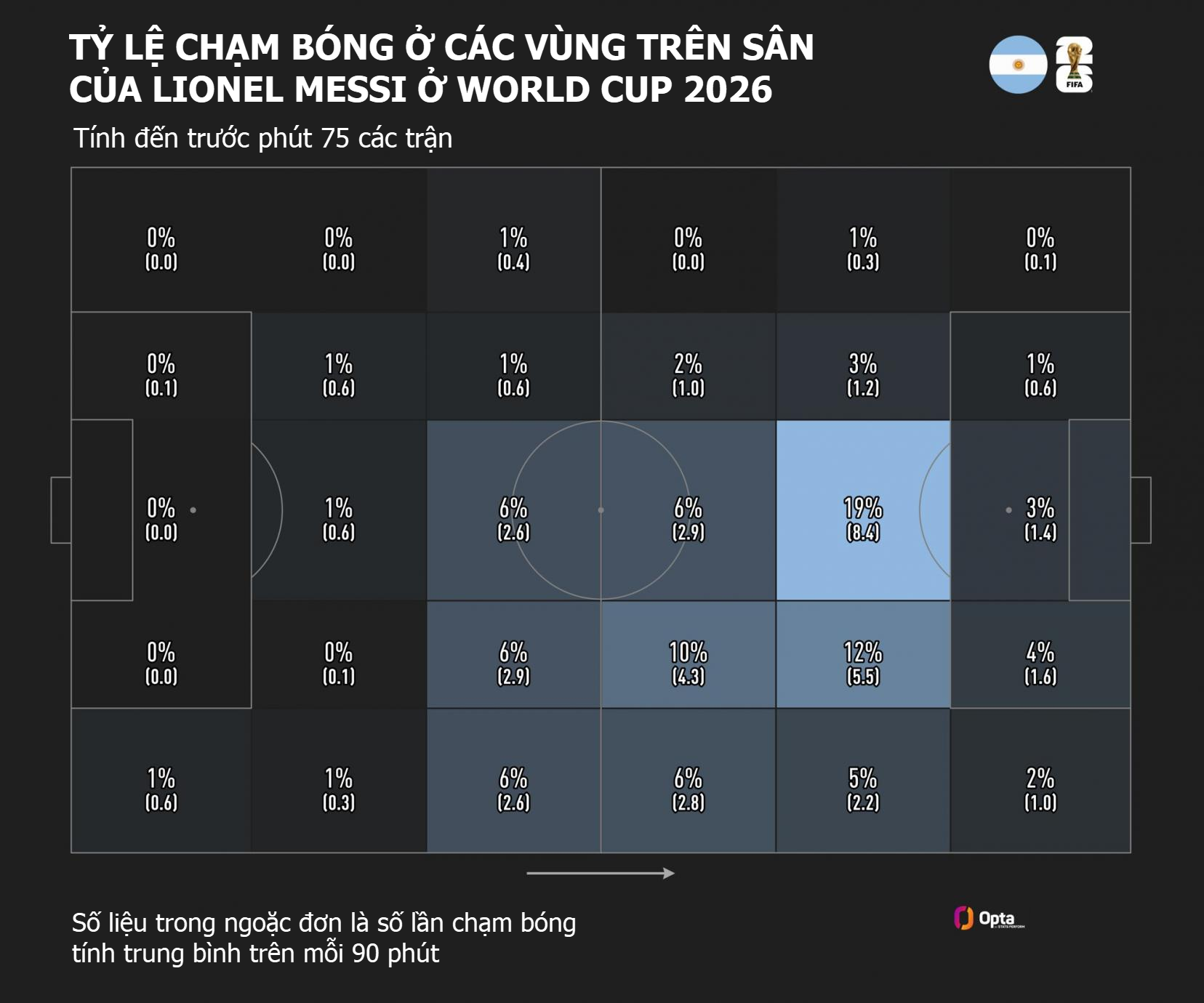 |
Messi's touch percentage in various areas of the field at the 2026 World Cup, up to the 75th minute of matches. Photo: Opta
However, in Messi's touch map from after the 75th minute, "Zone 14" continues to be where he appears and touches the ball most frequently. But the 1987-born superstar's touch percentage in the right half-space and right wing significantly increases.
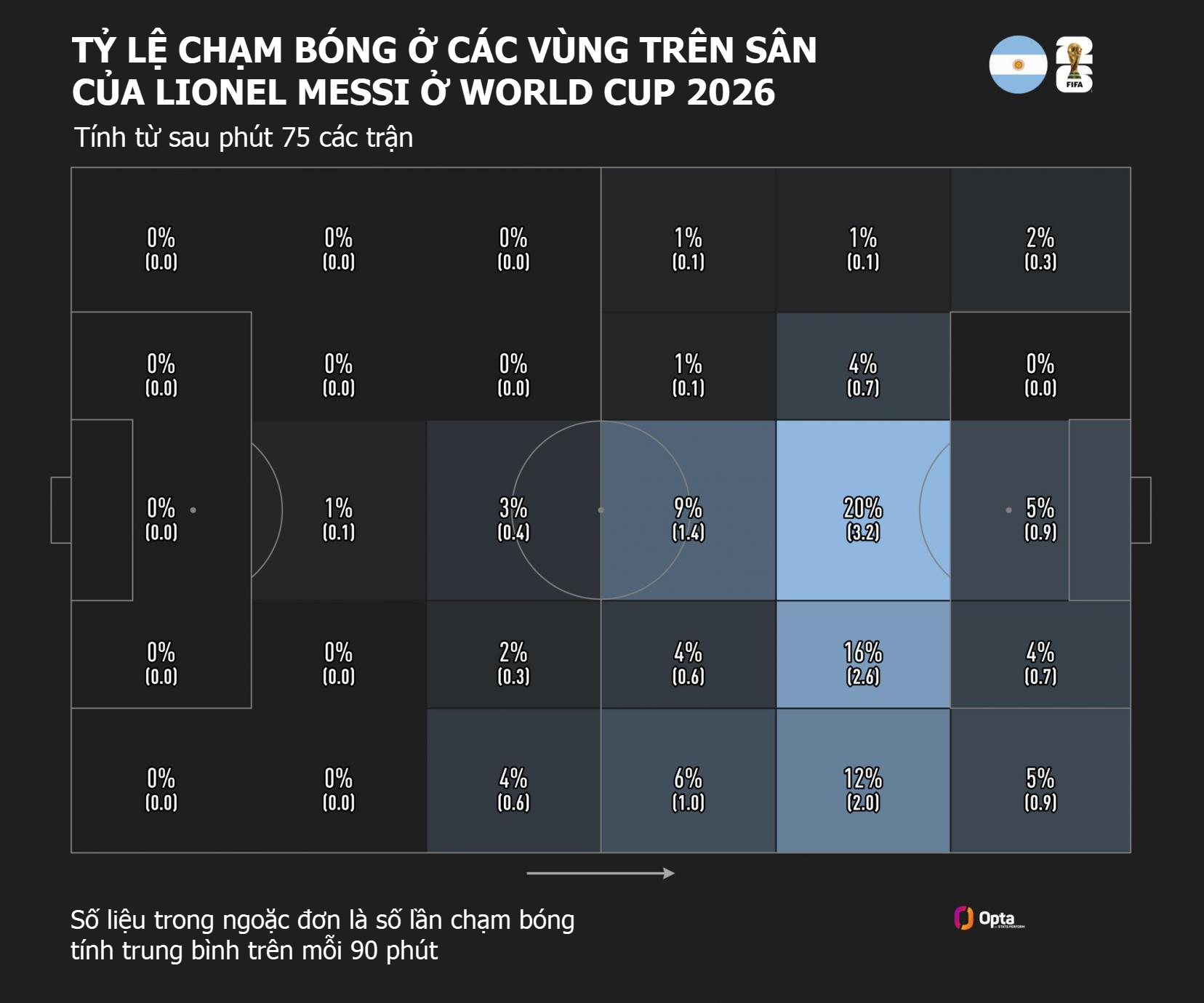 |
Messi's touch percentage in various areas of the field at the 2026 World Cup, from after the 75th minute of matches. Photo: Opta
According to Rafelt, Messi has "cracked the code that allows him to continuously create chances," and that code "relies largely on diagonal passes." He also stated that the football world has a clear distinction before and after the Messi era in this aspect. He did not forget to reiterate that the Argentina forward "has the ability to execute more complex passes than most other players."
Expert Hamilton shares a similar overall sentiment: "Diagonal passes bring a greater variety to attacking situations, making the task for the defense more complex and, conversely, better enabling the passer's attacking teammates. Ultimately, we can discuss this topic for hours, but the most important thing is still Messi. And Messi is truly incredible."
Compiled by Hoang Thong