


With domestic airfares trending sharply upwards during peak seasons, many families and tourists are re-evaluating their travel options. Instead of automatically choosing air travel, trains are gradually becoming an alternative thanks to their advantages in cost, experience, and itinerary flexibility.
Cost savings for short and medium routes
Data from the booking platform Vexere (for buses, trains, and flights) indicates that when calculating total "door-to-door" costs, ground transportation, including trains, often holds an advantage over airplanes.
For instance, on the Hanoi - Da Nang route, a sleeper train ticket currently ranges around 1,6 million VND, comparable to many airfare prices. However, train travel can occur overnight, saving passengers a night's hotel stay. If booked early, approximately 40 days in advance, and by utilizing promotional programs, costs can decrease by an additional 20%.
Furthermore, a low airfare does not always mean a low total cost. Incidental expenses such as checked baggage, transfers from the airport to the city center, or meal costs during wait times can increase overall spending. Some users report switching to train travel after experiencing this, finding it helps them control their budget better.
"My family once chose cheap flights to Da Nang, but the total cost was higher than expected due to checked baggage and airport transfers. After that, we switched to taking the train," shared Minh Anh (Hanoi) about her family's choice of transportation during the past April 30th holiday.
According to Vexere's recommendations, for routes under 800 km, a sleeper train is a balanced choice between cost, convenience, and experience. Conversely, for longer routes exceeding 1,000 km, air travel remains the optimal option if tickets are booked at least three weeks in advance.
Furthermore, purchasing train tickets is now more convenient. Users can book tickets online, receive e-tickets immediately after payment, and use the ticket code to board the train, eliminating the need to collect physical tickets at the station. This streamlines preparation time and reduces intermediate procedures.
Journey experience and the "slow travel" trend
Beyond just cost, train travel also meets a growing demand for experiential journeys, particularly within the "slow travel" trend. Instead of focusing solely on the destination, many tourists now consider the journey itself an integral part of their vacation.
Data from Vexere indicates that train bookings for summer 2026 are projected to increase by approximately 25% compared to the same period last year. Several scenic routes have seen high search growth, such as the Da Nang - Hue line via Hai Van Pass, with an increase of around 30%.
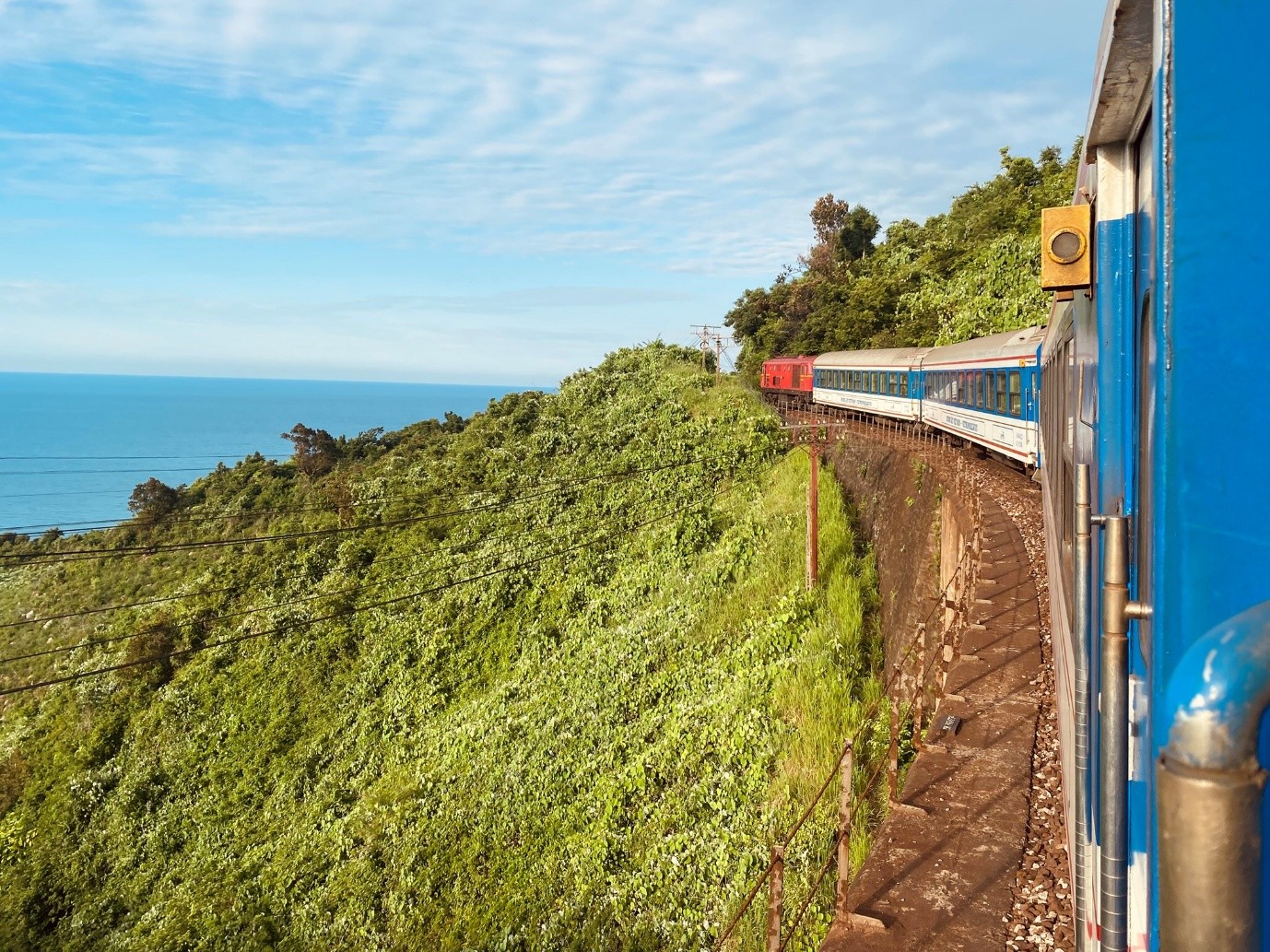 |
The Hue - Da Nang tourist train travels through Hai Van Pass. Photo: Vexere |
This route is popular among tourists due to its continuously changing scenery of the sea, mountains, and winding pass visible from every window. Unlike air travel, where the journey is largely separated from the external landscape, train travel provides a more direct, seamless, and relaxing visual experience.
A Vexere representative noted that users today are not only seeking the fastest way to travel but are also considering the value of the experience. For families, especially those with small children or elderly members, train travel provides spaciousness, flexible movement within the carriage, and a more stable feeling compared to other modes of transport.
To secure good seats during peak season, passengers are advised to book scenic train tickets at least two weeks in advance, especially for sleeper compartments.
Conversely, the air travel market is experiencing price pressure during peak season. Data on Vexere indicates that domestic airfares could increase by 35% to 55% during the summer, with prices on some major routes approaching Lunar New Year levels. Factors such as recovering tourism demand, operating costs, and limited flight supply are cited as the main reasons for sustained high fares. This compels consumers to calculate more carefully, rather than choosing out of habit.
Aggregated data from search behavior, railway industry website traffic, and Google Trends all indicate increasing interest in train travel. Users tend to compare total costs, travel time, experience, and convenience before deciding on a mode of transportation.
"In this context, train travel is a reasonable choice for many customer groups, especially families or those who prioritize experience and cost control," a Vexere representative added.
The Dan


