Japan has officially entered its cherry blossom season, with the Japan Meteorological Agency (JMA) announcing the start in Tokyo on 19/3 and Hiroshima on 23/3. These announcements follow inspections of designated "standard trees" at sites like Tokyo's Yasukuni Shrine. As crowds gather in major parks to admire the iconic Somei-yoshino blossoms, experts are working to maintain the accuracy of these crucial forecasts amidst the aging of the very trees used for prediction.
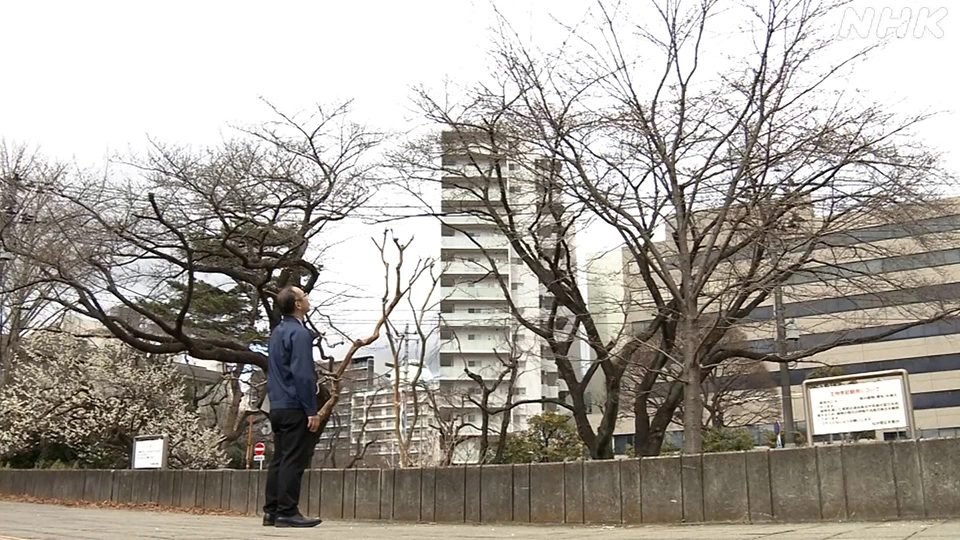 |
Cay hoa anh dao tieu chuan moi cua thanh pho Sendai. Anh: NHK
To provide precise forecasts for the start of the flowering season (kaika) and full bloom (mankai), Japan relies on a network of 58 "standard trees" across the country. Official declarations are made only when a local standard tree displays five open blossoms. Most of these trees, predominantly of the Somei-yoshino variety, were planted in the 1950s. They were integral to Japan's post-war reconstruction, used to green cities, mitigate air pollution, and symbolize new development.
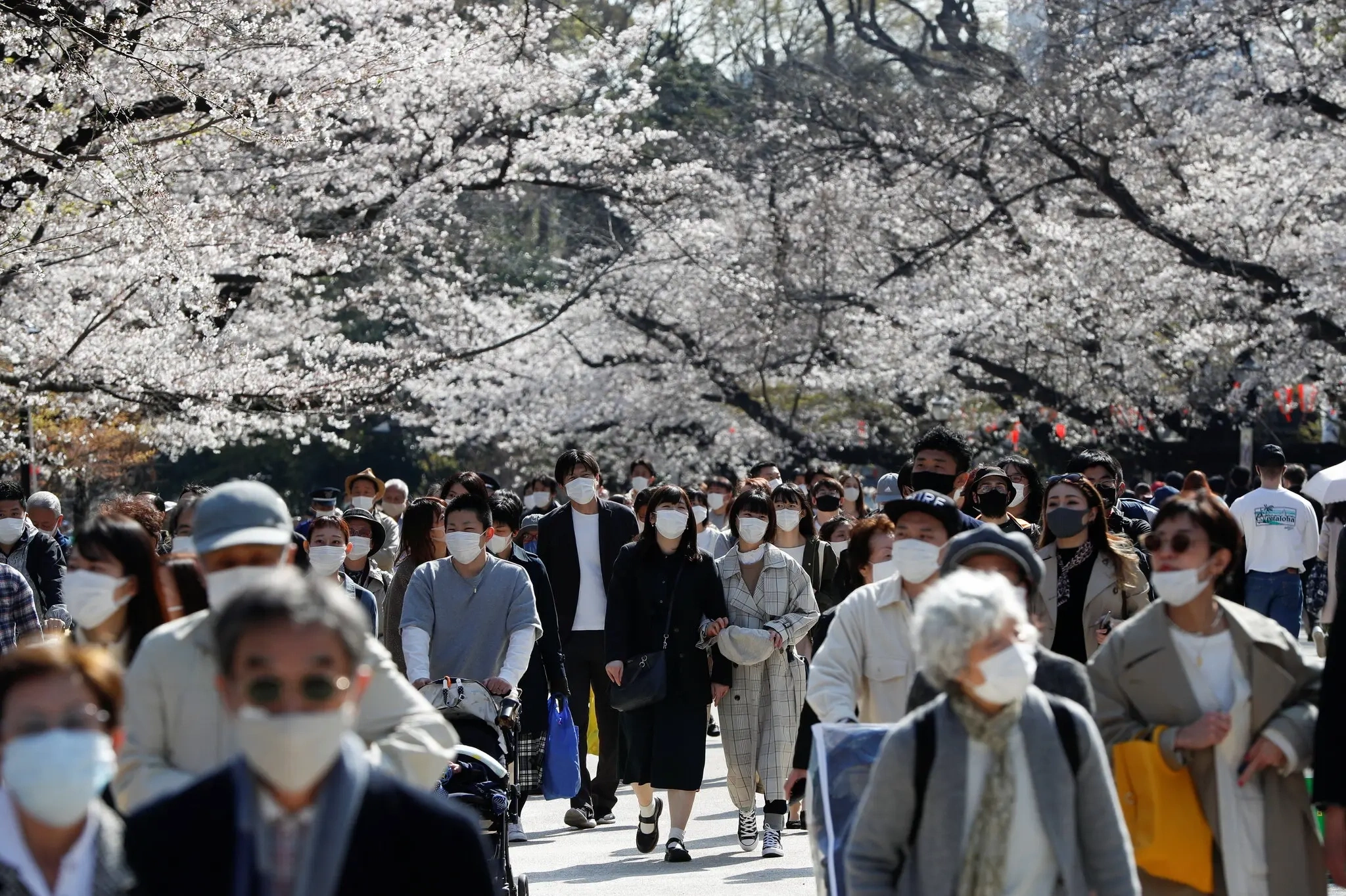 |
Hoa anh dao tai cong vien Ueno, Tokyo, nam 2025. Anh: Reuters
After more than 70 years, these standard trees are now aging. Kobayashi Akira, a member of the Japan Arboricultural Association, reports that many ancient trees exhibit fewer flowering branches, brittle limbs, and even decaying bases, sometimes leading to collapse. Statistics indicate that over 40% of the standard trees have been replaced by younger ones in the past decade to ensure continued accurate observation.
Sendai city, for example, will officially use a new standard tree this year. The previous tree, planted in 1952, had served for over 70 years. Two years ago, it developed "witches' broom disease," leading to abnormal branch growth, reduced flowering, and branch dieback, which compromised observation accuracy. To prepare for this, the Sendai meteorological agency planted two potential replacements a decade ago in spots with comparable light and soil. After years of monitoring and comparing their annual flowering data, the tree most similar to the old one was chosen as the new standard last December. Residents of Sendai are now anticipating the moment this new tree's buds fully open for its first official duty.
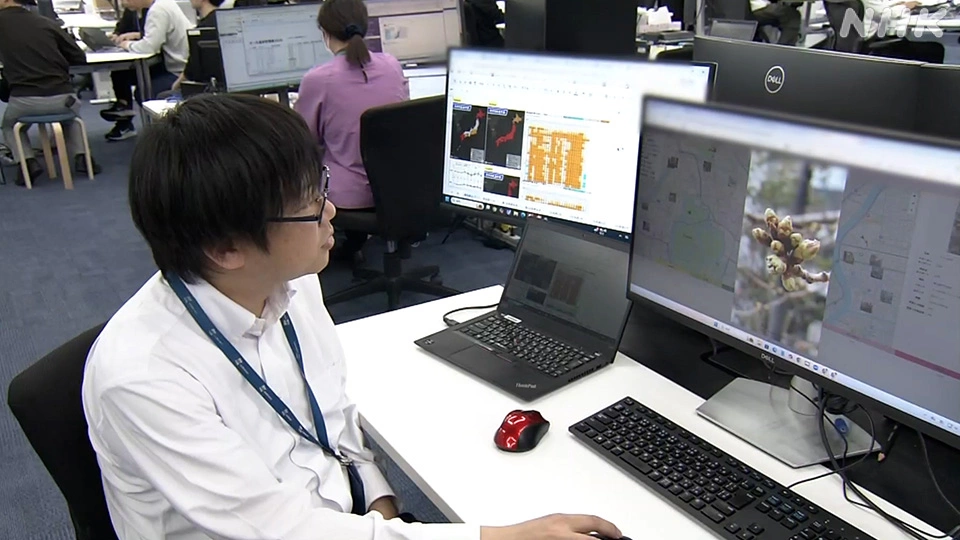 |
Nhan vien cong ty khi tuong nhan anh hoa anh dao no do nguoi dan va du khach gui ve. Anh: NHK
Beyond the JMA, private meteorological services also contribute significantly to cherry blossom forecasting. Weathernews, based in Chiba prefecture, utilizes data on average and maximum temperatures, along with hours of sunlight, to generate predictions. The company also engages the public, encouraging citizens to submit periodic photos of buds for analysis across seven development stages. This year, Weathernews enhanced its mobile app forecasting service, where artificial intelligence (AI) instantly analyzes over 10.000 bud samples from user-submitted photos. The service collected 55.000 photo submissions last season. Additionally, NHK World provides an online map, updated daily, showing blossom status at over 1.000 locations through six stages, from bud emergence to petal drop.
Mai Phuong (According to NHK, Japan Times)