As darkness creeps into every alley, vendors begin to pack up their stalls. The day's trading ends, but life in the Old Quarter does not stop. Instead, large, steaming pots of broth appear on the sidewalks. Hungry diners sit on stools, waiting for their turn to be served.
This scene depicts a typical image of Hanoi Old Quarter today, but it could easily be from a century ago, or even many centuries before that.
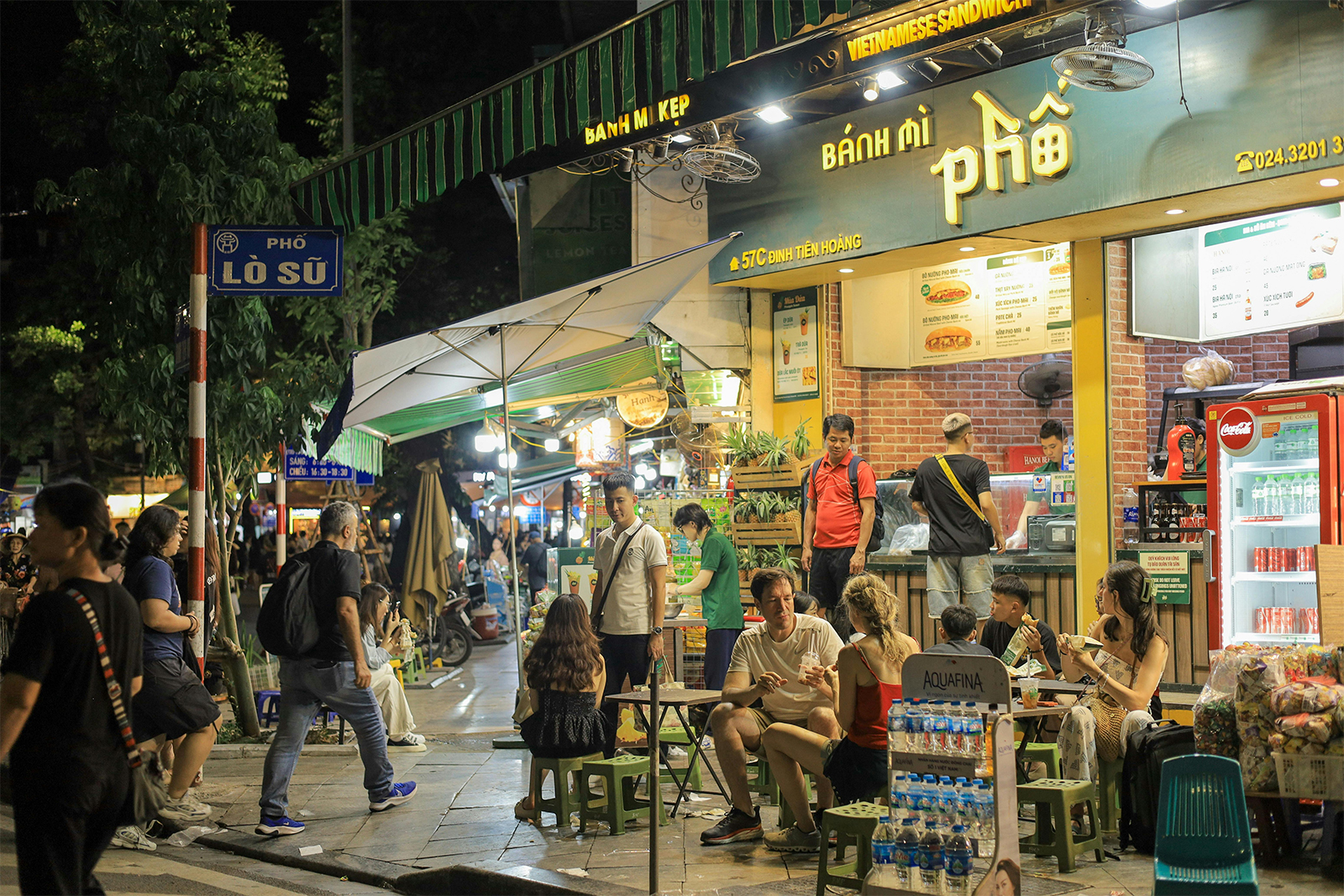 |
The Old Quarter's cuisine always has its own appeal. Photo: Hong Quang
History in street names
"Hanoi Old Quarter has existed since 1,000 AD and has always been a bustling commercial hub. People from other provinces, and even other countries, came here. Notably, there was a large wave of Chinese migration in the 17th century," said Trinh Khanh Linh, a culinary historian and doctoral candidate at the University of Michigan (US).
Traces of this trading legacy remain in the names of each street. Each street was named after a guild specializing in a particular commodity. Wealthy jewelers once settled on Hang Bac Street (Silver Street). Thuoc Bac Street (Herbal Medicine Street) was where traditional doctors practiced. Hang Thiec Street (Tin Street) became the domain of welders, and on Hang Chieu Street (Mat Street), traders exchanged mats.
Today, most streets in the Old Quarter no longer sell items corresponding to their names. Hang Ca Street (Fish Street), Hang Ga Street (Chicken Street), or Hang Bun Street (Vermicelli Street) are now better known for their food, restaurants, or other goods. "On Hang Khoai Street (Sweet Potato Street), which once traded vegetables, you will find vendors selling sweet potatoes and boiled cassava," shared Andrea Nguyen, an award-winning cookbook author. "History is hidden in the street names, but you need to know how to 'read' them."
International characteristics
As merchants gathered, so did cooks. "Street vendors congregated, and this competition led to the creation of many dishes we know today," Linh added. Noodles (or noodle dishes) were introduced from Trung Quoc, becoming a staple. Today, most Vietnamese street foods carry international characteristics.
By the late 19th century, another cultural layer formed. The French colonial period reshaped Hanoi's architecture, infrastructure, culture, and cuisine. However, like previous influences, Vietnam adapted rather than simply adopted. Pho, the most iconic dish, with influences from Trung Quoc, Vietnam, and France, is perhaps the most typical example.
"Vietnamese people refined the essence of French cuisine and localized it, adjusting preparation methods and flavors, rather than merely imitating," noted Charles Degrendele, executive chef of Le Beaulieu, a Michelin Guide 2025 restaurant at the Sofitel Legend Metropole Hanoi hotel.
Le Beaulieu, which opened in 1901, was one of the city's influential culinary institutions at the time. "Over 125 years, a large number of Vietnamese and foreign chefs have worked at this hotel. Afterwards, they opened their own restaurants. That alone has had a significant impact on how they later operated kitchens and cooked," Degrendele shared.
For much of the 20th century, dining out in Hanoi primarily meant enjoying street food or hotel restaurants. This only began to change in the 1990s when Vietnam opened its economy. And the Old Quarter was where these shifts began.
"I was born in 1994, and the restaurant opened in 1998, so in a way, I grew up with it," said Long Nguyen, an operating member of the family-run Hanoi Garden eatery on Hang Manh Street, Michelin Guide 2025.
Today, Hanoi Garden is a well-known establishment in the Old Quarter. However, opening such a restaurant nearly 30 years ago was quite unusual. "In the 1990s, independent restaurants hardly existed outside the confines of large hotels," Long added.
Pride in origins
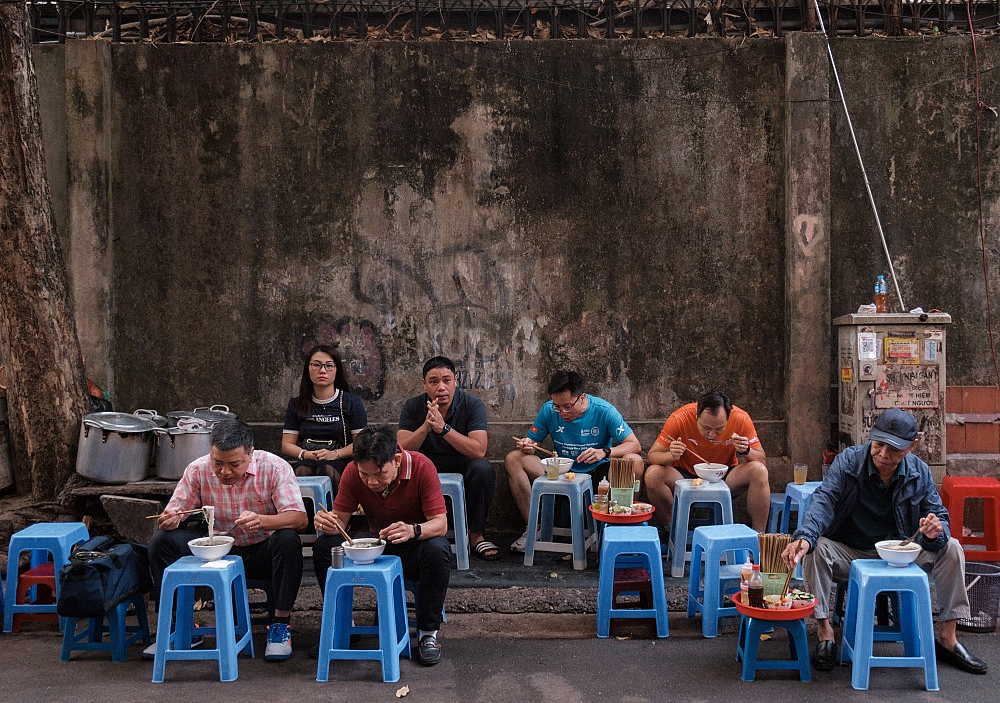 |
A famous pho restaurant in Hanoi Old Quarter. Photo: Michelin Guide
"Most of my childhood memories are tied to eating in the Old Quarter. Sitting on a bench in a dimly lit house, enjoying a simple breakfast in the Hanoi cold, is an unforgettable memory," Long added. For him, the Old Quarter is the core foundation of Vietnamese cuisine. Without these roots, chefs would only copy from abroad instead of building new things based on identity and heritage.
Truong Quang Dung, executive chef and owner of Chapter restaurant (Michelin Guide in Hanoi), also grew up during that period in the Old Quarter. Using traditional ingredients like local corn or field eels to create modern dishes, his menu carries a Vietnamese identity while exploring new possibilities. "We are not trying to change Vietnamese cuisine, but we are elevating standards to approach world-class levels," he said.
For young chefs, Hanoi Old Quarter remains a launching pad. "Sooner or later, some of the young people here will open their own restaurants, likely still in the Old Quarter," Dung added.
Today, the Old Quarter is a cultural melting pot. Restaurants not only cook to Vietnamese tastes but also aim for global standards in flavor, service, and experience. Dung also admitted that despite all the talk of innovation, the Old Quarter remains a traditional, sharp, and sometimes harsh trading area by nature.
"People are demanding, but the food is delicious," he joked. This very strictness, he believes, preserves tradition. Old Quarter residents are very proud of their origins. If you want to find authentic original flavors, look for the recipes in the Old Quarter.
As long as there are evenings, simmering pots of broth, and stools, the Old Quarter's cuisine will endure. "That is what makes Hanoi different from the rest of Vietnam. It is a rustic charm and a preserved layer of time that makes it appealing," Andrea Nguyen remarked.
Tam Anh (according to Michelin Guide)