On 4/5, Xinhua news agency released a video showing Chinese soldiers training with Type-100 main battle tanks on a hilly terrain training ground. The video depicted them practicing movement over rough terrain and firing at simulated targets, though it was unclear if they fired while on the move.
The footage also revealed three crew members seated in a separate compartment at the front of the tank, completely isolated from the rear turret. This design, previously implemented on Russia's Armata T-14 tank, significantly enhances crew survival should the turret be penetrated and ammunition inside explode.
The Type-100, also known as ZTZ-100, made its public debut at a military parade in Beijing in September 2025. This main battle tank has an estimated weight of 35-45 tons. It operates with a hybrid engine that combines diesel and electric power, and it is equipped with an active defense system and advanced sensors.
"The Type-100 indicates a strategic shift towards lighter tank warfare, prioritizing threat detection and interception over increased armor thickness. China considers the Type-100 a key asset in high-intensity warfare against technologically advanced adversaries like the US," stated the Belgium-based analysis group Army Recognition.
The Type-100 is designed to function as a digitized, highly mobile combat node, capable of countering beyond-visual-range threats. Its design reflects a new development direction where tanks become integral to a networked battlefield. This integration enables faster responses, longer-range targeting, and effective anti-unmanned aerial vehicle (UAV) capabilities.
The Type-100 is armed with a 105 mm smoothbore cannon and an automatic loader system holding 30-40 rounds, capable of firing 8-12 rounds per minute. China employs improved propellants to increase projectile muzzle velocity, compensating for any potential deficit in destructive power from using a smaller caliber cannon compared to Russian and NATO tanks.
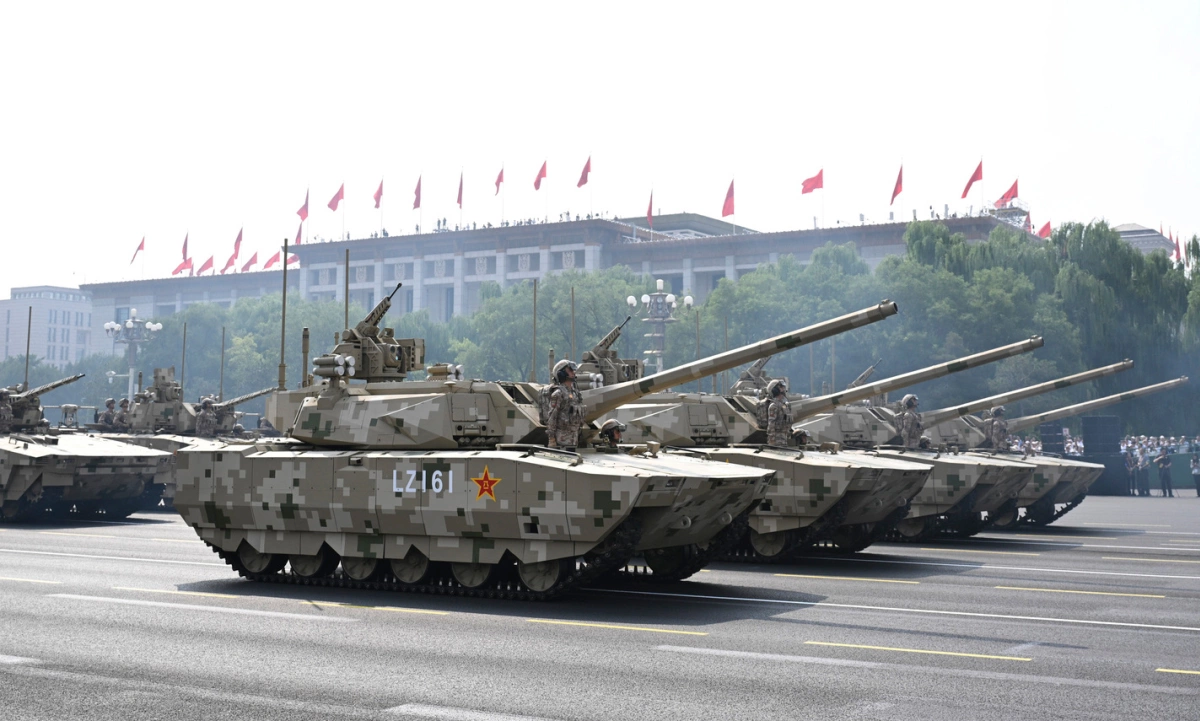 |
A Type-100 tank at the September 2025 military parade in Beijing, China. Photo: Xinhua |
The tank boasts a direct fire range of 2-4 km. With external targeting and navigation systems, it can engage targets up to 5 km away via indirect fire. The Type-100 also features a QJY-201 coaxial machine gun and a 12.7 mm gun mounted on a remote-controlled weapon station with a thermal imaging sight, primarily for countering UAVs or low-flying aircraft.
Information from the Type-100's sensor system, as well as from supporting UAVs, will be processed in real time and displayed on the crew's new-generation helmets. However, soldiers operating the Type-100 tanks in the recently released video appeared to be using basic helmets without such assistive devices.
The Type-100's hybrid engine allows it to travel at speeds of 80 km/h on paved roads and 50 km/h on uneven terrain. When operating solely on its diesel engine, the Type-100 achieves an operational range of 400-600 km.
Furthermore, the tank can operate in electric-only mode for several tens of kilometers. This significantly minimizes sound and infrared signatures from the engine, crucial for maintaining stealth during reconnaissance or ambush operations. The Type-100's battery system can also provide sufficient power to run sensors and electronic equipment without continuously running the main engine.
By Nguyen Tien (According to Xinhua, Army Recognition, WarZone)