A war powers resolution, introduced by Democratic members of the US House of Representatives, sought to require President Donald Trump to obtain Congressional approval before ordering the use of force. The resolution emphasized that the US Constitution grants Congress, not the president, the authority to declare war.
In a vote on 16/4, the Republican-controlled House rejected the resolution with 214 votes against and 213 in favor. Nearly all Republican representatives opposed the resolution, with the exceptions of Representative Thomas Massie, who voted in favor, and Representative Warren Davidson of Ohio, who voted "present" (equivalent to an abstention). On the Democratic side, Representative Jared Golden of Maine voted against the resolution.
The resolution's rejection came one day after a similar proposal failed to pass the Senate.
Since the Iran conflict erupted, this marks the second time the US House has rejected a resolution aimed at limiting President Trump's authority to initiate war. According to observers, the House vote indicates that President Trump continues to receive support from his Republican allies in Congress regarding his policy toward Iran.
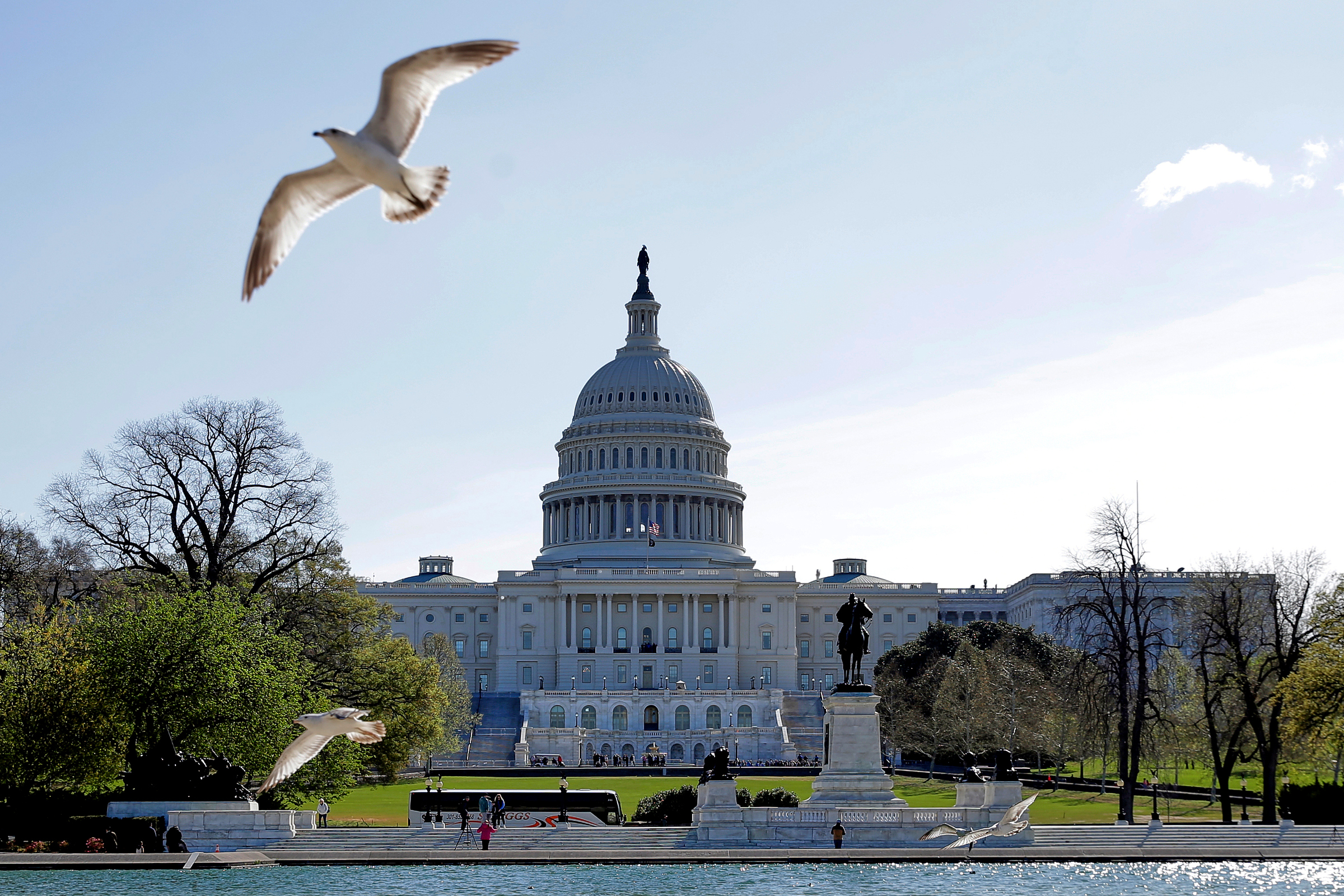 |
The US Capitol building in Washington on 7/4. Photo: AP |
In 1973, the US Congress passed the War Powers Act, which stipulates that the US president is not permitted to deploy troops into prolonged conflict without Congressional approval.
However, successive US presidents from both parties have long argued that the constitutional provisions regarding presidential war-making powers do not apply to short-term military operations or in cases where national security faces an urgent threat.
The White House and almost all Republican representatives supporting President Trump in Congress asserted that his order to attack Iran was lawful and fell within his "commander-in-chief authority", aimed at protecting the US through limited military operations.
Despite reaching a two-week ceasefire agreement from 7/4, the US and Iran remain at odds over many issues during negotiations, primarily Tehran's nuclear program. The US reportedly proposed suspending Iran's uranium enrichment program for 20 years, while Tehran offered a 5-year period, which Washington rejected.
The two sides are expected to resume negotiations in the coming days. President Trump announced on 16/4 that Iran had agreed to hand over uranium to the US, but provided no evidence. Iranian officials have not commented on the information; Tehran has not previously given any public signals that it would abandon its enriched uranium stockpile.
The US Navy began blockading Iranian ports from 13/4 to increase pressure on Tehran to make concessions in negotiations. The Pentagon threatened further attacks on 16/4 if an agreement is not reached. Chairman of the Joint Chiefs of Staff Dan Caine stated that US forces are "ready to resume large-scale combat operations almost immediately".
By Duc Trung (Reuters, AFP, AP)