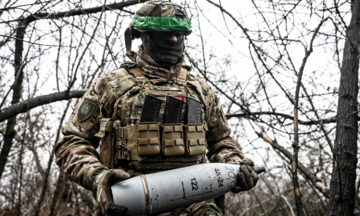
"Russia's guided bombs remain a problem for Ukraine. Russia possesses a large quantity of these weapons, causing significant damage. They are aware of this and continuously improve their guided bombs", said Serhii Beskrestnov, an advisor to Ukraine's Minister of Defense, on 11/2.
Beskrestnov referred to the UMPB-5 guided bomb, developed from the conventional FAB-500T bomb, which contains about 200 kg of high explosives. The UMPB-5 achieves a range of 150 km in its original configuration and can fly up to 200 km with an auxiliary jet engine.
In comparison, Ukraine's patriot air defense systems can hit targets at a maximum distance of 160 km with older PAC-2 missiles, while the latest PAC-3 MSE version offers improved accuracy but has a reduced range of 120 km.
UMPB-5 glide bomb deploys its wings after being released from a Su-34 fighter-bomber in a video released on 9/2. *Video: Osvedomitel*.
"There is nothing technologically new. However, I want to study the new electronic warfare countermeasures system on the UMPB-5 glide bomb", Beskrestnov added.
Russian military news sites previously released a video of a Su-34 fighter-bomber dropping a salvo of 4 UMPB-5 guided glide bombs, along with images of FAB-500T bombs suspended under the aircraft's wings, ready for sortie. The UMPB-5's wing assembly is fixed to the FAB-500T bomb with two steel straps, but the wing deployment mechanism has been streamlined and hugs the bomb body more closely than previous generations of guided glide bombs.
"The UMPB-5 features a simple design, without a small turbofan engine. However, the FAB-500T bomb's improved aerodynamic design, combined with a guidance module and larger wings, increases the bomb's flight range to about 150-160 km", stated the Osvedomitel news site.
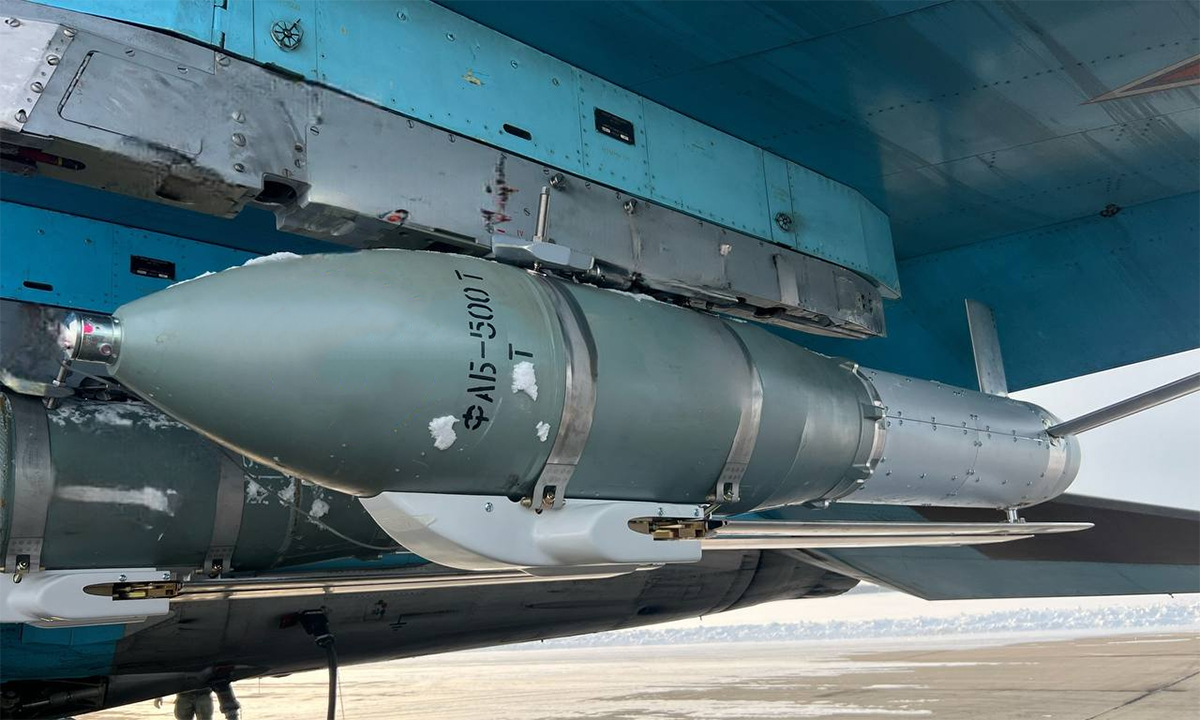 |
UMPB-5 glide bomb mounted under the wing of a Su-34 fighter-bomber in a photo released on 9/2. *Photo: Osvedomitel*.
According to Osvedomitel, the UMPB-5 bomb is also equipped with a radio altimeter, allowing it to detonate at a predetermined altitude for greater damage. Additionally, the bomb features a 16-channel controlled reception pattern antenna (CRPA) to significantly enhance its jamming resistance.
The UMPB-5 version will allow Russian Su-34 fighter-bombers to strike targets far from the front lines, as well as deploy bombs from safe areas beyond the interception range of Ukrainian air defenses.
In 3/2024, the Russian military also deployed the Unified Multi-purpose Glide Munition (UMPB) D-30SN for the first time, capable of being launched from tactical fighter jets and heavy Tornado-S multiple rocket launchers.
This type of weapon can fly horizontally or upward, rather than only downward like conventional guided bombs. This feature allows UMPB to fly over hilly terrain, deploy from low altitudes and areas with many obstacles, limiting the enemy's detection and interception capabilities.
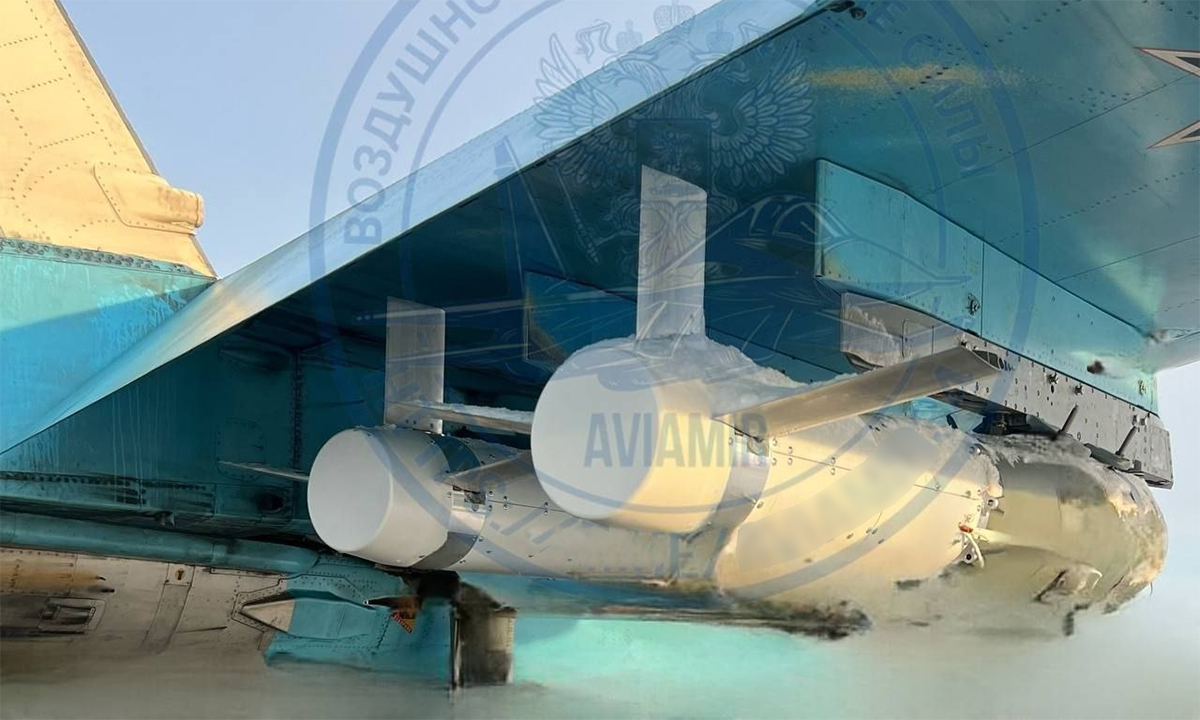 |
The tail section of an UMPB-5 glide bomb mounted under the wing of a Su-34 in a photo released on 9/2. *Photo: Osvedomitel*.
This gives UMPB an operational method similar to many modern Western weapons in the Ukrainian military's arsenal, such as French-made HAMMER rocket-boosted glide bombs and Ground-Launched Small Diameter Bombs (GLSDB) equipped for HIMARS multiple rocket launchers.
By Nguyen Tien (According to *AP, Strana, RusVesna*).