Chicken is served in paper buckets in American suburbs, in rice dishes at shopping centers in Trung Quoc, at shawarma shops in the Gulf region, peri-peri restaurants in England, biryani dishes in India, and in sandwiches at supermarkets worldwide. Chicken can be prepared in numerous ways: fried, roasted, grilled, shredded, stewed, pureed, or made into nuggets.
Once an expensive and less favored food for much of the 20th century, chicken has risen to become the most popular source of protein in the 21st century. This growth continues to accelerate. The number of chickens raised globally increased from 48,3 billion birds in 2006 to 76,2 billion birds in 2023, according to Nan-Dirk Mulder, a global poultry specialist at Rabobank.
For most of the last century, beef held a premium status, while pork dominated in terms of production volume, especially in Trung Quoc and Europe. Historically, farmers primarily raised chickens for eggs. Chickens used for food were typically hens past their laying cycle or young roosters.
In the United States, chicken prices in the 19th century were sometimes even higher than beef, according to Roger Horowitz, a historian specializing in the American food industry.
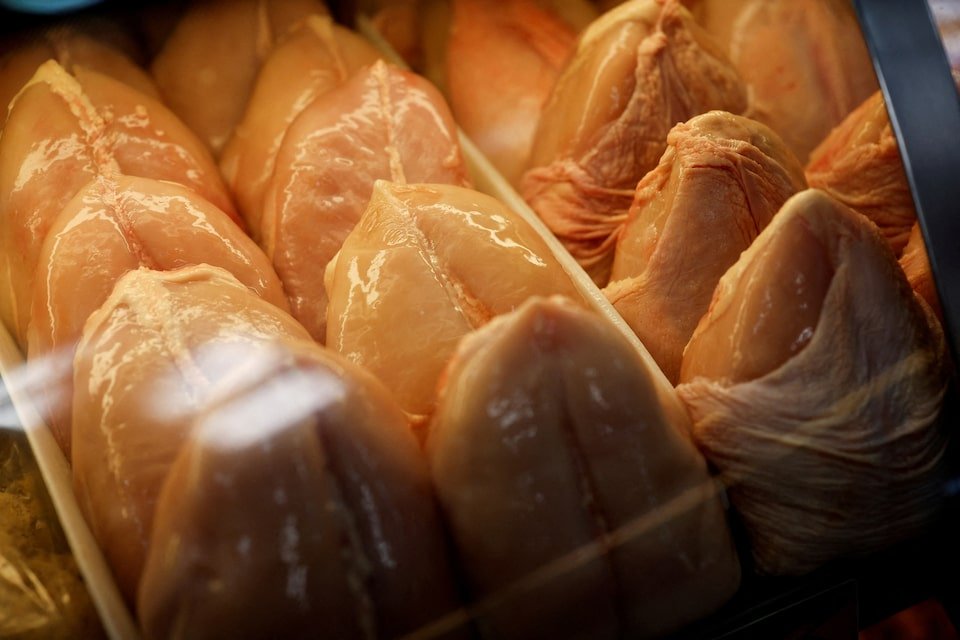 |
Chicken displayed in a refrigerated cabinet at a market in Sao Paulo, Brazil, 5/2025. Photo: Reuters
However, the industry began to transform in the 20th century, driven by advancements in refrigeration technology, railway systems, and urban consumer demand.
"The role of Jewish people in this story cannot be overlooked", Roger Horowitz said. Jewish communities in cities like New York, who migrated in large numbers from Eastern Europe and Russia since the late 19th century, maintained a distinct chicken market. This was due to religious rules requiring chickens to be slaughtered, cleaned, and salted according to Kosher principles within residential areas.
From around 1930, supermarkets transformed this business into a mass market, meeting the demand for a standardized, refrigerated, pre-processed, and inexpensive product. Poultry companies began constructing slaughterhouses and processing plants closer to farming regions.
By the 1950s, companies in states like Delaware and Arkansas had implemented processes to slaughter, process, and distribute chicken to the national market.
The poultry industry shifted from egg-laying breeds to those better suited for meat production. Funded by supermarkets and industry businesses, post-war "Chicken of Tomorrow" competitions encouraged farmers to develop chicken breeds that were meatier, grew faster, and converted feed more efficiently (eating less while gaining more meat). These were chickens "designed" for the era of mass retail.
Chicken is well-suited for global supply chains because it can be cut into specific parts for distribution to markets that pay the highest price for each type of meat. For example, chicken feet, often less valued in Western supermarkets, are a valuable export item to Trung Quoc.
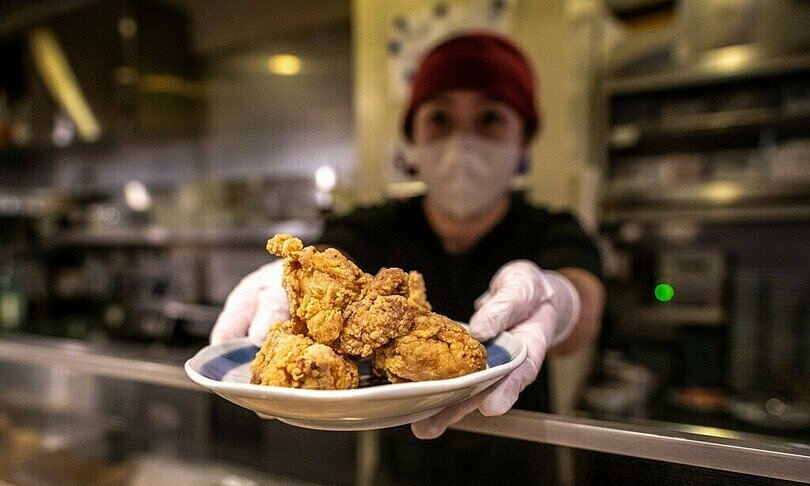 |
Karaage, Japanese-style fried chicken, at an eatery in Tokyo. Photo: AFP
Demand is increasing in both developed nations and emerging markets, driven by factors such as high beef prices, a trend towards higher protein consumption, and the expansion of the fast-food industry. According to the Food and Agriculture Organization of the United Nations (FAO), chicken surpassed pork in 2022 to become the world's most produced meat.
Chicken possesses many long-term advantages: low cost, high feed conversion efficiency, short production cycles, and fewer cultural or religious restrictions compared to pork or beef.
However, the future of the chicken industry will no longer rely on major exporting powers shipping large quantities of frozen meat worldwide. Instead, international trade is giving way to domestic supply chains – a shift Mr. Mulder calls "from globalization to localization."
The reason behind this trend is partly political. Many emerging economies seek self-sufficiency in livestock farming to ensure food security and create domestic jobs, rather than depending on foreign supplies.
This is prompting countries in the Trung Dong, Chau A, and Chau Phi to invest in farms, animal feed mills, hatcheries, and processing plants.
Nevertheless, expanding chicken farming and slaughtering operations also faces environmental and political risks. Increased production leads to a rise in total emissions, waste (manure, bedding), and pressure on animal feed supply systems. Animal rights activists have significantly influenced public perception through shocking images of genetically modified chicken breeds (often called "monster chickens" or "frankenchickens") and scenes from dark, cramped concentrated animal feeding operations.
In Europe, Mr. Mulder stated that poultry companies are struggling to obtain permits for new farm construction and processing capacity expansion. A mega-project by the Ukrainian poultry group MHP in Croatia was canceled this year following a wave of protests. Local authorities in Mallorca, Tay Ban Nha, last year also refused to grant a permit for a chicken farm and processing plant after facing strong public opposition.
Therefore, the greatest challenge for the chicken empire now is no longer consumer purchasing power, but rather legal hurdles and waves of opposition from local communities.
"If we are serious about food security and production self-sufficiency, we must expand farm acreage and housing infrastructure. But the harsh reality is that we do not have those things," Richard Griffiths, Chairman of the International Poultry Council, noted.
Hoang Lan (According to FT, AP, Reuters)