The Islamic Revolutionary Guard Corps (IRGC) announced on 25/3 that an advanced air defense system "fired and hit a US F/A-18 fighter jet" over Chabahar city. The force claimed the aircraft crashed into the Indian Ocean, stressing it was the 4th US fighter jet shot down since the conflict began.
Video released by Iranian state media shows an air defense missile rushing towards a fighter jet circling in the sky and exploding near the target, seemingly due to a proximity fuse activation.
Moment Iranian air defense targets a "US F/A-18 fighter jet" in a video posted on 25/3. Video: Tasnim, Clash Report.
US Central Command (CENTCOM), the agency overseeing US military operations in the Middle East, denied reports of one of its F/A-18 fighter jets being hit. "This is fake news. The truth: No US fighter jet has been shot down by Iran," the agency emphasized.
OSINTWarfare, a social media account specializing in open-source intelligence data collection, suggested the US F/A-18 might have been damaged by shrapnel from the Iranian missile.
Iran has repeatedly claimed to have attacked US military aircraft since the start of the conflict.
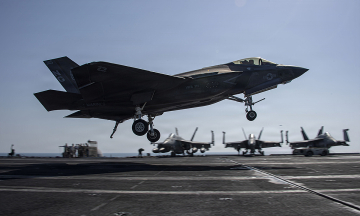
One of the most notable incidents occurred on 20/3, when CENTCOM reported a US F-35A stealth fighter made an emergency landing after a combat mission over Iran, without specifying the cause.
The IRGC later released a video showing an infrared sensor tracking the F-35 before an air defense missile exploded at close range, damaging it.
Air & Space Forces magazine on 22/3, citing informed sources, stated the incident severely damaged the F-35A, and the pilot was also injured by shrapnel. The magazine estimated about 20 US aircraft have been damaged or completely destroyed after nearly four weeks of hostilities, including three F-15E multirole fighter jets mistakenly shot down by Kuwait.
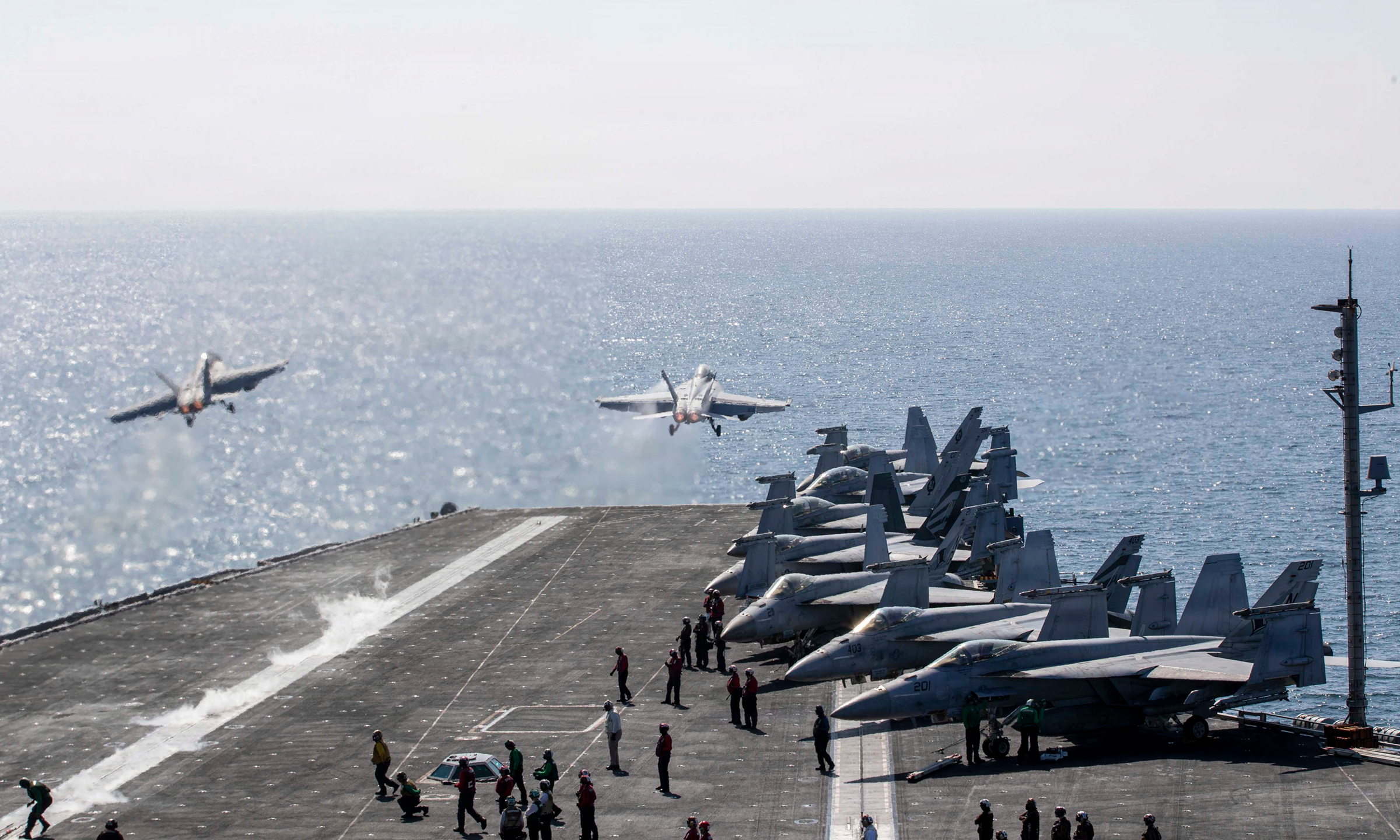 |
A Super Hornet fighter jet takes off from the aircraft carrier USS Abraham Lincoln to participate in an operation against Iran on 3/3. *Photo: US Navy*.
Observers commented that the US Air Force would face greater danger by moving further east and penetrating deeper into Iranian airspace. This area concentrates Tehran's mobile air defense systems, which are very difficult to detect and destroy.
"Mobile air defense systems are often well camouflaged, appearing only when ready to fire and quickly evacuating after launching missiles. They will continue to be a battlefield threat long after fixed air defense systems are destroyed," stated Debanish Achom, an editor at India's NDTV.
By Pham Giang (According to Tasnim, War Zone, Air & Space Forces)