Images posted on 15/4 showed F-4 Phantom II and MiG-29 fighters flying over Iran's capital, Tehran. These aircraft were reportedly escorting Pakistani military commander Asim Munir, who was visiting the country for discussions on a second round of talks between Iran and the US.
Days prior, two Mi-28 attack helicopters, believed to have been transferred from Russia before hostilities erupted, were also observed over Tehran. Howard Altman, editor of the US military specialized site War Zone, commented, "It seems the Iranian air force still has some operational fighter jets."
F-4 fighters and Mi-28 helicopters flew over Iran's capital Tehran on 15/4 and 13/4, respectively. Video: X/Clash Report, X/OSINTWarfare
This contradicts prior statements from US officials. In a recent Fox Business interview, President Donald Trump reaffirmed that Iran's air force, navy, and air defense forces were wiped out during the conflict. US Defense Secretary Pete Hegseth also previously declared Iran "no longer has an air force."
US Central Command (CENTCOM), the agency overseeing US military operations in the Middle East, repeatedly released videos showing attacks on Iranian aircraft parked outdoors. Commercial satellite images further revealed numerous aircraft destroyed at Tactical Fighter Base 8 in Isfahan province, central Iran, following strikes conducted by Israel.
Defence Blog, citing open-source intelligence, reported that Iran lost at least 38 aircraft during the conflict: 36 were destroyed, and two were damaged. These losses included various types of fighter jets, tanker aircraft, transport aircraft, maritime patrol aircraft, trainers, and helicopters.
The majority of these aircraft were hit while parked on aprons or in hangars. Additionally, at least two Su-24 attack aircraft and one Yak-130 jet trainer were shot down during airborne missions.
According to the defense specialized site Eurasian Times, the F-4s and MiG-29s survived the US-Israeli attacks by being dispersed across multiple bases. "They may also have been stored in hardened underground facilities to avoid damage from missile strikes," the site noted.
US military strikes on Iranian aircraft in a video posted on 12/3. Video: CENTCOM
Dylan Malyasov, editor-in-chief of Defence Blog, shared a similar assessment. He suggested that from the outset of the conflict, Iranian leaders opted to preserve their forces rather than deploy their air force against the technologically and numerically superior US-Israeli coalition.
"Almost all operational combat aircraft were dispersed within the network of underground bases and remained there throughout the intense fighting," Malyasov stated. "Only after the ceasefire was announced on 8/4 did Iranian aircraft begin to reappear in the sky."
This strategy was made possible by Iran's extensive network of underground facilities. The most documented location is Oghab 44, situated in Hormozgan province, which was first publicly revealed in 2/2023.
According to Iranian officials, Oghab 44 includes operational areas, command posts, hangars, repair and maintenance centers, navigation equipment, runways, and fuel depots.
State news agency IRNA described Oghab 44 as one of Iran's most important air force bases. It is capable of receiving and operating fighter jets equipped with long-range cruise missiles and unmanned aerial vehicles (UAVs).
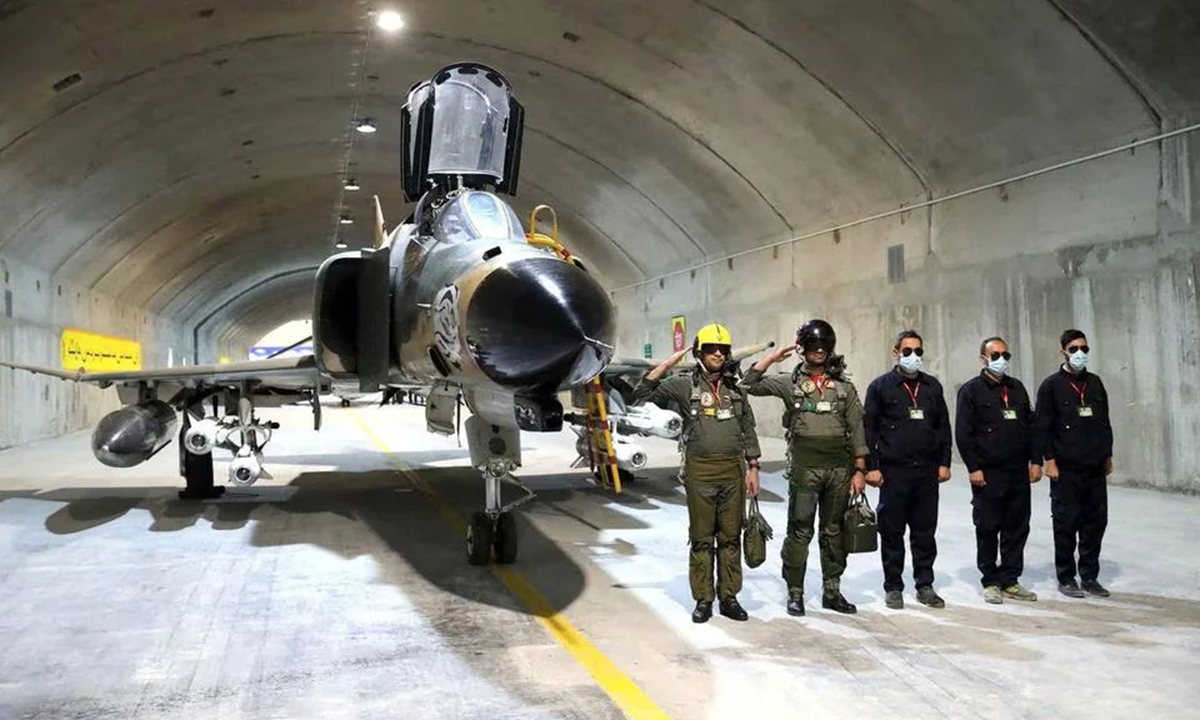 |
F-4 fighters in an Iranian underground base in an image released in 2023. Photo: Iranian Military
Open-source intelligence analysts estimate that a similarly structured base could house over 20 aircraft. These aircraft would launch directly from the base for missions and return to shelter when an adversary conducts bombing campaigns.
Iran's Chief of Staff of the Armed Forces, Mohammad Bagheri, stated in 2023 that any attack on Iran would face retaliation from its air bases, including Oghab 44.
"This statement is more like an assertion of military doctrine, which has been proven in practice, rather than mere boasting," Malyasov commented.
Elmustek, an open-source intelligence analyst, explained that the US and Israel initially focused on missile systems, air defenses, radars, and older aircraft parked outdoors. Their aim was to quickly degrade Iran's surveillance and response capabilities. This priority meant aircraft hidden in underground bases were not primary targets, as they are inherently difficult to attack directly.
However, the drawback of this approach also became evident during the conflict. Commercial satellite images captured by Airbus on 8/4 showed an impact crater at the entrance of a shelter at Oghab 44 base. This crater appears to have blocked the path from the underground hangar to the runway, effectively trapping aircraft inside.
Small earth mounds and barriers were also observed on the runway, seemingly deployed by Iranian forces to prevent enemy aircraft from landing.
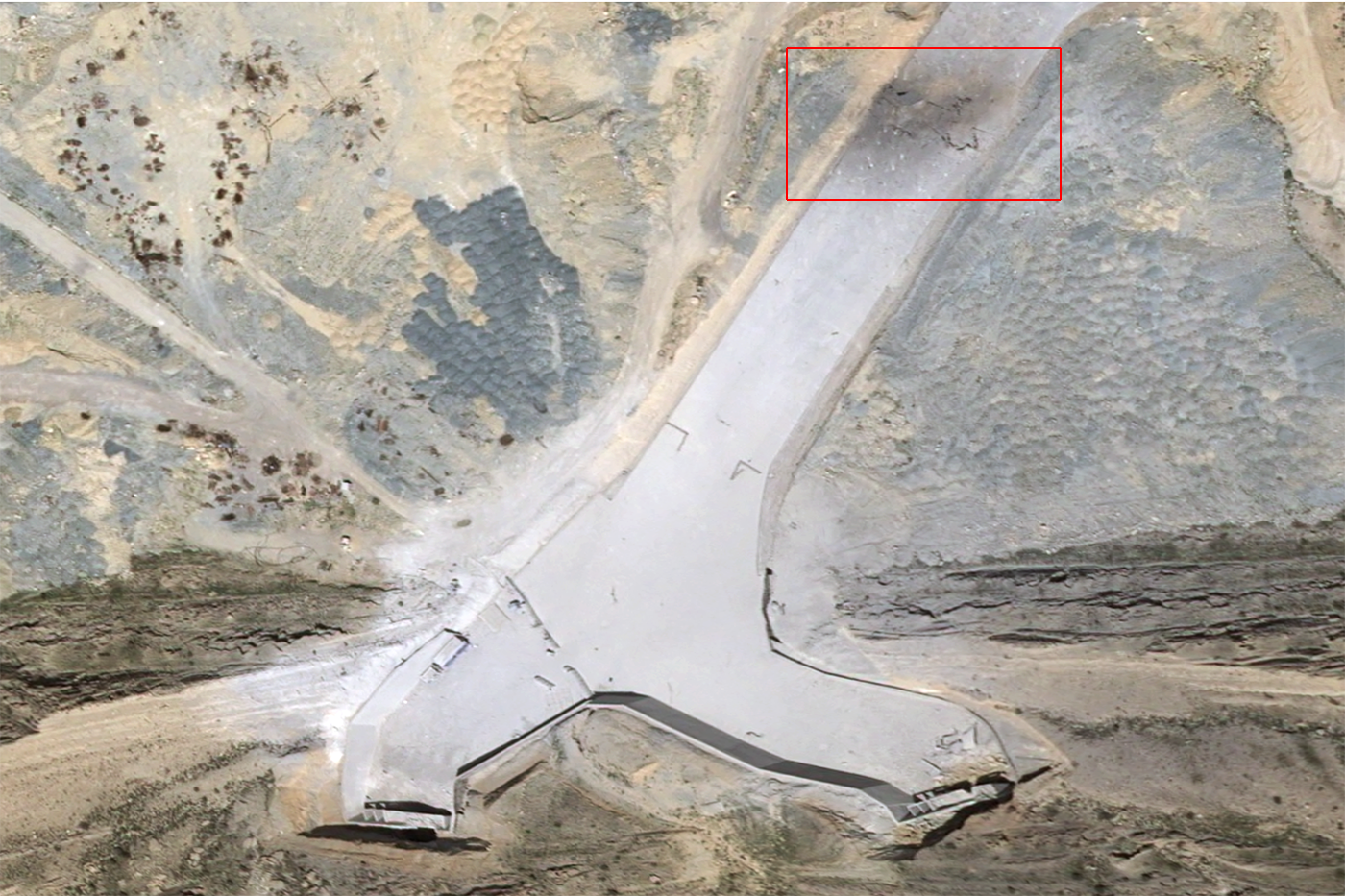 |
Impact crater (circled in red) at Oghab 44 base in a satellite image taken on 8/4. Photo: Airbus
"This reflects a core trade-off in Iran's underground base doctrine: aircraft are safe inside but operationally 'frozen'," the editor-in-chief of Defence Blog explained. "To launch a mission, aircraft must exit the tunnel onto the open runway, where they immediately face the risk of becoming targets."
This writer suggested that during intense fighting, that brief period of exposure was still very dangerous, leading Iran to choose to keep its aircraft in underground shelters.
The recent appearance of F-4 and MiG-29 fighters, alongside Mi-28 helicopters, indicates that this strategy has at least helped Iran preserve a portion of its air force. "Aircraft at Oghab 44 and similar facilities are not merely for hiding," Malyasov concluded. "The purpose is to help them survive a preemptive strike, ready for missions as soon as the danger passes."
Pham Giang (According to Eurasian Times, Defence Blog, New York Times)