Japan's drilling vessel Chikyu departed Shimizu Port, Shizuoka prefecture, on the morning of 12/1, heading towards the remote Minami Torishima island in the Pacific Ocean. Shoichi Ishii, program director at Japan's Cabinet Office, stated that the Chikyu's mission is to explore, extract, and produce rare earth elements at a depth of 6,000 meters beneath the sea.
"We are considering diversifying our supply sources and avoiding over-reliance on a specific country," he stated at the port as the ship prepared to depart.
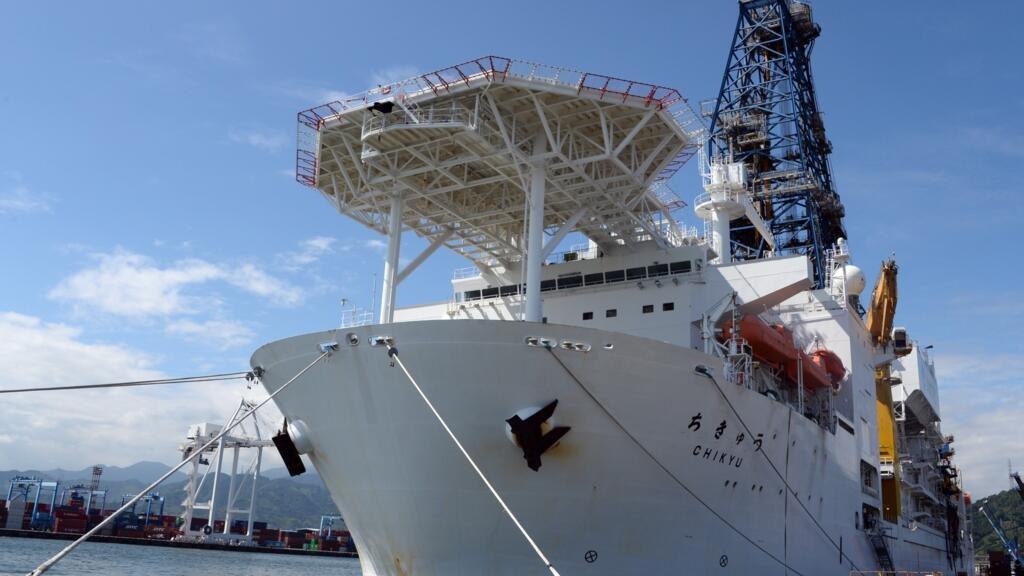 |
Japan's drilling vessel Chikyu docked at Shimizu Port, Shizuoka prefecture, on 11/1. Photo: AFP |
Japan's drilling vessel Chikyu docked at Shimizu Port, Shizuoka prefecture, on 11/1. Photo: AFP
Rare earth elements, a group of 17 metals widely used in energy and technology industries, are relatively abundant in the Earth's crust but difficult to extract.
The area around Minami Torishima, located within Japan's exclusive economic zone, is estimated to contain over 16 million tons of rare earth elements. According to Nikkei, this is the third largest global rare earth deposit, estimated to hold enough dysprosium for 730 years and enough yttrium for 780 years.
According to the Japan Agency for Marine-Earth Science and Technology (JAMSTEC), this marks the first time humans have attempted to extract rare earth elements at such a depth.
"If Japan can successfully and stably extract rare earth elements around Minami Torishima, it will secure a domestic supply chain for key industries," commented Takahiro Kamisuna, a researcher at the International Institute for Strategic Studies (IISS).
He added that this would be a significant strategic asset for Japan to "reduce its reliance on rare earth supply chains from China," especially as Beijing has banned the export of dual-use goods to Japan amid strained bilateral relations.
Hong Hanh (According to AFP)