South Korea's Joint Chiefs of Staff announced early on 3/10 that its military detected a ballistic missile launched from North Korea's Wonsan area towards the Sea of Japan. The agency stated the missile flew over 700 km and affirmed that South Korea, the US, and Japan maintain a robust defensive posture by closely sharing information on North Korea's ballistic missiles.
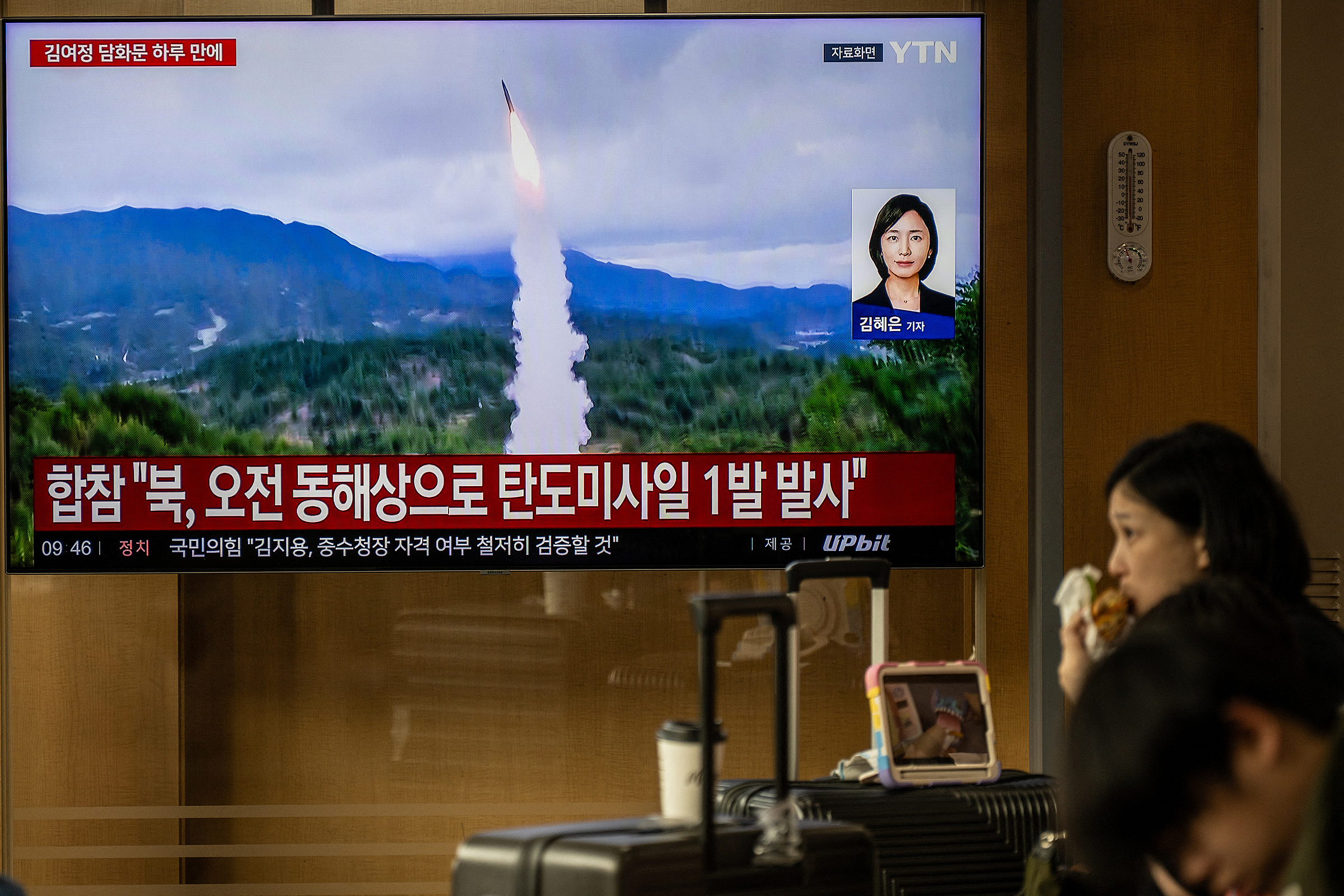 |
Archival photo of a North Korean missile launch displayed on a screen at Seoul Station in Seoul on 3/10. *Photo: AFP* |
Hours later, Kim Yo-jong, sister of North Korean leader Kim Jong-un, declared the missile launched that morning was a "medium-range strategic missile" that integrated artificial intelligence (AI) technology. She stated the missile possesses the ability to change its flight trajectory at low altitudes, implying it is "impossible to intercept". She added that Kim Jong-un affirmed "no country in the world will be able to access such technology for at least a few years". This statement followed Kim's emphasis last month on the need to raise the "level of artificial intelligence" in the country's weapon systems.
Kim Yo-jong also claimed that whenever North Korea tests a missile employing a "wave-gliding trajectory mode", South Korea is "unable to track the target from the initial bounce and glide points". Analysts suggest North Korea may be rapidly developing missile technology with military assistance from Russia, in exchange for sending troops to support Russia in the conflict in Ukraine.
North Korea's latest missile launch is seen as a display of force responding to South Korea's accusation that Pyongyang planted landmines in the demilitarized zone last month, injuring three soldiers. The planting of landmines and erection of anti-tank barriers were part of Pyongyang's border blockade plan, after Kim declared South Korea its "principal enemy" in 2024. The South Korean military demanded an apology from North Korea, while politician Lee Jae-myung called for North Korea to return to the negotiating table.
In response, Kim Yo-jong denied responsibility, criticizing the South Korean military's demand for an apology as "ridiculous" and likening Lee's reconciliation proposal to a "comedy". "Seoul calls for de-escalation, but Pyongyang responds by escalating tensions", said Yang Moo-jin, former president of the University of North Korean Studies in Seoul. "The message here is that North Korea is choosing confrontation over dialogue".
"Artificial intelligence (AI) is increasingly integrated into military technology worldwide, and ballistic missiles are no exception", said Hong Sung-pyo, a senior researcher at the Seoul-based Korea Institute for Military Affairs. He explained: "AI can assist in processing target information and missile launch operations; additionally, the conflicts in Ukraine and Iran demonstrate how combining AI with unmanned aerial vehicles (UAVs) and missiles can enhance combat effectiveness".
However, Hong suggested it is too early to confirm the accuracy of North Korea's claims about this missile's capabilities. "North Korea's missile technology is not truly advanced compared to leading military powers", he noted. "While missiles capable of maneuvering in the terminal phase of flight are very difficult to intercept, that does not mean they can strike targets with absolute precision".
Hong Hanh (According to AFP, Reuters)