North Korea has reportedly amended its constitution to redefine its territory and abandon the long-held goal of unifying the Korean Peninsula. According to parliamentary documents accessed by Reuters and Yonhap on 6/5, the revised Article 2 of the constitution now specifies the country's land as "bordering China and the Russian Federation to the north, and South Korea to the south," along with its territorial waters and airspace.
The amended text notably omits phrases such as "peaceful unification" and "great national unity," removing all references to the unification of the Korean Peninsula. Additionally, the achievements of late leaders Kim Nhat Thanh and Kim Jong-il are no longer mentioned. This document appears to have been adopted during North Korea's parliamentary session in March. North Korean officials have not commented on these changes.
The constitutional revisions also elevate the status of Kim Jong-un, who holds the position of Chairman of the State Affairs Commission. This role is now formally defined as the head of state, moving away from the previous description of "supreme leader" representing the state. The Chairman's authority is now placed above the Supreme People's Assembly within the state apparatus, and the legislative body's power to dismiss this position has been removed. Furthermore, command of the nuclear forces is explicitly granted to the Chairman of the State Affairs Commission, placing direct control of North Korea's nuclear arsenal under Kim's leadership.
A defense clause in the amended constitution describes North Korea as a "responsible nuclear-weapon state." It affirms the country's commitment to developing its nuclear capabilities to protect its existence, ensure its right to development, deter war, and maintain regional and global peace and stability.
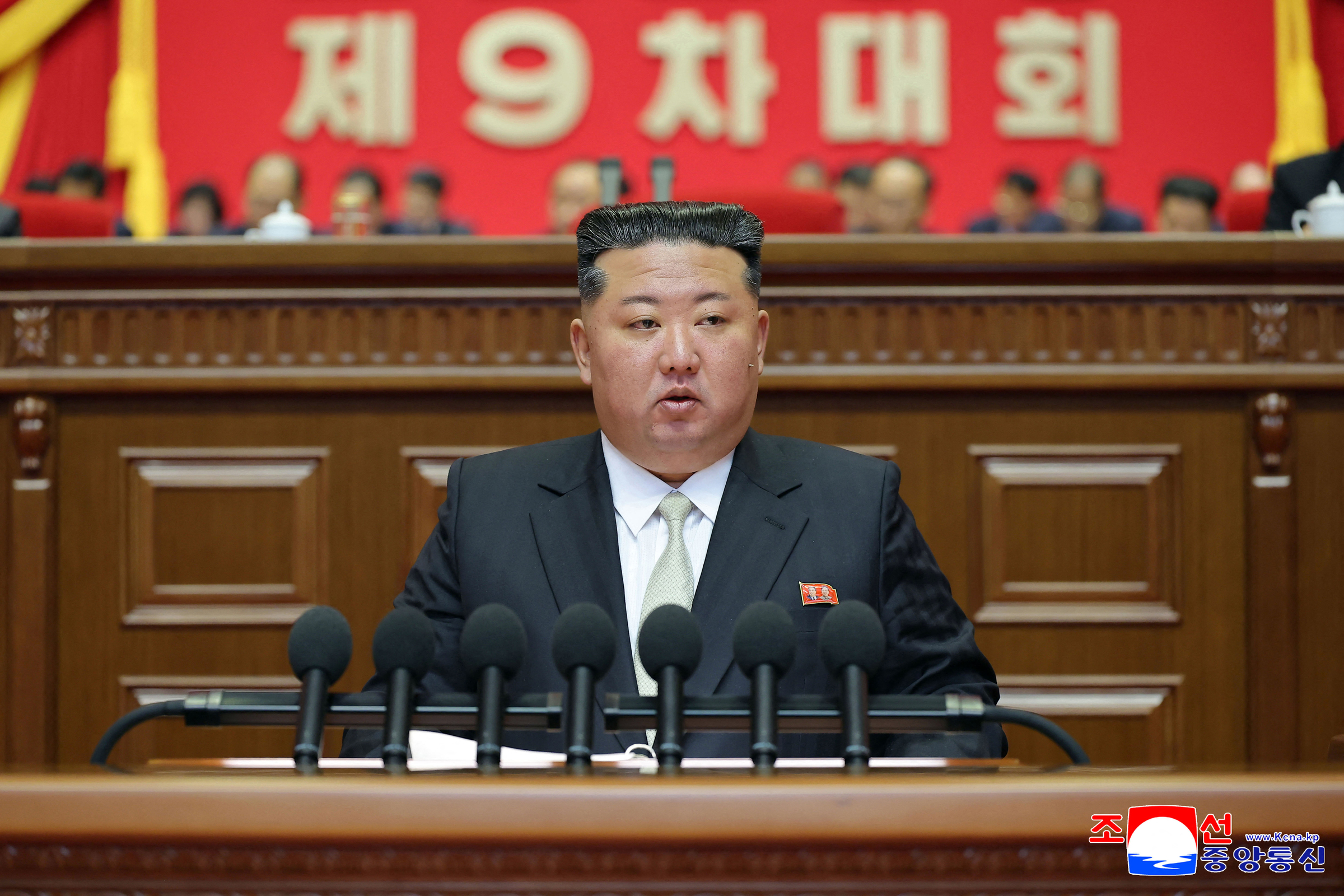 |
North Korean leader Kim Jong-un speaks in Binh Nhuong on 23/2. *Photo: KCNA* |
Lee Jung-chul, a professor at Seoul National University in South Korea, noted that this is the first time North Korea has included a specific territorial clause in its constitution. He suggested that the document's deliberate omission of a clear inter-Korean border definition indicates Binh Nhuong's intention to avoid creating new sources of tension. Despite continuing to characterize the two Koreas as "two hostile states" in the constitution, Binh Nhuong refrains from labeling Seoul as the "main enemy." This contrasts with earlier predictions following Kim Jong-un's statement in 1/2024, where he referred to South Korea as "the main adversary and immutable enemy."
Professor Lee commented that these constitutional changes signal Binh Nhuong's desire to project the image of a normal state. He believes that the avoidance of overtly hostile language towards Seoul could potentially establish a foundation for peaceful coexistence between the two Koreas.
Thanh Danh (According to Reuters, Yonhap)