For Jeffrey Cesari, ube is nothing new. Every time he visited relatives in the Philippines since childhood, he enjoyed cakes and desserts made from this distinctive purple root. But it wasn't until seven months ago, when he stepped into a cafe in Istanbul, Turkey, and ordered an ube latte, that Cesari realized this agricultural product was creating a global sensation.
A business idea sparked in the 31-year-old former auditor's mind. If consumers in Istanbul embraced an ube-based drink, why not bring that product to Paris, France, where Cesari lives? However, when he began searching for ingredients, Cesari quickly discovered that ube was not as easy to find as he thought.
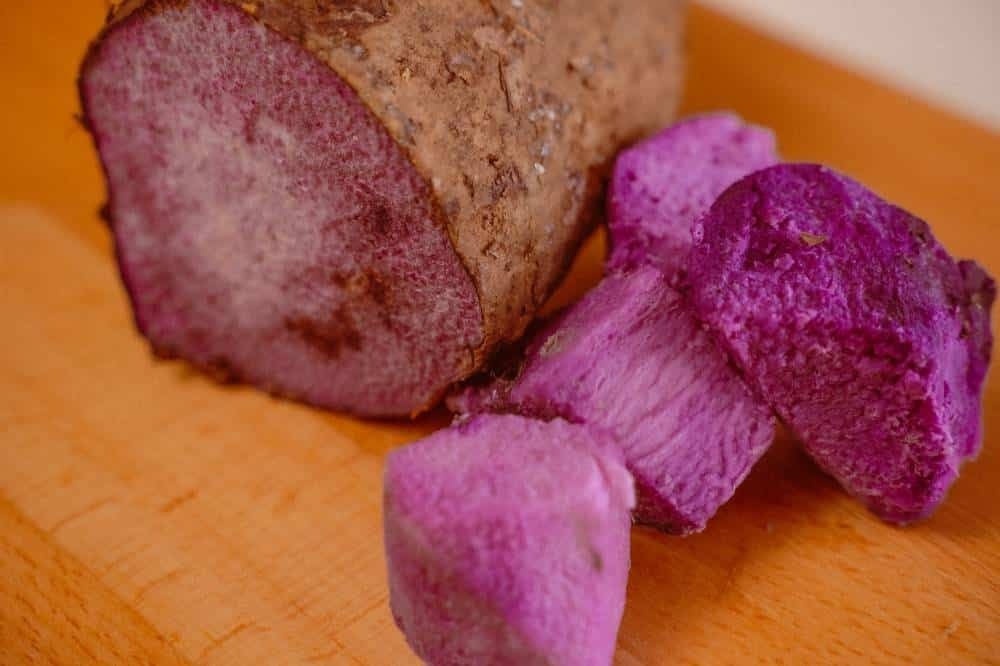 |
A distinctive purple yam from the Philippines. Photo: Inquirer
Ube, a native crop of the Philippines, has a sweet, earthy flavor and a striking purple color, often mistaken for taro. It is primarily grown on small, seasonal plots and has long been processed into jams, ice cream, and pastries.
Cesari initially searched for information through Facebook groups and artificial intelligence tools. However, he did not fully trust the leads he found. The market offers various ube varieties, with products available in multiple forms such as powder, extract, and concentrated jam. What worried Cesari more was the difficulty in determining what was pure ube and what had been blended with purple sweet potato or taro to reduce costs.
Upon returning to the Philippines to visit family in February, Cesari decided to trace the supply chain directly, from bakeries to wholesale suppliers, hoping to find a source directly from farmers. But accessing the supply proved challenging. Many entities were hesitant when asked about their suppliers.
"To get high-quality ube, we have to be there, to see with our own eyes, check with our own hands, and taste it ourselves," Cesari said. "You have to be very careful because there are projects where you don't know the level of transparency."
After much effort, a relative introduced him to a project developing an ube growing region for export on Bohol island. Cesari took a two-hour boat ride from Cebu to meet the farmers there. They informed him that, in the initial phase, they could supply him with about 10 kg per month. Cesari is currently aiming to launch his product, Ube Signature Paris, by late June.
"I feel the immense potential of ube latte," he said. "But I also feel that everyone wants to create their own ube latte because they all see that opportunity."
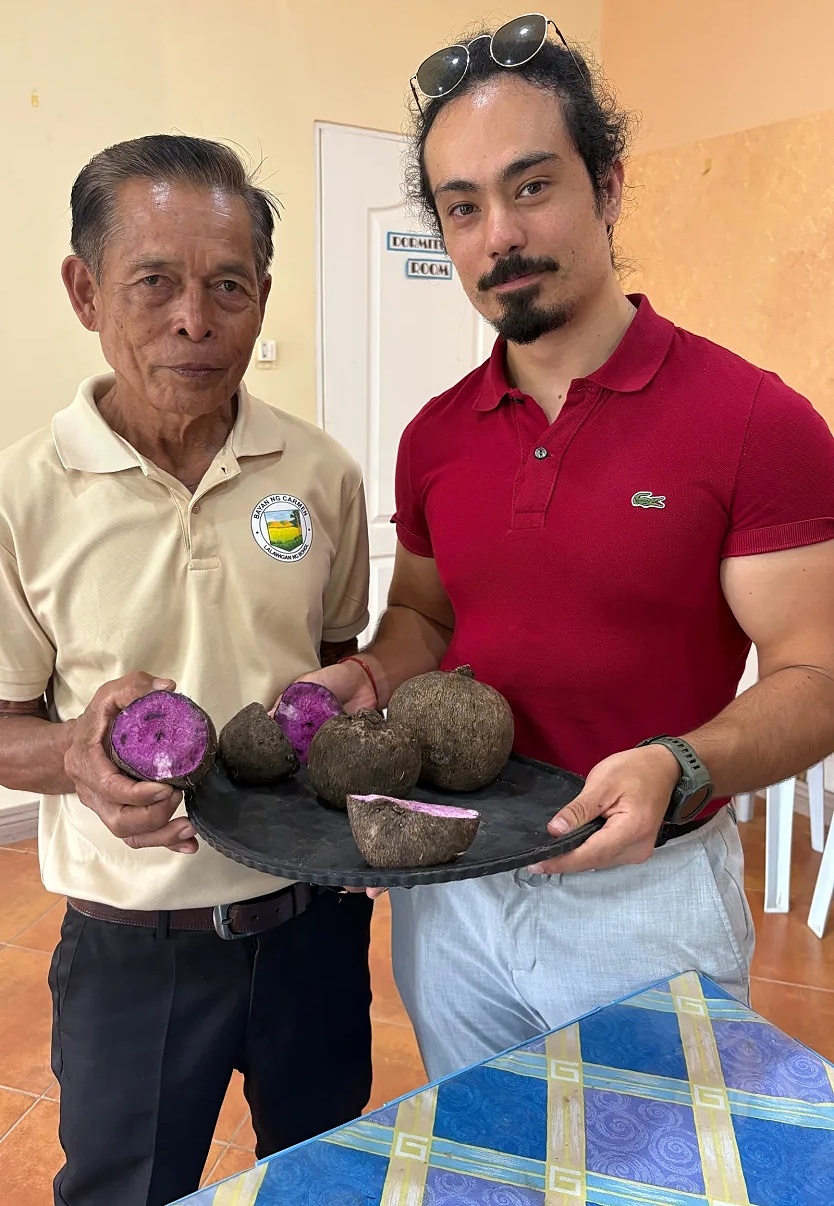 |
Jeffrey Cesari (right) and an ube supplier on Bohol island. Photo: Jeffrey Cesari
The appeal of ube is no longer just a story for small entrepreneurs. In March, US-based Starbucks added ube-flavored drinks to its seasonal menu, and UK-based Costa Coffee also launched hot chocolate and frappe products featuring the purple yam flavor.
According to market research firm Datassential, about 27% of US consumers are now aware of ube, a sharp increase from 15% five years ago. The number of dishes and drinks featuring ube on menus in the US has tripled in the past four years, although it still appears in less than 2% of restaurants and cafes.
Rhea Topacio, founder of Pamana World, a Netherlands-based company specializing in ube-flavored products, believes the ube boom is partly driven by a global matcha supply shortage, prompting the market to seek new alternatives. Both ingredients originate from Asia, possess striking colors, and align with social media consumption trends.
"Ube is accelerating very quickly," Topacio said. "Consumers are always looking for something new, especially in an era where every trend spreads on social media."
While not yet as popular as matcha, the ube craze is creating significant pressure on a supply chain that has not been systematically developed. The Philippines is ube's homeland, but its production and distribution network remains fragmented. Farmers often sell their produce to traders rather than directly accessing the export market. Value addition primarily goes to intermediaries, while growers have little incentive to expand cultivation areas.
An ube crop takes from nine months to one year to harvest, significantly longer than many other crops that can be sold within a few months. High investment costs, a long return on investment period, and unstable output mean ube is not yet considered a crop that generates attractive cash flow. "To date, the biggest beneficiaries of rising ube prices are still the traders," said Grace Backian, director of the Northern Philippines Crop Training and Research Center. "Farmers do not yet see this as a truly commercial crop."
The situation is further complicated by the conflict between the US-Israel and Iran, disrupting energy supplies from the Middle East. In the Philippines, rising fuel prices have escalated irrigation and farm operating costs. Camelle Morta Singh, 31, began farming ube with her family in Pangasinan province in 2024. Singh stated that fuel costs to operate the irrigation system have tripled this dry season. This has forced her to raise the price of raw ube to 90 pesos per kg, an increase of nearly 30% compared to before the conflict.
"We cannot stop production," Singh said. "We cannot let the ube dry out. Even though fuel prices are very high, I still have to buy it because it is vital for the business."
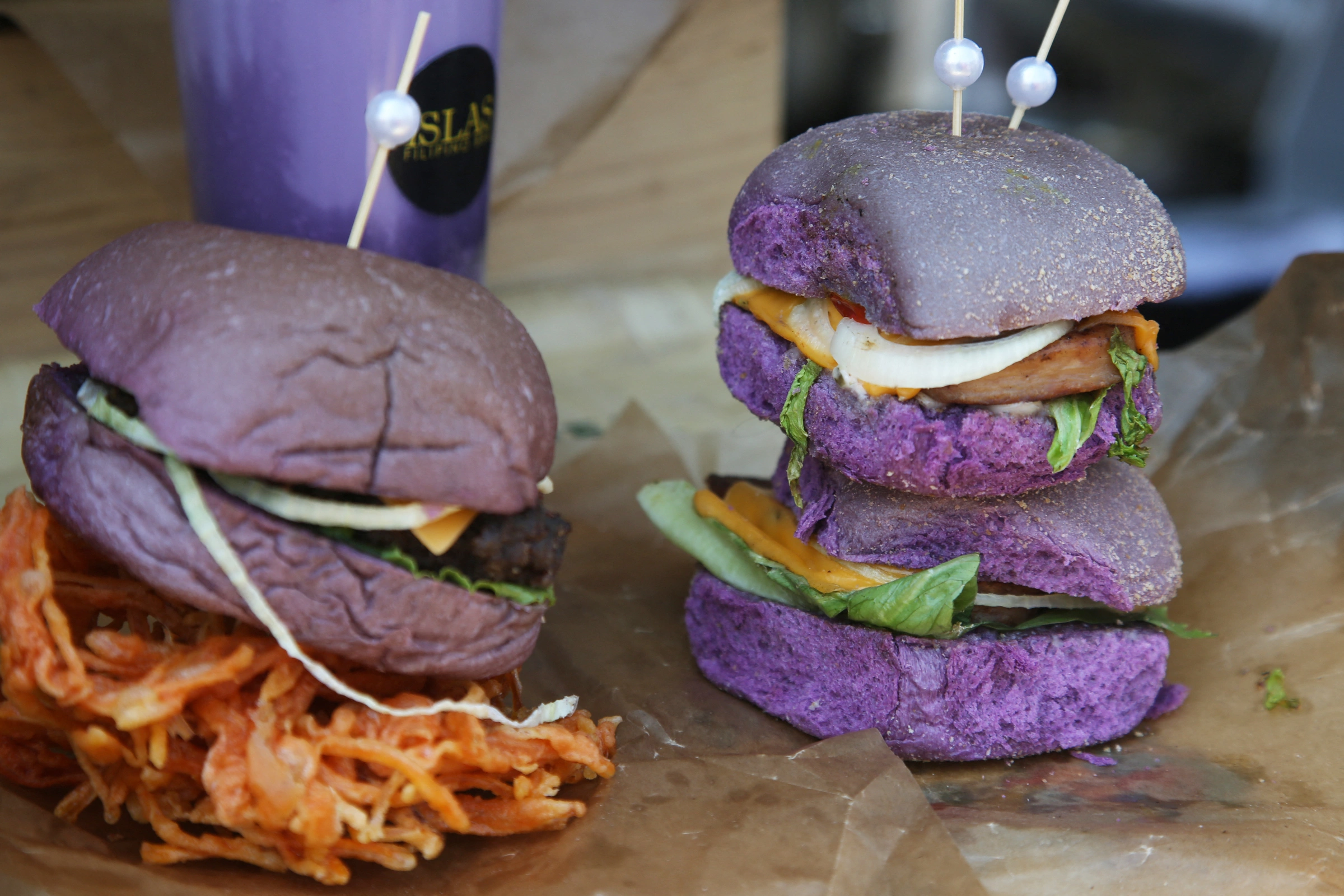 |
An ube burger at a food stall in Toronto, Canada, August 2023. Photo: AFP
Rapidly increasing demand, coupled with insufficient supply, is making it difficult even for domestic consumers in the Philippines to access this once-common agricultural product. The food processing center at Benguet State University has produced ube jam, or ube halaya, since the 1980s. Johnabel Basatan, the facility manager, noted that customers previously bought only one or two 400-gram packs for family use. Recently, however, many businesses have purchased hundreds of packs at once, clearing out this month's inventory.
The price of raw ube has increased by about 38% compared to two years ago. Basatan said that last year, her supplier could only deliver about 3,000 kg to her facility, equivalent to half of her usual order. In February, she ordered an additional 6,000 kg of ube but has yet to receive a response.
"The demand this time is truly urgent," Basatan said. "Those who only bought for family use no longer have products to buy. Meanwhile, with our current capacity, existing workforce, and operating machinery, we cannot expand production further."
By Nhu Tam (According to CNN, AFP, Reuters)