The Our Lady of La Vang statue, depicting the Virgin Mary in a traditional Vietnamese ao dai, was placed in the Vatican Gardens in 4/2025. This project, long cherished by the Vietnamese Catholic Church, aims to introduce "the beloved Mother of the Vietnamese people" to the wider Church. The late Pope Francis approved the initiative on 17/10/2024.
Pope Leo XIV expressed a special bond with Vietnam, noting that the statue of Our Lady of La Vang in the Vatican Gardens serves as a constant reminder of the country. This sentiment was shared during an audience with National Assembly Chairman Tran Thanh Man on 11/4, when Man delivered an official invitation from General Secretary and President To Lam for Pope Leo XIV to visit Vietnam. The Pope gratefully accepted and expressed his desire to visit in the near future.
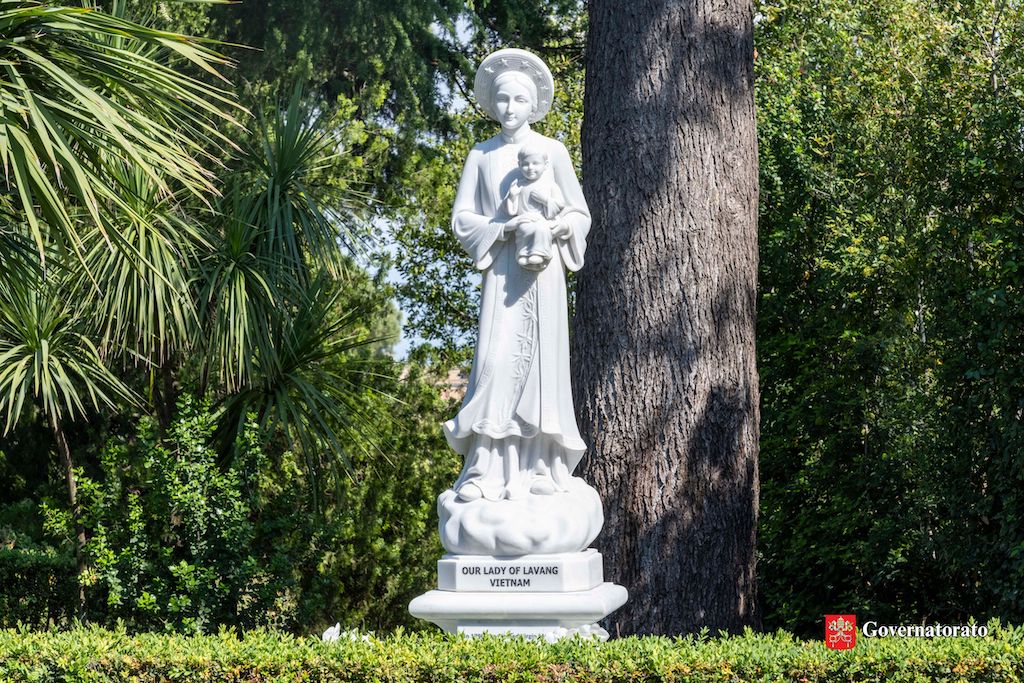 |
Our Lady of La Vang statue in traditional ao dai in the Vatican Gardens. Photo: Vatican City State
Standing 1.6 meters tall, the statue was meticulously crafted from white marble sourced from Quy Hop, Nghe An. Artisan Giuse Tran Van Giang sculpted and completed the work in Ngu Hanh Son, Da Nang, before it was transported to Rome by plane. The statue is positioned near the Great Jubilee Bell 2000, with Saint Peter's Basilica's dome forming a majestic backdrop.
Cardinal Giovanni Lajolo, a proponent of placing the statue in the Vatican Gardens, remarked that it represents not only a Vietnamese creation but also "the patroness of everyone in the region." During the blessing ceremony for the statue, Archbishop Giuse Nguyen Nang of the Archdiocese of Ho Chi Minh City offered incense and prayers. He stated, "We believe that Our Lady here will intercede for all Vietnamese Catholic communities everywhere. We give thanks to God and entrust ourselves to the Mother."
 |
Archbishop Giuse Nguyen Nang incenses and blesses the Our Lady of La Vang statue in the Vatican Gardens. Photo: Vatican City State
The Vatican Gardens, a historic landscape covering about 23 hectares, constitute over half of the Vatican City State. Dating back to the Middle Ages and flourishing during the Renaissance, the gardens feature diverse landscapes, including Italian, French, and English styles, interspersed with fountains, religious structures, and walking paths. The gardens house numerous statues and mosaics of the Virgin Mary from various nations, each with distinct artistic styles, such as Our Lady of Guadalupe from Mexico, Our Lady of Lujan from Argentina, and Our Lady of Naju from South Korea.
According to oral tradition, the Virgin Mary and the Child Jesus appeared in La Vang, Quang Tri, in 1798. She reportedly consoled the faithful during difficult times and taught them to gather medicinal leaves for healing. Local residents later built a small church in her honor at the site of the apparition.
Duc Trung