"We have seen the lowest poverty rate in American history. In other words, the number of poor people in the US is the lowest it has ever been," President Donald Trump stated on 27/9.
Trump's statement followed the US Census Bureau's announcement of data showing the nation's poverty rate in 2025 decreased by 0,5 percentage points to 10,2%.
This marks the second consecutive year the poverty rate in the US has declined, bringing the index to its lowest level since the US Census Bureau began tracking data.
In 2025, a family of two adults and two children in the US was classified as poor if their annual income was below 32,649 USD. The supplemental poverty measure, which accounts for non-cash government benefits and taxes, stood at 13,1%, and median household income rose by 2,6%, reaching 87,460 USD.
The official child poverty rate dropped to a record low of 13,4%. The poverty rate among Hispanic Americans also stood at about 13%, the lowest ever recorded.
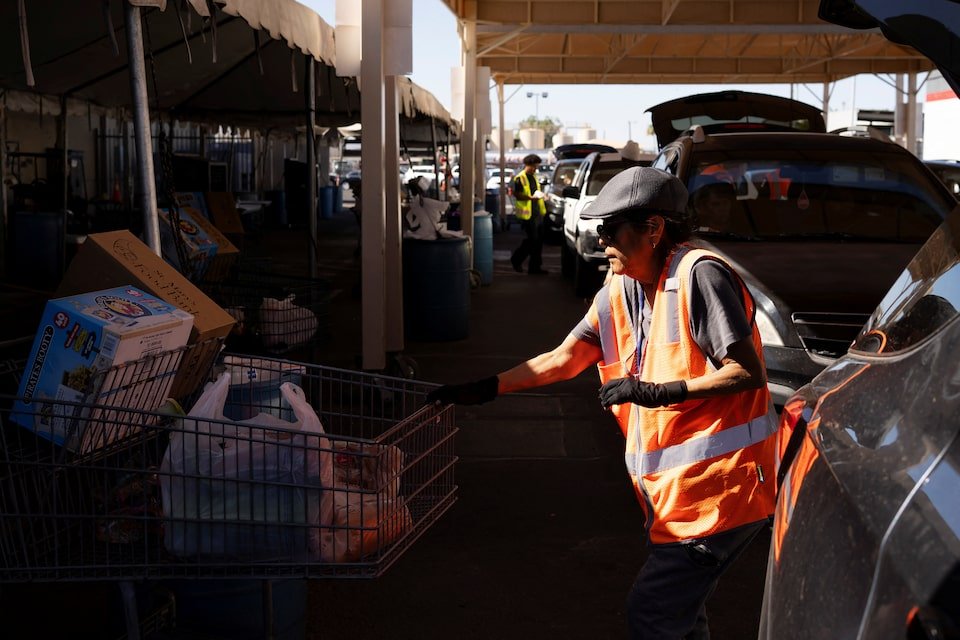 |
Volunteers load items onto a resident's car outside St. Mary's Food Bank in Phoenix, US, on 29/5. *Photo: Reuters* |
However, advocates for the poor warn that these positive outcomes may not last long, according to the Washington Post.
They argue that these statistics reflect the number of poor people in the US last year, before the social welfare policy cuts in the Omnibus Budget Reconciliation Act (OBBBA) fully took effect this year.
Experts suggest next year's census data could show a significant increase in the poverty rate, primarily due to cuts to the Supplemental Nutrition Assistance Program (SNAP), also known as food stamps.
"Annual statistics may not fully reflect the changes families have already begun to experience," said Megan Curran, a poverty expert at Columbia University.
These figures do not yet reflect the current living situation of families dependent on SNAP and similar programs in September, Curran said.
The Center on Budget and Policy Priorities reported that 5 million people lost food stamp benefits between 7/2025 and 5/2026 due to the OBBBA legislation.
This law tightened work requirements for food stamp recipients and shifted much of the program's cost to the states. Those who do not meet the work requirements are expected to see their benefits cut starting in 3/2026, depending on the re-certification schedule in each state.
In the first five months of this year, the Center on Budget and Policy Priorities observed a decrease in food stamp recipients across 47 US states, with Arizona experiencing a reduction of up to 20%.
Chastity Lord, president of an anti-poverty program for single mothers and children, stated that rising prices have forced many women to work extra hours this year to support their families, reflected in their increased incomes.
The prices of gasoline, food, and essential services in the US have all risen this year. These are indispensable living expenses, so people must find ways to earn additional income, Lord said.
Her organization, Jeremiah Program, supports mothers in 9 cities across the US. "Many have to earn more from short-term jobs or work extra hours outside their main employment. We call it the 'survival economy'," she added.
Hoang Lan (According to Washington Post, Reuters)