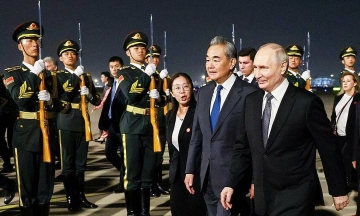
President Vladimir Putin's plane landed at Beijing Capital International Airport around 11:15 p.m. on 19/5. Chinese Foreign Minister Wang Yi, Chinese Ambassador to Russia Zhang Hanhui, Russian Ambassador to China Igor Morgulov, and senior Russian diplomatic officials welcomed the Russian president at the airport.
A red carpet was laid on the airport runway for the Russian president's arrival. This gesture is among the most formal welcoming protocols for foreign leaders at airports.
As President Putin walked along the red carpet, a group of students waved the national flags of both countries and chanted "welcome" in Chinese.
Following the airport welcome, President Putin boarded his Aurus limousine for his residence. He typically uses his personal vehicle, with Russian license plates, for all his travels, including international trips. For this visit, the presidential limousine was brought from Russia, but its license plate was replaced with a Chinese one.
President Putin's official visit to China is scheduled for 19-20/5. According to Yury Ushakov, the Russian president's foreign policy assistant, a key highlight of the visit is a tea party between Chinese President Xi Jinping and President Putin. During this gathering, the two leaders are expected to discuss pressing international issues.
The visit is expected to see the signing of approximately 40 bilateral agreements, including a joint statement aimed at strengthening the comprehensive strategic partnership between the two nations. Ushakov also noted that both leaders are anticipated to endorse a statement promoting a "multipolar world" and a "new type of international relations".
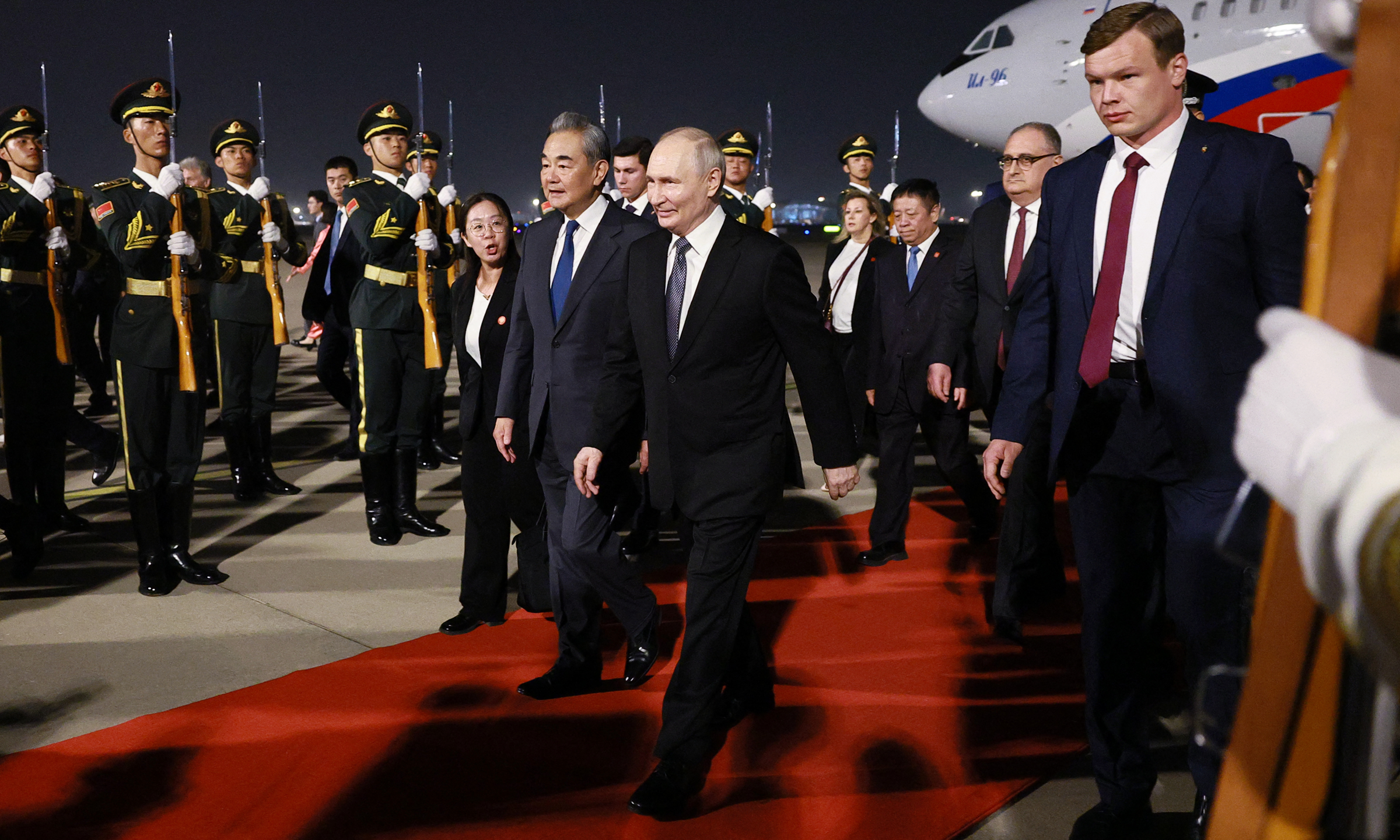 |
President Putin moved along the red carpet at the airport in Beijing, China, on 19/5. Photo: AFP |
President Putin is also scheduled to meet various Chinese officials, including discussions with Premier Li Qiang focused on trade and economic matters. His itinerary includes attending the opening ceremony of the Russia-China Cultural Exchange Year, visiting a joint photo exhibition on the history of bilateral relations organized by TASS and Xinhua, and meeting young Chinese engineer Peng Pai. Peng previously met President Putin as a child during the Russian president's 2000 visit to China. He subsequently pursued studies in Russia and currently works for a major Chinese enterprise.
China stands as Russia's most significant ally. Chinese-manufactured electronic components are crucial for Russia's defense industry. As Russia's largest oil customer, China provides a vital revenue stream, particularly as the Russian economy faces pressure due to the Ukraine conflict.
President Putin's visit follows, by several days, a state visit by US President Donald Trump to China. This marks the first instance of China hosting leaders from two major global powers within the same month. This reflects Beijing's strategic effort to navigate relations with both nations and assert itself as a central power amid an increasingly fractured world order.
By Pham Giang (According to TASS, RT, Reuters)