In 1993, the Chinese government promulgated the Beijing Urban Master Plan for 1991-2010. This plan aimed to decentralize the population from central areas to new urban zones and satellite cities.
The plan was introduced as Beijing's population had surged from over 3 million in 1954 to over 10 million by 1990, primarily concentrated in four inner-city districts. At that time, Beijing's central area occupied only 8,15% of the city's total area, yet it bore the brunt of political, economic, and employment functions, facing increasing pressure from population density, traffic, and environmental concerns.
Over the subsequent ten years, Beijing launched 162 renovation projects, demolished 4.36 million square meters of dilapidated housing, relocated nearly 160,000 households, and invested over 40 billion yuan in renovation efforts.
The turning point for the demolition campaign occurred in 2001 when Beijing won the bid to host the 2008 Summer Olympic Games. Statistics revealed that Beijing's eight inner and suburban districts then contained 7.55 million square meters of old, dilapidated housing, with 3.03 million square meters classified as dangerously unsound.
Many of these were "ten-lacks apartments", meaning they lacked running water, sewage systems, gas, heating, kitchens, toilets, balconies, built-in wardrobes, bicycle storage, and green spaces. Some families of seven even lived crammed into a mere 13 square meters for decades.
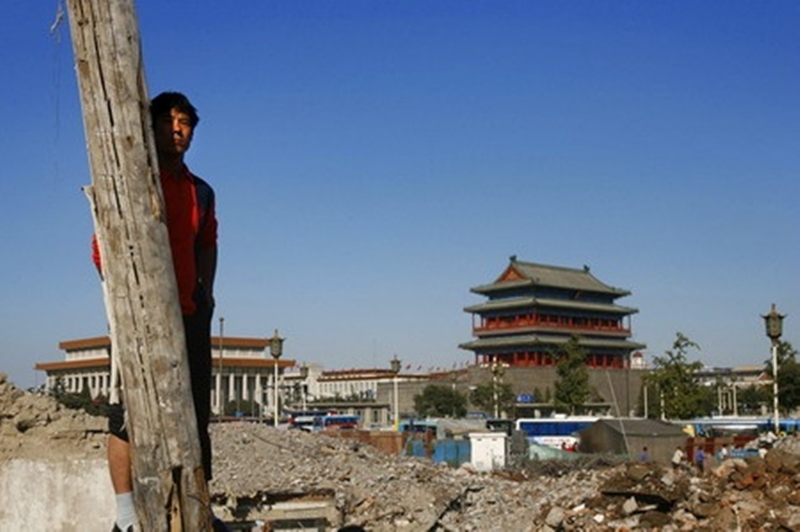 |
A foreman at a demolition site in a hutong in Qianmen, an inner-city area near central Beijing on 4/10/2006, part of the urban renewal project before the 2008 Olympic Games. *Photo: Sohu*
To meet new requirements, the city issued the Beijing Urban Master Plan for 2004-2020. This plan aimed to modernize the capital, reduce population density, increase green spaces, improve per capita housing area, and develop infrastructure.
Achieving this required the systematic demolition of 164 areas, totaling 9.34 million square meters of housing. This involved relocating 347,000 households over five years, equivalent to 69,400 households annually, with compensation valued at approximately 27,000 yuan per square meter of housing.
This made the 2001-2008 period a boom time for demolition, resettlement, and urban renewal in Beijing, leading to the emergence of the term "Sach Nhi Dai". This term refers to individuals who rapidly became wealthy due to receiving substantial demolition compensation.
Truong Luc, 34 years old, is one such "Sach Nhi Dai". He and his parents once lived in a single-story house spanning just over 11 square meters in central Beijing. In 2001, Truong’s family received notification that their house was slated for demolition as part of urban redevelopment.
At that time, Truong only recalls his parents arguing over whether to take cash or a resettlement apartment, while he played video games at a neighbor's house, unconcerned.
"Back then, my parents had no idea how to handle the situation. They didn't know how to assess land location, policy trends, urban planning, or find a house near a school like others. Our family was squeezed into a dilapidated single-story house, so they thought receiving cash was most important", he shared.
With over 300,000 yuan in compensation at the time, equivalent to 66,500 USD today, his parents borrowed extra from relatives to purchase a 100-square-meter apartment on the southern 6th ring road of the city.
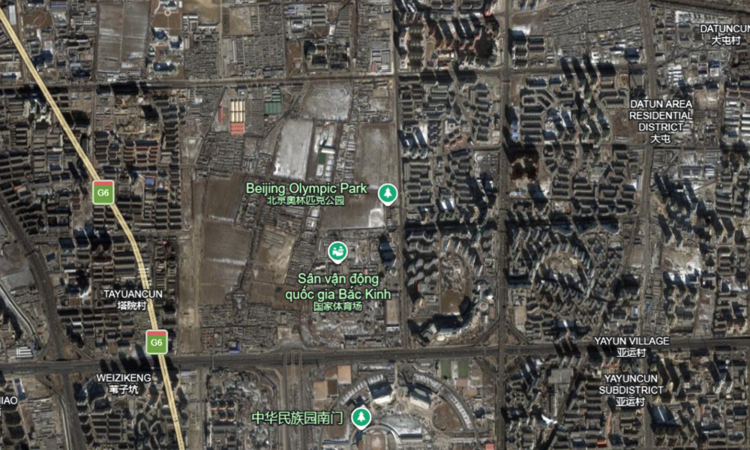 |
The Beijing Olympic Park and Beijing National Stadium area before and after construction. *Photo: Google Earth*
Beijing's housing prices subsequently soared, from an average of 4,700 yuan per square meter to over 13,000 yuan per square meter, depending on the area. A childhood friend from a similar background to Truong’s family, who was compensated two years later, received more money and purchased three apartments.
While the compensation allowed Truong’s family to buy a home, it remained their only asset. After graduating from university, he became an operations employee at an Internet company in Beijing, earning just enough for daily expenses. The two-bedroom apartment bought over 20 years ago is now considered "old and dilapidated" in the real estate market.
In March 2022, Truong lost his job. Living with his parents, he also struggled to find a girlfriend, often labeled a "mama's boy". "I might own a house worth tens of millions of yuan and have a Beijing hukou (household registration), but I still worry about making a living day and night", Truong confessed.
In 2008, Ly Phuong Hy's family in Phong Dai district received a demolition notice. She did not disclose the compensation amount but stated that after purchasing a resettlement apartment, her parents still had over one million yuan left (221,000 USD today).
"Not only did my family suddenly become wealthy, but our lives also transformed. My parents even bought a small villa in a coastal city. When I heard the news, I was shocked because our family used to be very frugal, carefully considering every purchase, let alone a villa", Ly said.
The villa also changed the family's life. Ly’s parents frequently live there and rarely return to Beijing. She lives alone in the resettlement apartment, eating meals at her paternal grandparents' house "like an orphan".
In 2022, Ly became unemployed and received pocket money from her parents. Although she does not worry about daily expenses, she is unhappy because she only sees her parents a few times a year and is concerned about their spending habits. "Now I don't even know how much of that one million yuan is left, it's probably running out soon", Ly stated.
News stories about families spending their entire substantial compensation often appeared in Chinese media about ten years ago.
In 2014, a 26-year-old man named Luu in Beijing, after receiving over 4 million yuan in compensation and a resettlement apartment, drove a car to commit robbery. He did so because he felt empty and depressed after becoming wealthy too quickly, seeking "thrills".
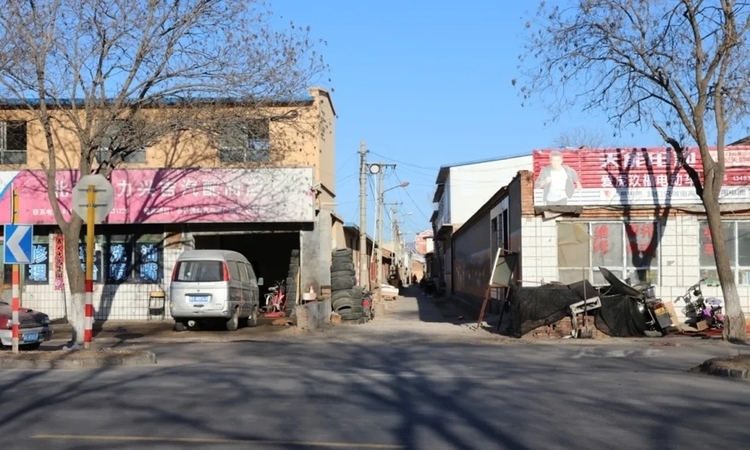 |
The nearly 70-hectare Nam Tam Thon area before (left) and after demolition, redevelopment, and resettlement with 41 apartment buildings (right). *Photo: Beijing News*
Unlike those who squandered or flaunted their wealth after receiving huge compensation, Mr. Duong, 60 years old, with a high school education, remains dedicated to his driver's job, earning several thousand yuan a month.
In 2002, when his 11-square-meter single-story house on Trieu Noi Street, on the eastern 2nd ring road of Beijing, was demolished, his family received nearly 300,000 yuan. He used this money to buy two apartments near his old home, and their value increased to nearly 19 million yuan by 2026 (nearly 2.6 million USD).
Before his house was demolished, this man, who started working at 18 years old, already owned two houses. He subsequently invested continuously in real estate, eventually acquiring six houses and other investments with a total value exceeding 100 million yuan.
He explained that coming from a poor background, he was accustomed to hardship, and therefore happy with his stable driving job. Compared to young office workers, he felt fortunate to have seized opportunities effectively.
"Many people wonder why I don't just stay home and enjoy leisure, why I'm constantly busy running around despite not lacking money. I believe people cannot be lazy and sit still; the more idle one is, the lazier one becomes", he explained.
Despite being called a "Sach Nhi Dai", Mr. Duong prefers a busy life and does not want to be idle. "I also enjoy driving, and this job helps me continue contributing to social insurance, which is very good", he shared.
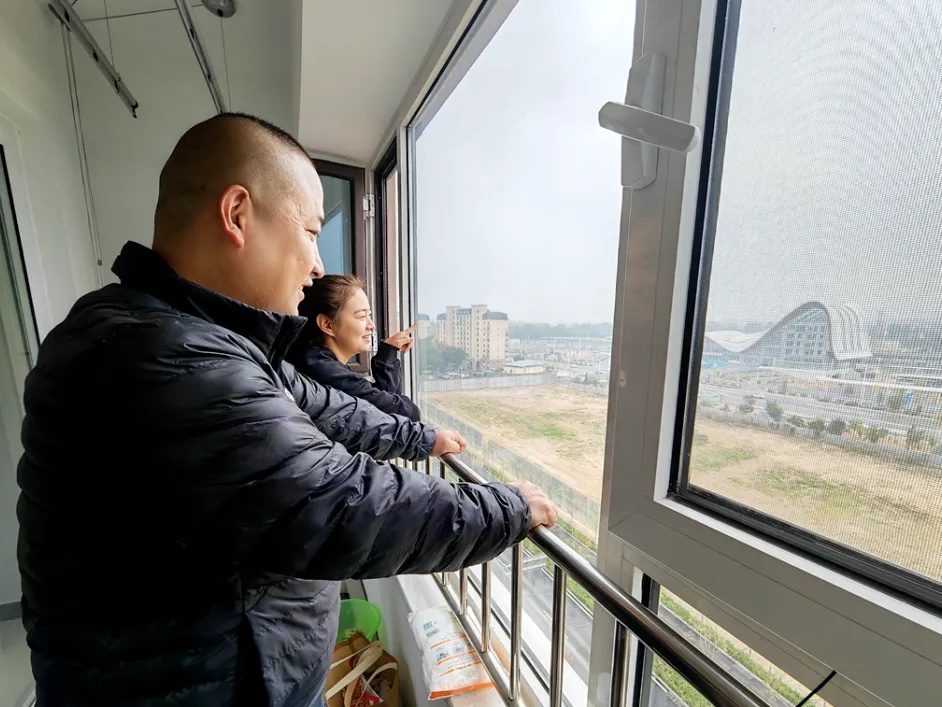 |
A couple receiving a resettlement home in Yen Khanh district, Beijing suburbs, November 2025. *Photo: Beijing News*
For Dien Dinh, her family's demolition compensation provided an entrepreneurial opportunity. Giving up her job as a sports reporter, Dien and some friends opened a men's suit tailoring company and expanded franchise agencies nationwide.
She believes that many households receiving compensation are "workers who rose from poverty", and thus still value money, even sums they once could not have dreamed of.
"A few people burn through their compensation on entertainment and pleasure, but the majority deposit the money in banks, continuing to tighten their belts", Dien said.
This is clearly demonstrated in Ly Minh's case in Beijing. In 2006, his family received two million yuan in compensation along with five resettlement apartments for their 50-square-meter house in the city center. "At that time, several million yuan was an extremely large sum; many people had never seen that much money in their lives", Ly Minh recounted.
However, six months after receiving the compensation, Ly’s parents divorced. He lived with his mother, while his father took two houses. His father immediately quit his job, rented out houses for living expenses, but later had to sell them to repay debts incurred from stock market losses.
Ly Minh's mother, meanwhile, moved with her son to a new apartment, put the money into savings, and enabled him to study abroad in the United States. "Previously, my family could not have dreamed of having one million yuan to study abroad in the United States", he expressed.
His mother later sold the house in a distant location and added more money to buy an apartment in the core area of Hai Dien district within the 4th ring road, where China's top universities are concentrated. The value of the new house also soared over time.
"The difference between us and those born with a silver spoon is that even with significant assets, no one taught us how to spend money, or how to make money generate more money", Ly Minh said. "No one can hold onto money beyond their level of understanding, no matter how temporary their good fortune".
Hong Hanh (According to People, The Paper, Sina)