The All-Russian Public Opinion Research Center (VTsIOM), Russia's oldest and largest sociological and public opinion research organization, released a public opinion survey on 24/4. The poll, conducted daily from 13/4 to 19/4, gathered opinions from approximately 1,600 people across 80 Russian regions.
The survey results indicate that Russian President Vladimir Putin's approval rating has decreased for the seventh consecutive week, reaching 65,6%. This marks the lowest level since Russia launched its operation in Ukraine in February 2022.
Putin's approval rating surged after the Ukraine conflict began, rising from 64,3% to nearly 80% in March 2022. According to VTsIOM, this figure remained above 75% for most of the conflict, despite brief dips after Russia announced a partial mobilization in 2022.
By early March, Putin's approval rating stood at 73,3% and has consistently declined in the subsequent weeks. VTsIOM reported that the Russian president's personal trust rating also dropped from over 77% to 71% during the same period.
In the recent poll, over 24% of respondents stated they "do not trust" Putin, and more than 31% "disapprove of the government's activities."
VTsIOM did not offer an explanation for the decline in Putin's approval rating over the past two months. Last week, the Russian president urged senior officials to find ways to restart the economy after a two-month slowdown at the start of the year.
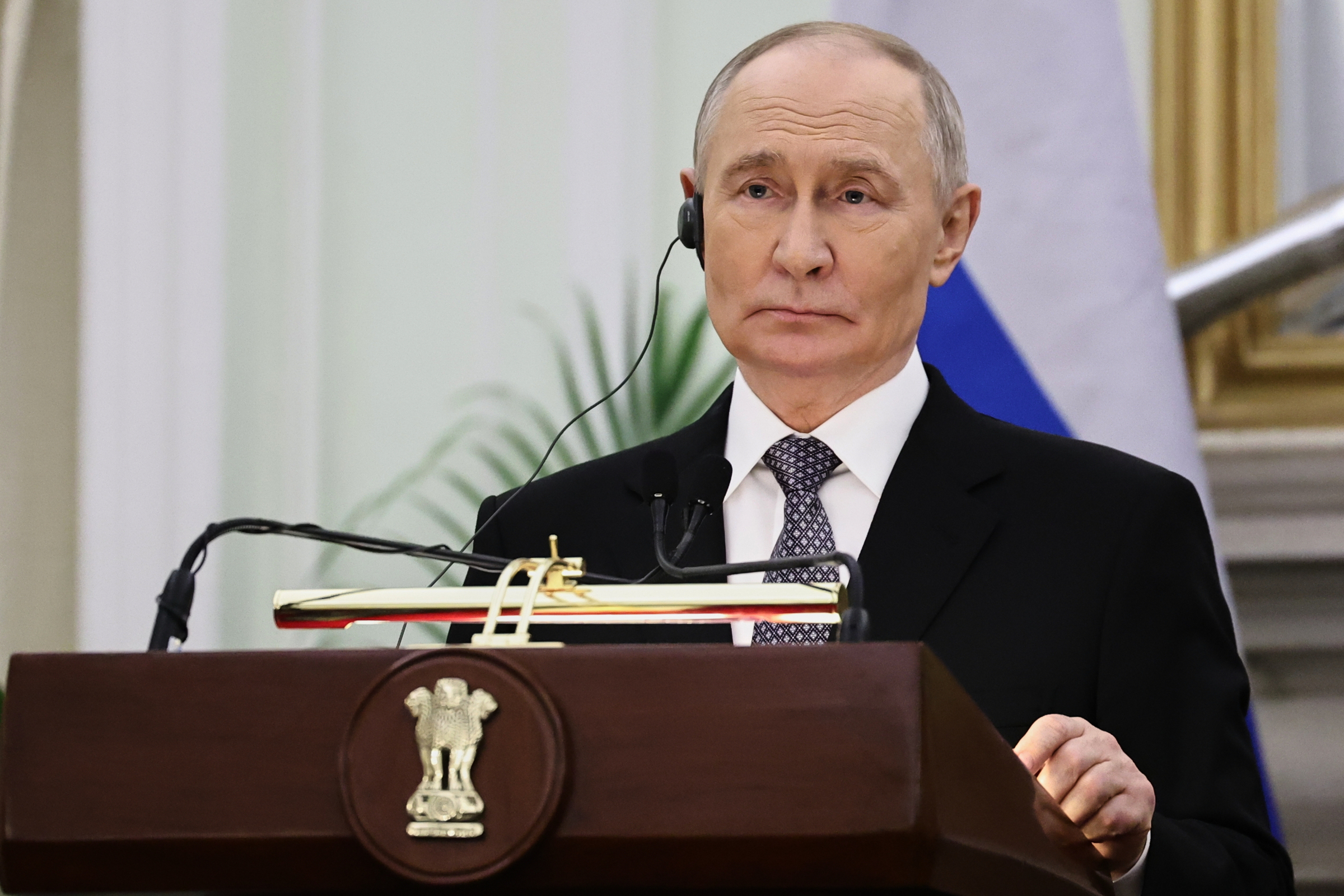 |
Russian President Vladimir Putin at a press conference in New Delhi on 5/12/2025. *Photo: AP* |
Prime Minister Mikhail Mishustin's trust rating also fell to 53,8%. In contrast, Dmitry Medvedev, Deputy Chairman of the Security Council of the Russian Federation, who often issues strong statements against the West, saw his rating increase to 36,8%.
President Putin was re-elected for his fifth term in the 2024 election. If he completes his six-year term in 2030, he will surpass Josef Stalin to become Russia's longest-serving leader since Catherine the Great. Theoretically, he could run for another term and lead Russia until 2036.
When Putin first came to power in 2000, Russia was facing a difficult period, with negative GDP growth for nearly a decade, a government constantly in budget crisis, and a small share of global GDP.
After four presidential terms and one term as prime minister, Putin has helped Russia transform in many areas. From 1999 to 2008, Russia's GDP increased by 94%, and per capita GDP doubled. Russia's share of the global economy also rose from 2% to approximately 4%.
However, Western sanctions related to the Ukraine conflict over the past four years have created economic difficulties for Russia, while military spending continues to increase.
In 2024, the Central Bank of Russia aggressively raised its key interest rate to 21% in a decisive effort to cool down an economy overheating due to military spending. This move drew criticism from business leaders, who warned that soaring borrowing costs would curb growth.
On 24/4, the central bank cut its key interest rate from 15% to 14,5%, the eighth consecutive reduction since it began implementing a loose monetary policy. This move reverses the earlier action that had raised borrowing costs to a two-decade high to curb soaring inflation.
Duc Trung (According to Reuters, Sky News, Moscow Times)