In a video released last week and analyzed by The Telegraph on 31/3, a Russian interceptor first-person view (fpv) drone plunged into a Darts series suicide drone deployed by Ukraine.
The Russian drone was equipped with two metal rods; one pierced the aircraft's left wing. The other penetrated the lithium battery pack in the fuselage, causing the Ukrainian unmanned aerial vehicle (UAV) to ignite and crash. The Russian interceptor drone appeared undamaged and could continue its search for other targets.
Russian interceptor drone uses metal rod to ram Ukrainian UAV in a video posted on 29/3. Video: X/SU_57R
This is not the first instance of such an attack, though success is not guaranteed, according to Telegraph editor Antonia Langford. Langford explained: "Some Ukrainian UAVs have wings made of polystyrene plastic or foam sheets to reduce manufacturing costs and simplify production processes, making them easily penetrated."
This method is becoming increasingly popular on the battlefield. Interceptor drones are not only using metal rods but are also fitted with trident-like tools to pierce enemy UAVs.
Journalist David Kirichenko, an autonomous systems expert at the Henry Jackson Society research institute in the UK, noted Russia has increased its use of interceptor drones equipped with metal rods over the past year.
Justin Bronk, a senior fellow at the Royal United Services Institute (RUSI), identified a key advantage of this method: the operating crew can recover and reuse the interceptor drone after each successful attack.
However, this method does have limitations. Bronk commented: "In reality, most such strikes will damage the interceptor drone itself. A direct collision also does not guarantee a high success rate in downing targets compared to detonating a warhead at close range."
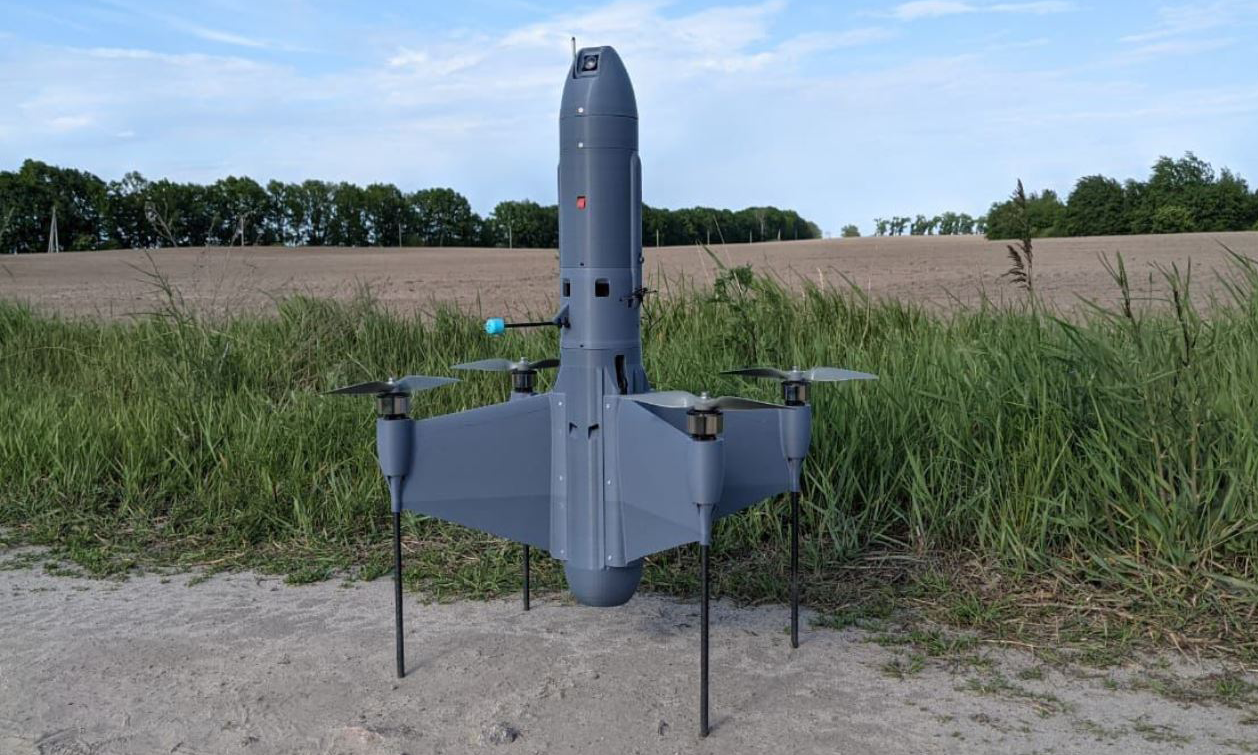 |
A Ukrainian interceptor drone model in a photo posted in 8/2025. Photo: Militarnyi
Beyond future-oriented innovations, the widespread use of drones on the Ukrainian battlefield has prompted both sides to adopt more primitive innovations to counter this threat.
In late February, Ukrainian forces in Kharkov province discovered their Backfire drone, specialized in dropping explosive warheads, had been pierced by a trident made of nails and thin steel rods. This object was launched by a Russian drone from an altitude of 800 m.
Kirichenko stated: "Both sides are experimenting with every cheap method and technology they can use to counter drones. Recently, more and more videos have shown Ukrainian interceptor drones dropping nets to disable flying Russian UAVs."
Pham Giang (via The Telegraph)