Images posted on social media last weekend show a Russian T-90M main battle tank inside a warehouse, surrounded by metal bundles welded onto a steel frame, forming a structure resembling a dandelion flower. The gaps are also covered with heavy-duty steel mesh.
This is considered the latest measure to protect Russian military equipment from the threat of Ukrainian suicide drones. The metal bundles are designed to entangle drones or damage their propellers, preventing them from crashing into the tank. They also aim to activate the drone's fuse wire at the nose, causing the warhead to detonate remotely and minimizing damage to the tank's main armor.
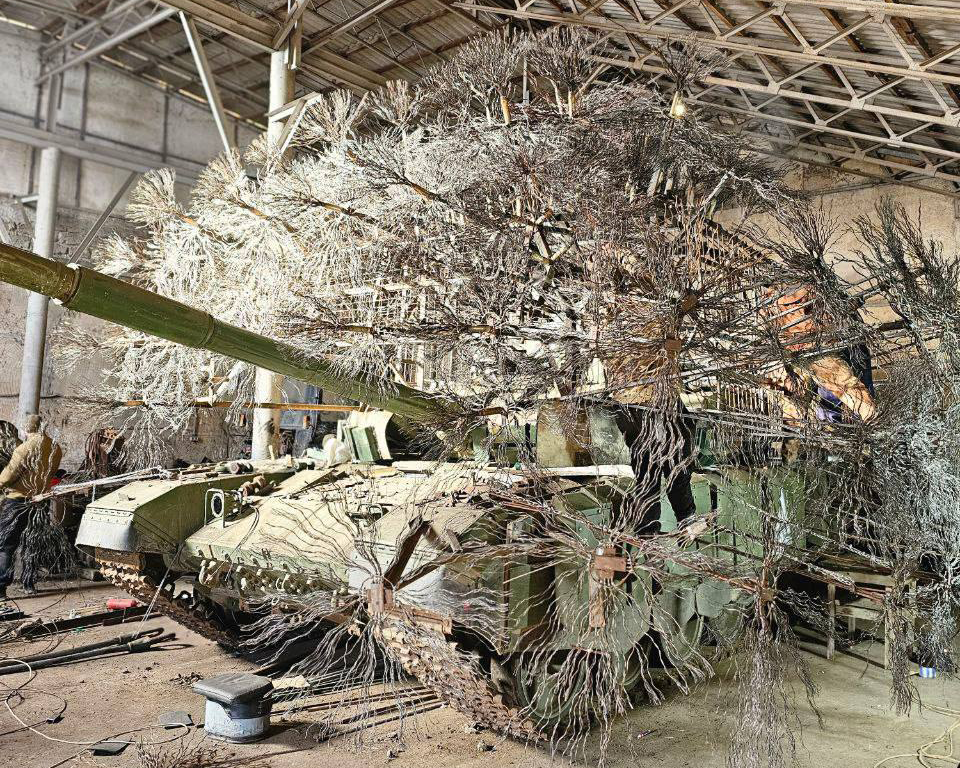 |
A T-90M tank fitted with dandelion-style armor in an image posted on 10/1. Photo: Telegraph |
According to David Axe, a writer for Euromaidan Press, "The original T-90M tank has high defensive capabilities, thanks to thick composite armor, combined with slat armor and explosive reactive armor. When integrated with dandelion armor, the T-90M will possess the best passive anti-drone defense network available today."
The Russian Ministry of Defense has not commented on the images, but the agency recently patented the design.
This is believed to be an upgraded version of "hedgehog armor", which consists of bundles of metal fibers or steel bars welded directly onto the vehicle's body. The Russian military began deploying tanks and armored vehicles with "hedgehog armor" in 5/2025, and Ukrainian forces copied this method a few months later.
David Kirichenko, a weapons expert writing for Forbes, stated, "Everything can be tested on the front lines, from spikes, chains, and iron cages to a combination of all, as long as it saves soldiers' lives. Ukrainian soldiers once mocked Russia for attaching slat armor to military vehicles, and now they are doing the same."
However, dandelion-style armor also increases the vehicle's weight, affecting its maneuverability on the battlefield.
This protection method does not make tanks invulnerable. Ukrainian forces can maneuver drones under the tank to attack the thinner armor there. Another option is to use drones to lay anti-tank mines on roads, ambushing vehicles.
Valerii Riabykh, editor of Ukraine's military publication Defense Express, believes dandelion armor cannot withstand traditional weapons like artillery shells, especially high-precision types. Nevertheless, Riabykh concedes that dandelion armor helps Russian tanks resist suicide drones, at least until Ukraine "discovers the secret of this protection or breaks through it."
By Pham Giang (Source: Telegraph)