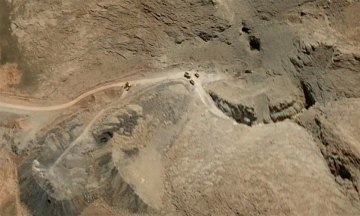
Satellite images captured by Airbus on 10/4 and analyzed by CNN on 14/4 show burned-out traces at a makeshift airfield in Isfahan province, central Iran. US forces had established this site to gather and evacuate special forces and F-15E fighter pilots during a rescue operation on 5/4.
The images show that most of the aircraft wreckage, including a MC-130J special operations transport aircraft and AH/MH-6 helicopters, at the eastern end of the 1,200 m runway, has been removed. Iran has erected an earthen berm around the wreckage site, a measure the US-based Institute for Science and International Security (ISIS) believes is to prevent external observation of cleanup and recovery efforts.
The runway itself shows a series of impact marks or mounds of earth, seemingly created by Iran to deter future use of the facility by an adversary.
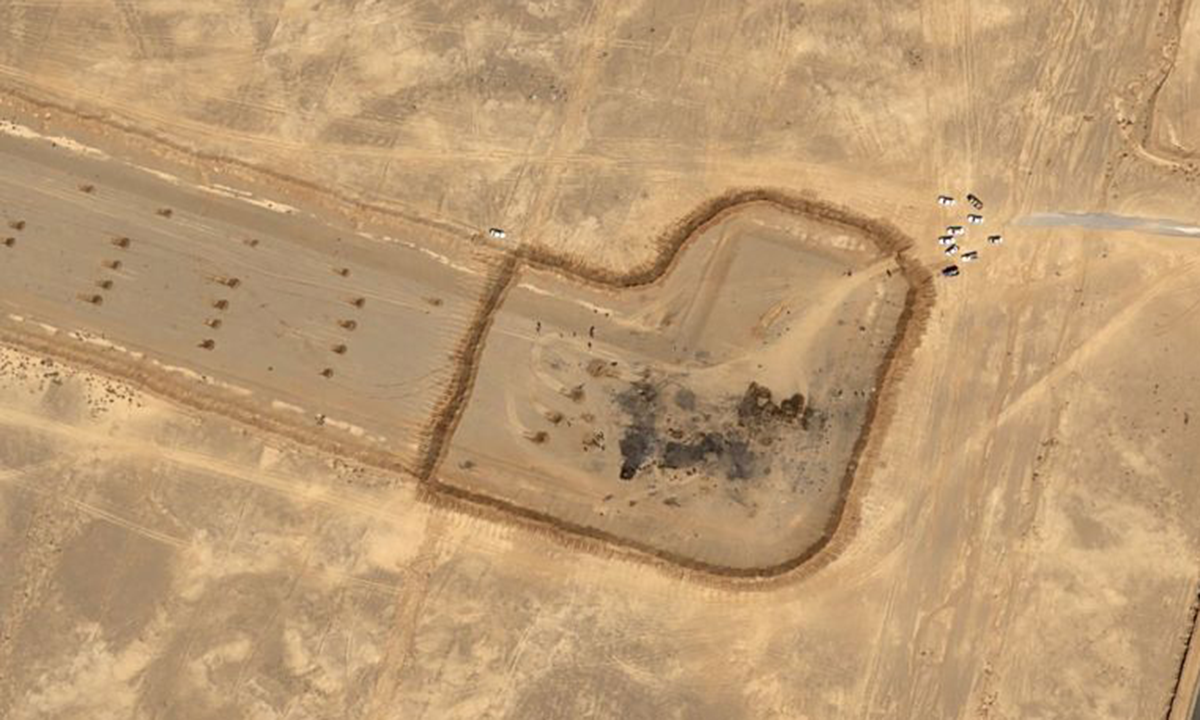 |
Satellite image of the US makeshift airfield in Isfahan province, Iran on 10/4. *Airbus* |
ISIS commented, "This is noteworthy because the runway is relatively close to the Isfahan Nuclear Complex. This action would complicate any ground operations aimed at seizing the high-enriched uranium stored in underground bunkers there."
Iranian and US officials have not commented on the images.
OSINTWarfare, an open-source intelligence tracking account on social media, previously posted a video showing Iranian soldiers next to what appeared to be a relatively intact laser transmitter component of the AN/AAQ-24(V) system. This system, also known as the large aircraft infrared countermeasures (laircm) system, is equipped on the MC-130J special operations transport aircraft.
Developed by Northrop Grumman, the laircm system can detect incoming missiles, warn the crew, and emit high-energy laser beams to neutralize infrared seekers, effectively "blinding" the munition.
A US F-15E multirole fighter was shot down on 3/4 during a combat mission in Iran. The front-seat pilot was evacuated immediately. However, the weapon systems officer in the back seat had to climb a mountainside, reaching an altitude of about 2,100 m, to evade pursuing Iranian militia. He hid in a ravine and was subsequently located by the Central Intelligence Agency (CIA).
The US then mobilized hundreds of elite soldiers and special forces, along with dozens of aircraft, to rescue the trapped service member. After reaching the target, they retreated to the makeshift airfield to board aircraft and depart Iran. However, two MC-130J special operations transport aircraft experienced malfunctions and could not take off, compelling US commanders to dispatch reserve aircraft to evacuate personnel in waves.
Reuters, citing unnamed US officials, reported that special operations units destroyed 6 aircraft, including two MC-130J transport aircraft and 4 helicopters, to prevent them from falling into Iranian hands. US President Donald Trump stated that US forces destroyed two aircraft stuck in the sand, adding that Washington used three helicopters in the rescue operation.
Meanwhile, the Iranian military claimed its forces shot down two helicopters and one C-130 transport aircraft involved in the search for the US pilot.
By Pham Giang (According to CNN, Reuters, Middle East Eyes)