Ukrainian President Volodymyr Zelensky announced on X today that the "Ministry of Defense of Ukraine and the Ministry of Defense of Saudi Arabia reached an important defense cooperation agreement. This document was signed ahead of our meeting with Saudi Crown Prince Mohammed bin Salman."
Zelensky stated that the agreement lays the foundation for future contracts, technology collaboration, and investment between the two nations.
"We are ready to share our expertise and systems with Saudi Arabia, cooperating to enhance the protection of human lives," President Zelensky said, adding, "Saudi Arabia also has capabilities that Ukraine is interested in, and this cooperation can benefit both sides."
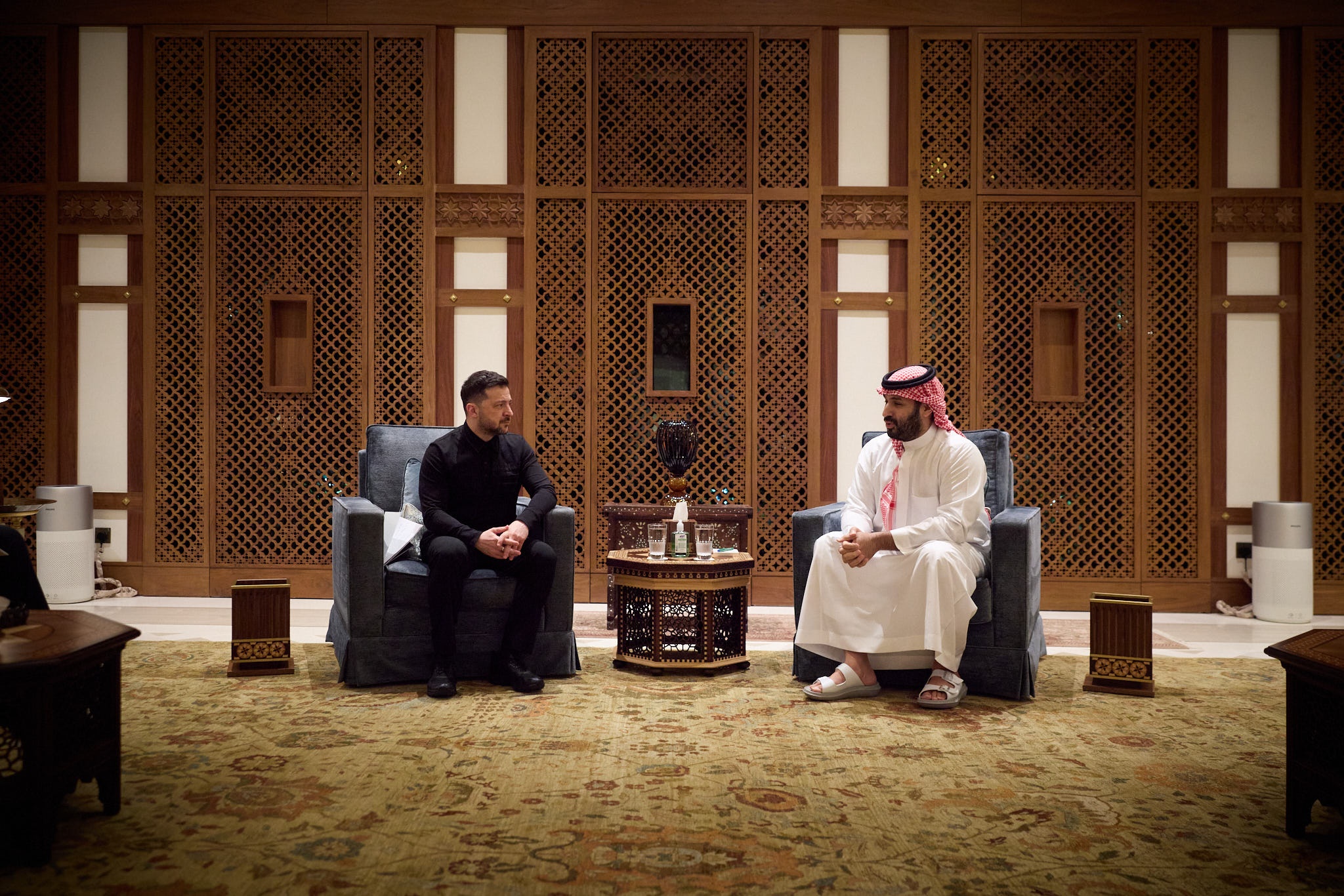 |
Ukrainian President Volodymyr Zelensky (left) meets Saudi Crown Prince Mohammed bin Salman in Jeddah on 27/3. Photo: X/ZelenskyyUa |
Zelensky arrived in Saudi Arabia on 26/3 as part of an unannounced tour of Gulf nations, aiming to garner support for Ukraine in its conflict with Russia. Concurrently, The Washington Post reported that the US is considering redirecting weapon supplies earmarked for Ukraine to the Middle East, as escalating tensions with Iran strain Washington's ammunition reserves.
Ukrainian Foreign Minister Andrii Sybiha announced today that Ukraine is nearing completion of several security agreements with Gulf nations. These agreements aim to assist the Gulf states in countering retaliatory attacks from Iran. Ukraine has engaged in negotiations with Saudi Arabia, Kuwait, Jordan, Oman, the United Arab Emirates (UAE), and Qatar, with significant progress reported in discussions with Abu Dhabi and Doha.
Sybiha expressed hope that "these documents will be signed and finalized during Zelensky's visit."
The context for these security talks stems from recent regional instability. Following attacks by the US and Israel on 28/2, Iran retaliated by launching missiles and unmanned aerial vehicles (UAVs) at Israel and various targets across Gulf nations. These targets included US military bases, ports, airports, and oil facilities.
While US and Israeli air defense systems proved effective, intercepting most of Iran's ballistic missiles, swarms of inexpensive UAVs successfully struck several targets, including energy infrastructure.
Amidst these developments, Ukraine possesses extensive experience in intercepting suicide UAVs, given Russia's consistent use of Shahed-like drones to target Ukrainian infrastructure. In 3/2026, Kyiv deployed 220 experts to several Middle Eastern countries to provide consultation on intercepting attack UAVs.
In return, President Zelensky stated that Ukraine seeks financial and technological support from the region. During an interview with Reuters, he indicated that with adequate resources, Ukraine could produce 2,000 drone interception devices daily.
Nhu Tam (According to Reuters, AFP)