When Iran targeted vessels in the Strait of Hormuz with missiles and unmanned aerial vehicles (UAVs), this vital shipping lane was nearly paralyzed. This caused alarming consequences for the global economy, as 20% of the world's crude oil is transported through the Strait of Hormuz.
"We will not allow even one liter of oil to pass through the Strait of Hormuz for the benefit of America and its allies", Iran's state television IRIB quoted a spokesperson for the country's armed forces on 11/3.
According to the Marine Traffic tracking website, traffic through the strait decreased by 90% during the crisis. The UK Maritime Trade Operations (UKMTO) reported that 13 vessels were attacked in the area since the US and Israel launched their strike campaign against Iran on 28/2.
 |
Image of the cargo ship Mayuree Naree emitting black smoke after being attacked near the Strait of Hormuz, released on 11/3. *Photo: Royal Thai Navy*
The current concern extends beyond missiles or UAVs to Iran's potential deployment of a fleet of minelaying vessels, which could render the route impassable, according to observers. An American official with access to intelligence stated that Iran began using smaller vessels for minelaying operations in the Strait of Hormuz on 12/3.
British Defense Secretary John Healey also noted that Iran might have started laying sea mines in the Strait of Hormuz. He added that the UK has several automated mine-clearing systems in the region and is discussing further options with allies.
Sea mines are among the simplest yet most devastating weapons the US Navy has ever faced, damaging more warships than any other attack method since World War II, according to a US Naval Institute report from several years ago.
They are essentially metal blocks packed with explosives, lying dormant beneath the sea, waiting for prey to pass by to detonate. They are designed to be moored, sink to the seabed, or drift with ocean currents, using contact fuses or more complex triggers such as magnetic, acoustic, or pressure sensors.
The narrowest point of the Strait of Hormuz is only about 34 km wide, and the shipping lane is even narrower, making the risk from sea mines severe. Vessels passing through have little room to maneuver, increasing the likelihood of striking these explosive devices.
"When detonated, a sea mine can break a ship's keel in half", said Scott Savitz, a naval warfare expert at RAND. "They are more powerful than missiles, and a mine costing several thousand USD can cause millions of USD in damage".
The Strauss Center at the University of Texas reported that 77% of US Navy vehicle losses since 1950 were caused by sea mines.
In April 1988, the US destroyer USS Samuel B. Roberts struck an Iranian sea mine in the Persian Gulf while escorting oil tankers during Operation Earnest Will in the Iran-Iraq War. The explosion broke the ship's keel, flooded the engine room, and caused a large fire that nearly destroyed the vessel. More than 60 sailors were injured.
Rear Admiral Mark Montgomery, a former US aircraft carrier strike group commander and now a senior fellow at the Foundation for Defense of Democracies (FDD), stated that the current situation is more complex and dangerous than in the late 1980s, given Iran's arsenal now includes numerous missiles and UAVs.
"This is an effective tool of asymmetrical warfare", said Jahangir E. Arasli, a senior research fellow at the Institute for Development and Diplomacy in Azerbaijan, referring to sea mines.
 |
Strait of Hormuz. *Graphic: WSJ*
US Central Command (CENTCOM), which oversees the 5th Fleet based in Bahrain, posted a video on X this week showing its forces destroying 16 Iranian minelaying vessels. However, experts told NPR that inexpensive contact or magnetic mines in Iran's arsenal can be deployed easily from the stern of almost any type of vessel.
Observers indicate that Iran primarily lays sea mines using frogmen on small, ordinary-looking fishing boats. These maritime militia forces are difficult to identify or counter completely.
"It's just a quiet splash", expert Savitz said about minelaying operations. "Vessels are always dropping things into the sea".
Unlike missiles or UAVs, which sailors can see or hear, sea mines are completely silent killers. Some mines are designed to bypass the first few vessels, only detonating with the fifth ship, allowing mine-clearing vehicles to pass safely, but then striking a following oil tanker.
This instills fear and uncertainty among oil tanker crews, even when escorted by warships or minesweepers. Such apprehension deters ship owners from sending their vessels through the Strait of Hormuz, even if the risk of hitting a mine is not excessively high.
For Iran, the specific damage sea mines inflict on passing vessels is less important than their primary objective: "to cause disruption" to global transport and economic activity, according to Arasli.
Anas Alhajji, managing partner at Energy Outlook Advisors, added that sea mines could also be deployed to deter a US amphibious assault.
With thousands of vessels anchored, waiting for safe passage through the strait, pressure mounts on the US to organize escort fleets.
Mine detection will be a crucial part of any escort mission. Naval vessels would follow ships equipped with detection devices, avoiding or neutralizing each mine. These devices use sonar to locate targets.
Last year, the US Navy announced a series of contracts for anti-mine equipment, including robotic mine-hunting capabilities. This was described as a "diesel-powered unmanned surface vehicle" that can be deployed from littoral combat ships.
The US currently has at least three littoral combat ships (LCS) in the Persian Gulf region. The US Navy states LCS are designed for two key missions: surface warfare and mine countermeasures. However, LCS have faced numerous technical and reliability issues, lacked sufficient weaponry for their tasks, and were vulnerable to enemy shore defenses, particularly missiles and UAVs.
"As long as Iran possesses and continues to launch UAVs and missiles, I think many commercial ship owners will consider transit through the strait too dangerous, even with escorts", said Matthew Kroenig, executive director of the Scowcroft Center for Strategy and Security at the Atlantic Council.
 |
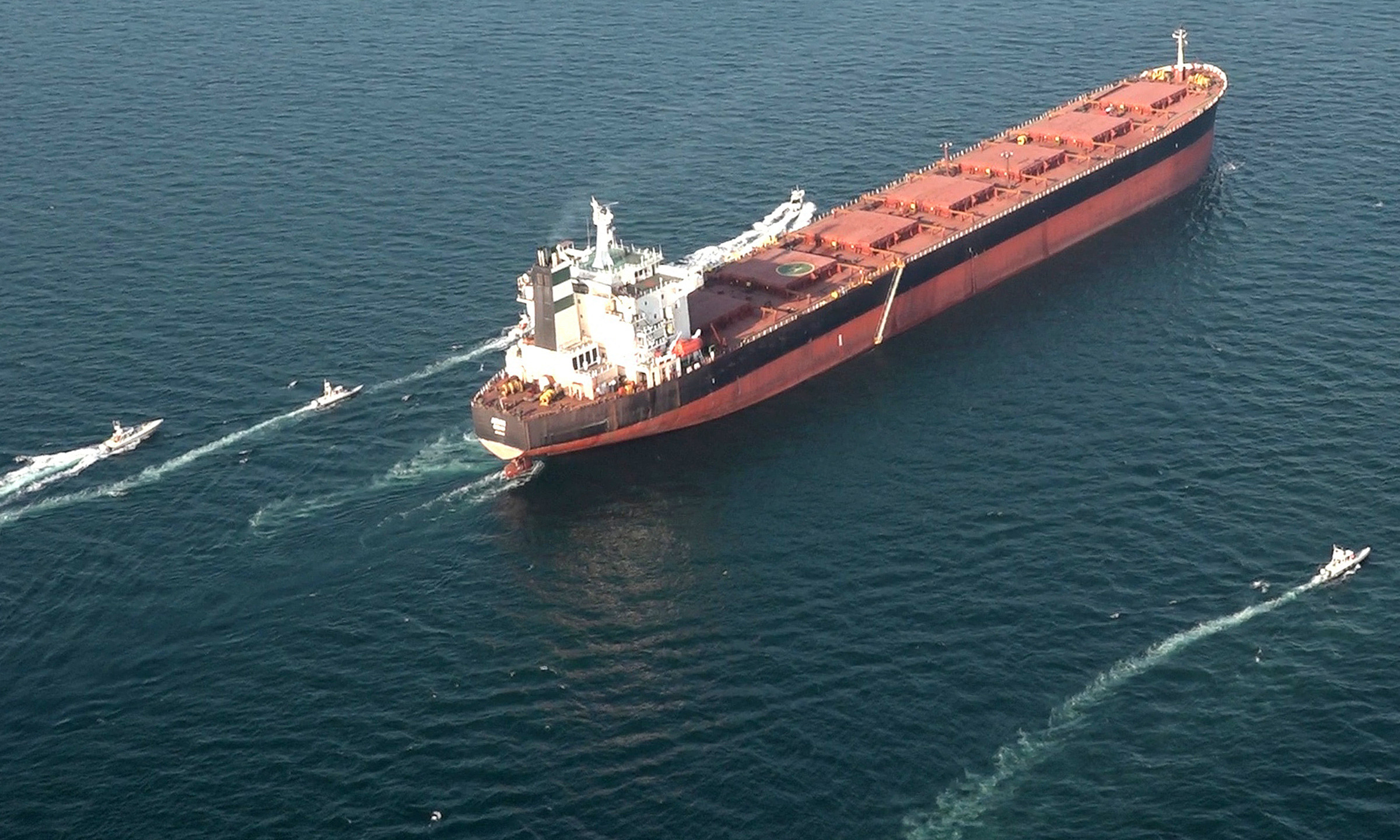
IRGC boats moving around an oil tanker during an exercise in the Strait of Hormuz on 17/2. *Photo: AFP*
Nick Childs, a senior fellow for Naval Forces and Maritime Security at the International Institute for Strategic Studies (IISS) in London, said that the US "probably hopes to deter any concentrated Iranian minelaying efforts in time". Because if Iran can lay a large number of mines, "it could take weeks or months to clear them".
Montgomery stated that the situation in the Gulf presents the White House with a dilemma. On one hand, there is political risk: the longer the strait remains closed, the greater the global and domestic pressure for President Trump to act.
But he also faces military risks. "If escort operations begin too soon, you could lose an oil tanker or a US warship", Montgomery warned.