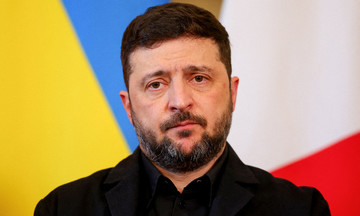
A discussion lasting over five hours between Russian President Vladimir Putin and U.S. envoys in Moskva on 2/12 yielded no breakthroughs on a potential peace agreement for Ukraine. Kremlin advisor Yuri Ushakov cited the primary obstacle as the parties' failure to find common ground on "territorial issues."
Russia insists that Ukraine must accept territorial concessions, including the Donbas region, which comprises the Lugansk and Donetsk provinces. These are two of the 4 provinces that Russia annexed in late 9/2022, though it has not fully controlled any of them. Currently, approximately 6,500 square kilometers in Donbas remain under Ukrainian control.
Analysts suggest this area is the sticking point that has deadlocked peace negotiations between the two sides. On 8/12, President Volodymyr Zelensky affirmed his unwillingness to cede Ukrainian land to Russia, despite significant pressure from the United States.
"Do we intend to cede territory? According to Ukrainian law and constitution, as well as international law, we have no right to do so. And morally, we absolutely cannot," he stated.
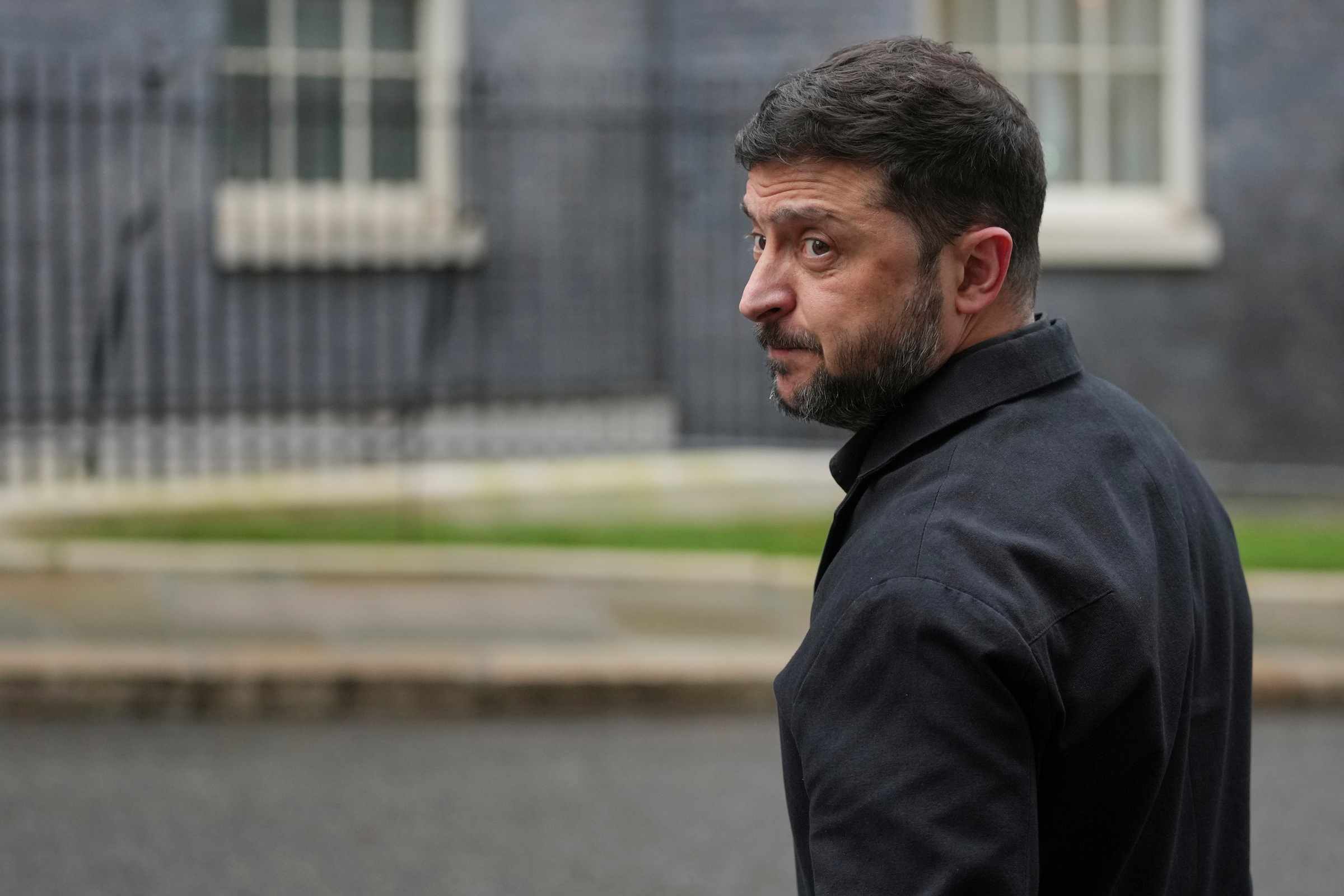 |
Ukrainian President Volodymyr Zelensky in London, England on 8/12. Photo: AP |
When launching the offensive against Ukraine in 2/2022, Putin stated Moskva's objective was to "protect Russian-speaking people who are oppressed" in the Donbas region. His statement alluded to Ukrainian government forces attacking Russian-backed separatists in Donetsk and Lugansk provinces since 2014.
In subsequent clashes between government troops and separatists in eastern Ukraine, both sides accused each other of shelling cities and civilians. Moskva claimed that the majority of local residents speak Russian, thus obligating its intervention.
Kiev, conversely, explained that in 2014, it had no choice but to respond to separatists with force to protect its territorial integrity. It also accused separatist forces of shelling cities and civilians.
The United Nations estimates that over 3,100 civilians were killed and approximately 9,000 injured in clashes between Ukrainian government forces and separatists from 2014 to 2022.
Over the past four years, Russian forces have attacked and successively captured major cities in the Donbas region, with the exception of Sloviansk and Kramatorsk. These two strategic cities have served as military centers for the Ukrainian army since 2014 and are where Ukraine has constructed its strongest defensive lines on the front.
These cities are vital to Kiev's defensive capabilities for the rest of Ukraine. The land west of Donetsk is much flatter; if the entire province were seized, Russian forces could advance further and gain more territory on the east bank of the Dnipro River.
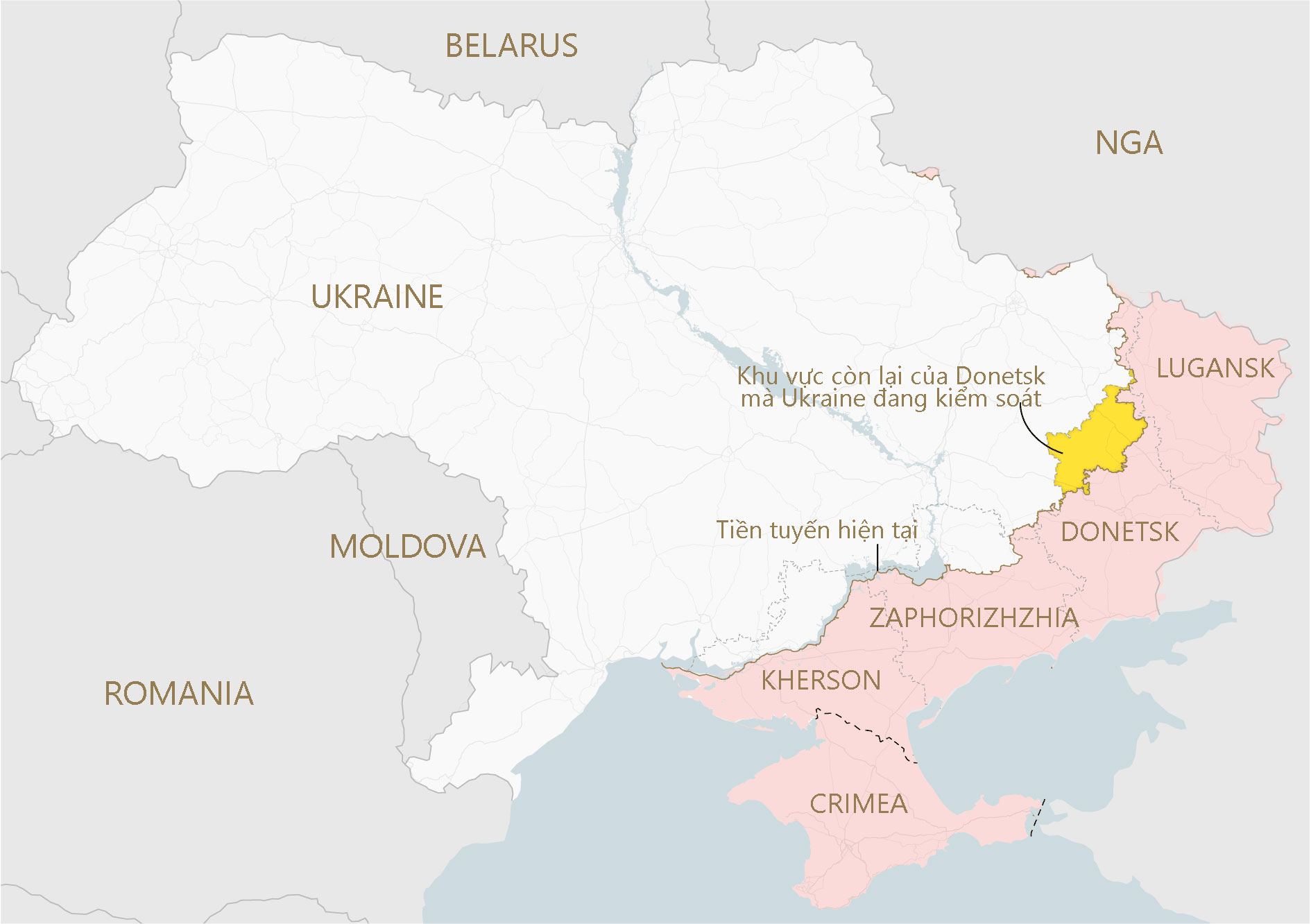 |
Area under Ukrainian control in Donetsk. Graphic: RYV |
Speaking to reporters after meeting with the leaders of France, the United Kingdom, and Germany on 8/12, Zelensky said the U.S. is urging Ukraine to "compromise" on Russia's territorial demands. A U.S. peace draft, released last month, also suggested that Kiev cede the entire Donbas region to Moskva, while Russia would also gain recognition for the Zaporizhzhia and Kherson regions it had annexed.
The draft drew strong criticism from Ukraine and European countries, who viewed it as an act of surrender to Russia. Although the U.S. has held discussions with both Russia and Ukraine to adjust the draft, the territorial issue appears to remain deadlocked.
Before his trip to India earlier this month, President Putin warned that if Ukraine does not agree to cede Donbas to Russia, his army will "liberate these territories by force."
The Institute for the Study of War (ISW) in the U.S. reported in 10/2025 that, at the current rate of advance, Russia cannot soon control the rest of Donetsk. However, ISW suggested that Russian forces could achieve this objective by 8/2027, provided their "rate of advance remains constant."
Russian military leaders expressed more optimism. Chief of the General Staff Valery Gerasimov told President Putin on 7/12 that Russian forces are maintaining momentum along the front and are striving to fully control Donbas.
 |
Donetsk and Lugansk provinces and areas Russia claims to control (red). Graphic: Telegraph |
Observers believe the future of Donetsk could shape the legacy of President Putin's and President Zelensky's terms. Putin has declared his commitment to protecting Russian-speaking people wherever they are, and controlling Donetsk will be central to this mission.
Meanwhile, Zelensky took office in 2019 with a promise to end the conflict in eastern Ukraine. Since 2022, he has been seen as a resilient defender of Ukraine, despite Russia's superior weaponry and numbers. Relinquishing Donetsk could be perceived as an act of betrayal after many Ukrainian soldiers have died and many civilians have lost loved ones due to the conflict.
Earlier this week, Zelensky emphasized that without clear security guarantees, including firm commitments from the U.S. and Europe, Ukraine's cession of land would be "very risky."
However, this firm stance faces increasing pressure from the U.S. In an interview with Politico on the evening of 8/12, President Donald Trump warned that Ukraine is "losing" and suggested that his counterpart Zelensky "will have to agree and start accepting things."
Thanh Tam (According to Reuters, WSJ, Politico)