The new research, titled "Too Hot To Live: Climate Change In Thailand" by Owen Mulhern, was introduced last weekend by Tara Buakamsri, program director of Climate Connectors.
The study highlights that 19 of the 20 hottest years on record have occurred since 2001. A concerning scenario is an annual mean temperature (MAT) exceeding 29 degrees Celsius, a condition currently found on only 0,8% of Earth's land area, primarily in the Sahara desert.
Such climate zones are projected to expand significantly due to current climate change, posing a particular concern for Thailand. Forecasts indicate that by the end of this century, Thailand's annual mean temperature (MAT) could surpass 29 degrees Celsius, matching conditions in the Sahara today.
The annual mean temperature (MAT) is calculated by averaging daily temperatures over a year at a specific location. Thailand's current MAT is approximately 26 degrees Celsius, nearing a critical threshold.
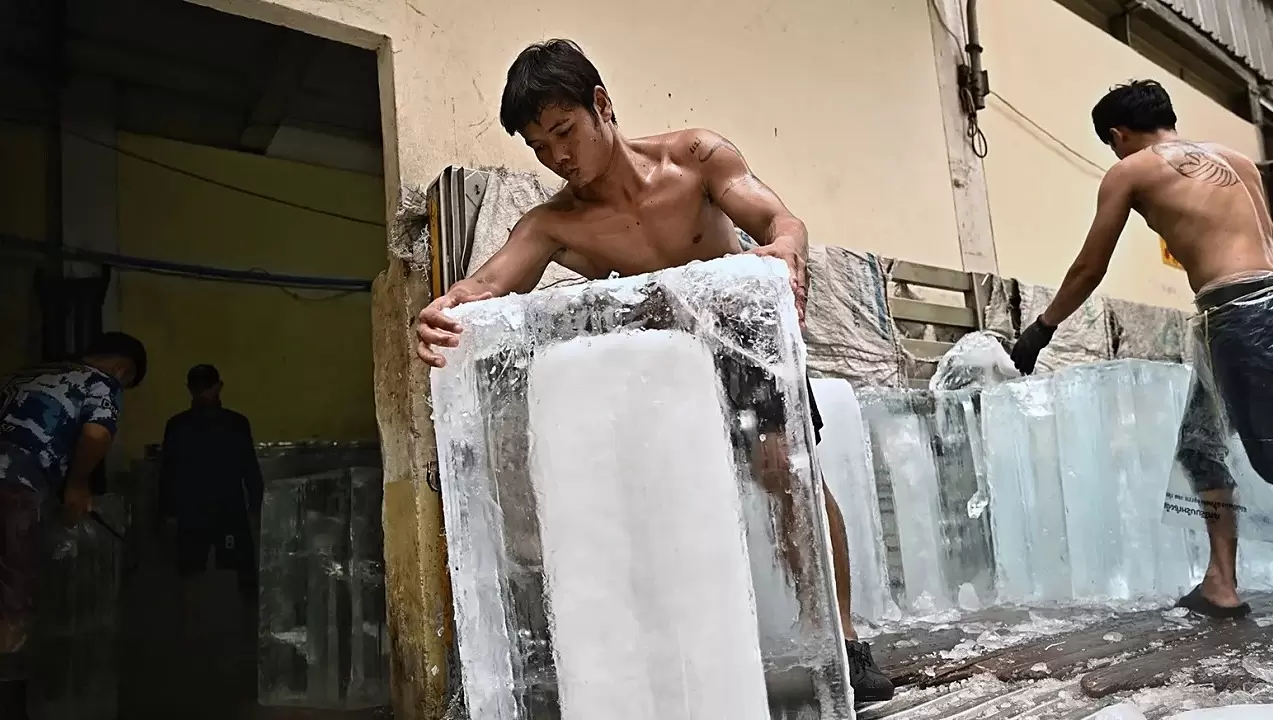 |
Workers moving blocks of ice into a storage facility at a fresh market in Bangkok in 2023. Photo: AFP. |
Workers moving blocks of ice into a storage facility at a fresh market in Bangkok in 2023. Photo: AFP.
The study introduces the concept of a "human climate niche," suggesting that historically, humans thrive best in areas with an MAT of 11-15 degrees Celsius. It argues that a rising MAT is more than just a few extra hot days; it represents a systemic shift in the climate. This creates harsh environments, disrupting the natural conditions that have supported stable life and economic development for thousands of years.
Buakamsri stated that these signs are already evident. From March to May annually, Thailand consistently records temperatures above 40 degrees Celsius. Over 50 towns and cities have reached or exceeded historical temperature highs.
In Thailand, extreme heat is accompanied by more frequent and devastating droughts and floods, along with sea-level rise threatening coastal communities and key economic zones.
According to Buakamsri, these are not isolated pressures but overlapping climate risks, making adaptation efforts much more difficult and costly.
"Therefore," she stated, "the question is no longer simply how to cope with hotter weather, but whether Thailand can redesign its cities, energy systems, public health capacity, and economic models quickly enough to maintain resilience in a much harsher climate environment."
By Duc Trung (Sources: Straits Times, Bangkok Post, Thai Rath)