The starting whistle ignited a burst of energy, as participants propelled their chairs backward by vigorously kicking the ground. Cheers erupted, echoing through the streets as racers sped and maneuvered sharp turns.
This vibrant scene unfolded in Kumamoto city, where three-person teams competed in the office chair race. Their goal was to complete the most laps within two hours, potentially covering over 20 km.
First organized in Kyoto prefecture in 2009, this unique sport has since gained national popularity. Annually, the event takes place in 10 cities, including Tokyo, Kyoto, and Shizuoka. Even major corporations like Toyota field teams.
Tsuyoshi Tahara, the competition's founder, stated, "The most appealing aspect is its inclusivity; anyone can participate. Office workers globally face demanding schedules, and I want them to step away from their desks."
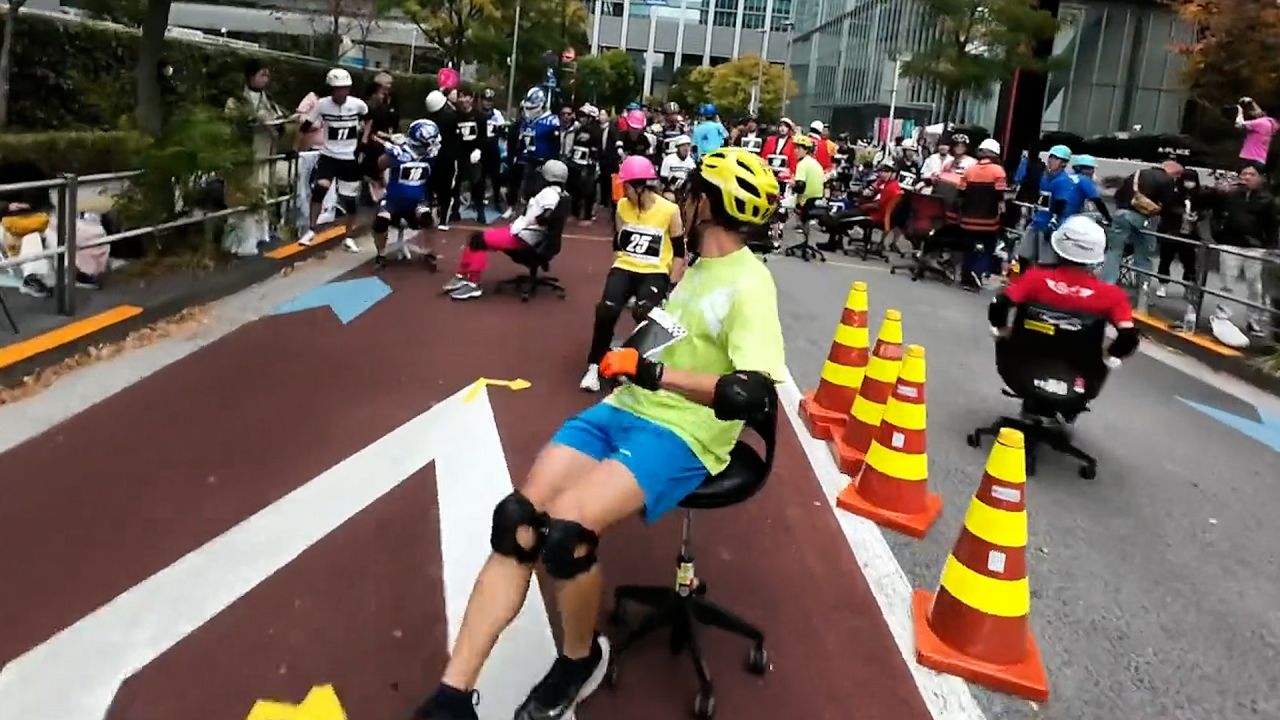 |
Racers take a corner on office chairs in Kumamoto, Japan. *Photo: CNN*
The winning team in Kumamoto receives 90 kg of rice. Prizes vary by location; for instance, the Tokyo champions are awarded 5 kg of tuna.
According to Tahara, this unusual event allows participants to reconnect with their childhood, enjoying activities they wouldn't typically experience. He added, "It also offers a reprieve from Japan's demanding work culture. Japanese people often work excessively, yet they can fully embrace and enjoy something as lighthearted as this, regardless of age."
Yasunori Miura, like many office workers, spends hours at his desk. However, in his free time, he dedicates himself to training with his office chair.
"My routine involves 40-50 laps of 200 m each, using a swivel chair at the gym", he explained, noting he trains four times a week with a weighted chair. "To surpass competitors, you need both refined technique and physical stamina."
Yasunori trains for the office chair race in Japan. *Video: CNN*
Participants must wear helmets, elbow pads, knee pads, and gloves. They are only permitted to use unmodified, commercially available office chairs.
Each course presents unique challenges. For instance, Shizuoka's rough road surface frequently causes chair wheels to jam. Miura estimates winning teams typically cover 20 to 25 km, requiring each member to complete approximately 8 km.
"Victory is unattainable if only one person trains extensively and races quickly", he explained. "All three team members must be strong, which is why we always train collaboratively."
The office chair race shares several familiar elements with Formula One (F1) for motorsport enthusiasts. Promotional materials and the event's website frequently feature imagery conveying speed, such as checkered flags and sparks emanating from chair wheels.
Office chair race in Kumamoto town, Japan. *Video: CNN*
Tahara envisions expanding the sport further, hoping to eventually bring the office chair race to the Monaco circuit. There, the global elite annually convene to witness F1 racers navigate the city's streets.
Mirroring F1, chair racers must return to a pit stop for driver changes. The event has seen participation from police, firefighters, and even members of the Japanese military.
Tahara expressed, "It resonates emotionally, fosters camaraderie, and connects people globally. Individuals of all ages can participate. This offers a unique kind of enjoyment, and we hope many will join."
Duc Trung (According to CNN, Mainichi, Asahi)