The Islamic Revolutionary Guard Corps (IRGC) announced on 29/3 that a Shahed-136 unmanned aerial vehicle (UAV) caused severe damage to a US E-3 Sentry early warning aircraft and nearby planes. This follows reports on 28/3 from the Wall Street Journal, citing unnamed US and Saudi officials, confirming an E-3 Sentry was hit during an Iranian missile and UAV attack a day earlier at Prince Sultan Air Base in Saudi Arabia, Nour News reported.
Iran's Fars News agency reinforced this claim on 29/3 by releasing a video. It showed a Shahed-136 UAV with two symbols on its nose resembling the AN/TPY-2 radar of the Terminal High Altitude Area Defense (THAAD) system and the AN/MPQ-53 fire control radar of the Patriot air defense system. The video then depicted an image of an E-3 Sentry being added to the UAV's nose.
An early warning aircraft symbol affixed to the nose of a Shahed-136 UAV in a video posted on 29/3. Video: Fars News.
Fars News further published a photo of a Shahed-136 UAV's nose listing past targets: AN/FPS-132, AN/TPY-2, AN/MPQ-65 radars, and the E-3 early warning aircraft, alongside the caption "What's next?"
Henry Bodkin, an editor at The Telegraph, highlighted the precision of the strike. He noted that "the impact point directly on the radar dish on the aircraft's back suggests a precise UAV strike, a weapon with far greater accuracy than the ballistic missiles Iran typically uses". Bodkin added that this attack indicated Iran's access to accurate target intelligence.
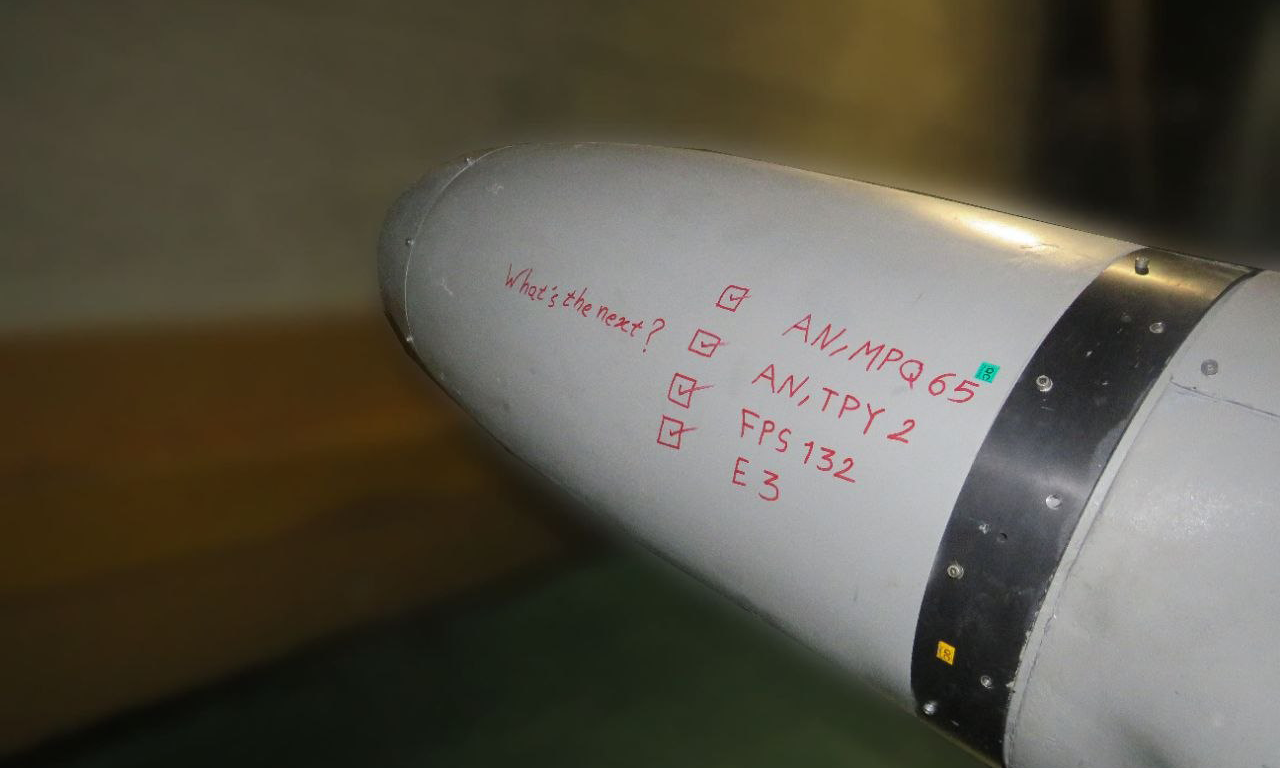 |
An Iranian Shahed-136 UAV with a list of targeted objectives in a photo posted on 29/3. Photo: Fars News.
The Associated Press (AP) reported Iran deployed 6 ballistic missiles and 29 suicide UAVs in the attack. Reuters, citing US officials, stated that besides the E-3, the assault injured 12 US service members and damaged several refueling aircraft. Satellite photos of Prince Sultan Air Base later showed the E-3 Sentry was almost completely destroyed.
US Central Command (CENTCOM), overseeing US military operations in the Middle East, has not yet commented on the attack.
The E-3 Sentry, often called an "eye in the sky" aircraft, detects planes hundreds of kilometers away. This model, derived from a Boeing 707 passenger jet, is distinguished by the large radar dish on its back.
The US Air Force once had many E-3 aircraft, but only 16 remained before the conflict, and not all were always mission-ready. The E-3 fleet's average mission readiness rate in fiscal year 2024 was 55,68%, meaning only about 8-9 aircraft could take off at any given moment. Experts warn that losing an E-3, especially one involved in operations against Iran, could degrade US Air Force battlefield control capabilities, in addition to the over 500 million USD cost per E-3G.