Vasyl, a shoulder-fired missile operator in a Ukrainian mobile air defense unit protecting the capital, Kyiv, could not hide his apprehension as he stared at the screen. A Russian Geran-series unmanned aerial vehicle (UAV) equipped with a jet engine was heading towards his position, but its altitude was outside the engagement envelope of his unit’s weapons.
"The Shahed series used to fly lower, only about 1,000-1,500 meters above the ground, and we could deal with them. Jet UAVs now fly at 4,500 meters, even up to 7,000 meters, beyond our interception capability", Vasyl stated.
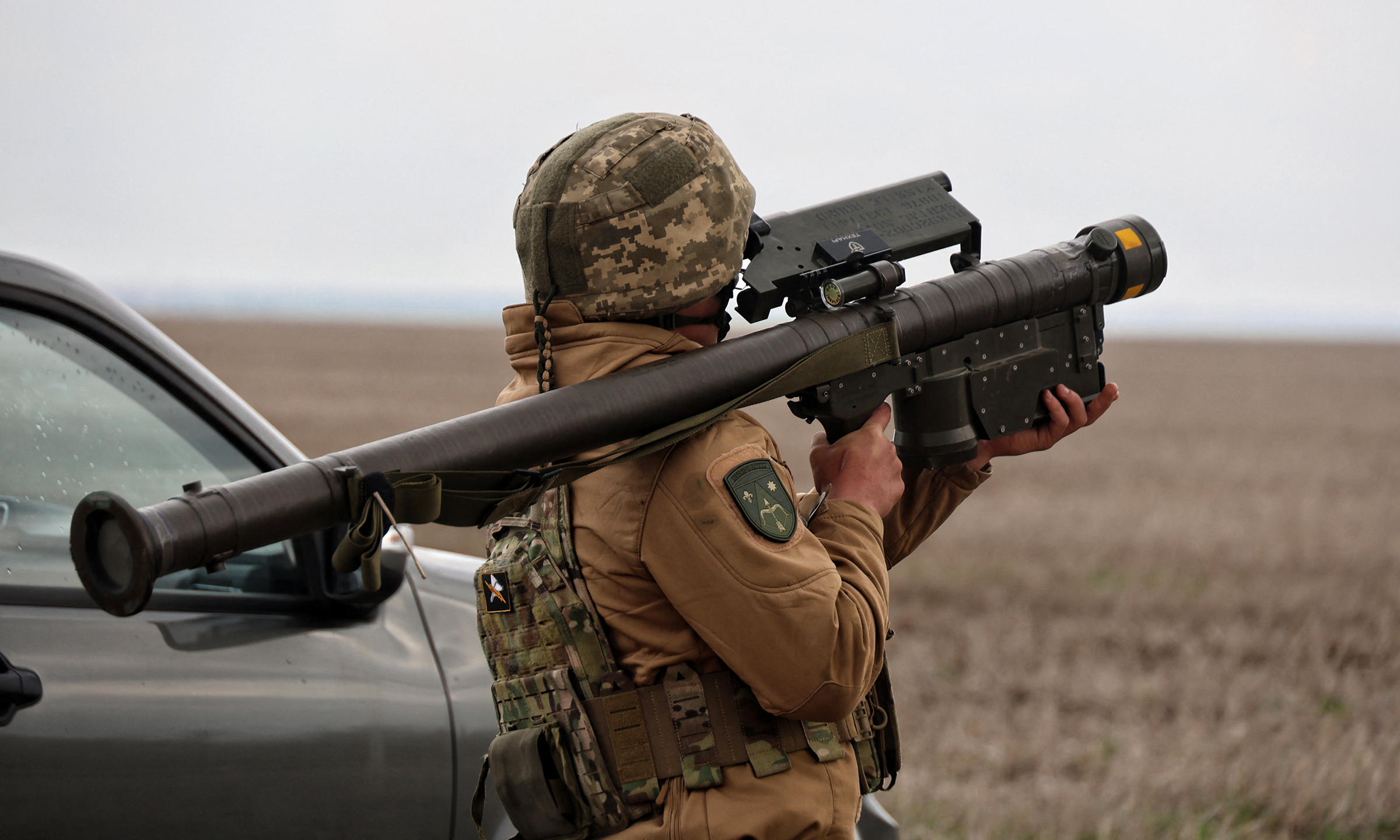 |
Ukrainian soldiers with shoulder-fired air defense missiles in Mykolaiv province in March. Photo: AFP |
Ukraine uses the term "Shahed" to generally refer to all long-range Russian kamikaze UAVs based on the Iranian-developed Shahed-136 design. However, current Geran versions are manufactured in Russia and possess superior technical and tactical features compared to the original.
The Geran-1 and Geran-2 versions use propeller piston engines, while the Geran-3/4/5 variants are equipped with jet turbine engines. The newest Geran-5 model has a design more akin to a cruise missile than the Shahed series.
The emergence of Ukrainian interceptor drones is believed to be the reason Russia developed jet-powered Geran variants. While these have a shorter range than their propeller-driven counterparts, they boast superior speed and cruising altitude, allowing them to bypass most of Ukraine’s low-altitude air defense systems.
Geran-4/5 variants are more expensive than the Geran-2, yet still significantly cheaper than specialized cruise missiles. These newer Geran versions also feature upgraded guidance systems, electro-optical and thermal cameras, AI-integrated target designation systems, anti-jamming satellite navigation antennas, and WiFi Mesh modems.
Serhii Beskrestnov, an advisor to the President of Ukraine on defense technology development, explained that Russian UAVs automatically attack after the operator detects and locks onto a target using the camera. He added that almost all jet UAVs Russia uses to strike Ukraine are equipped with such cameras.
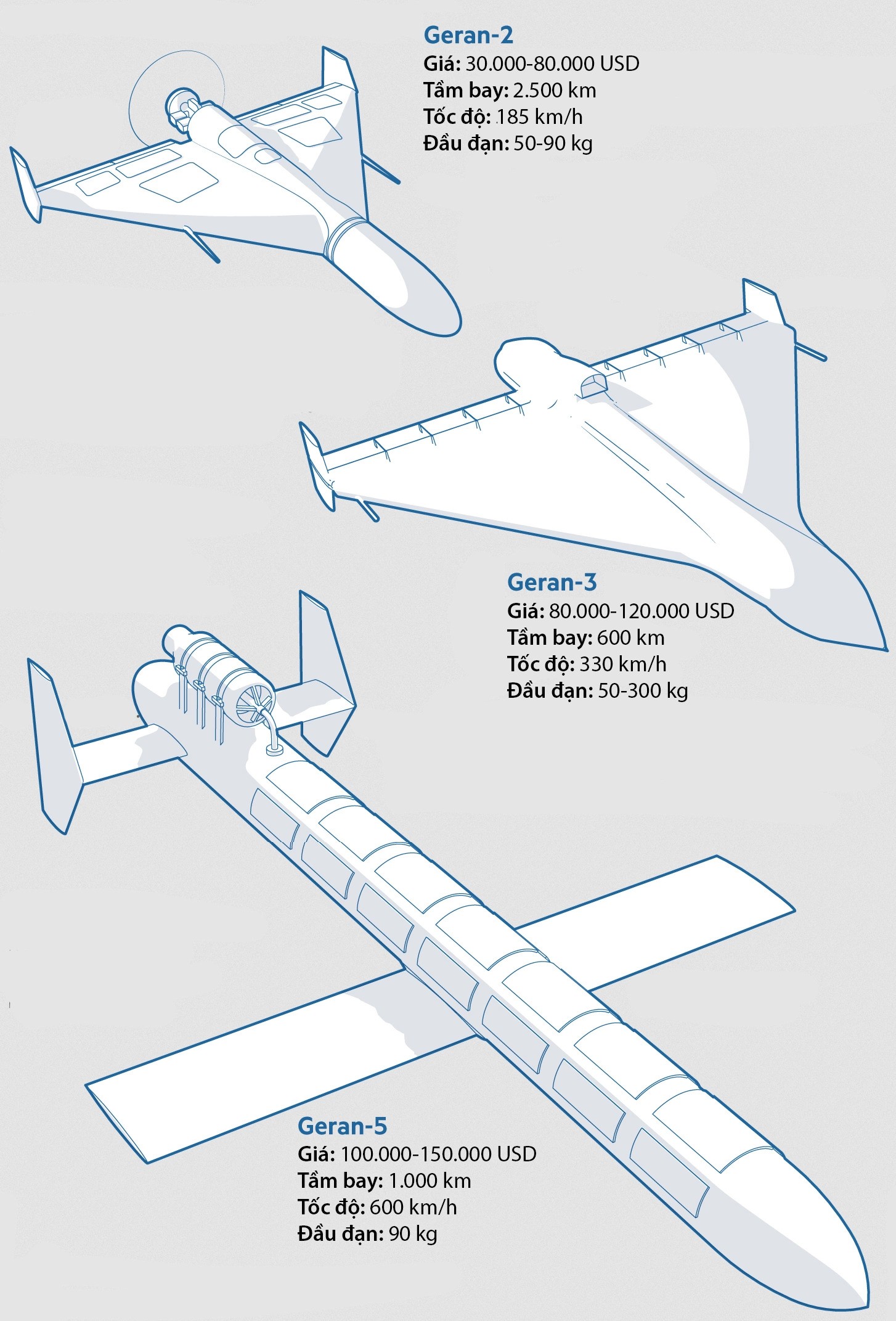 |
Russian Geran-2, 3, 5 UAV variants. Graphics: FT, H. I. Sutton |
Russia began widespread deployment of jet UAVs this summer. Hundreds of these aircraft have breached Ukraine’s air defense network, striking Kyiv and many other cities in recent weeks.
Prime Minister Sergii Koretskyi reported that Russia launched 2,100 jet-powered UAVs and 136 missiles of various types at Ukraine in the first three weeks of September. The total number of jet UAVs deployed by Russia in August exceeded 2,800 units.
Vasyl’s three-person air defense team now has only seconds to react to jet UAVs, a stark contrast to the several minutes they had with propeller-driven drones. Russia is also now launching UAVs day and night, rather than primarily at night as before.
"They want to wear down Ukraine’s air defense network. We are exhausted from being constantly on duty and getting almost no sleep", Vasyl said.
Ukrainian Air Force spokesperson Yuri Ignat admitted that Ukraine currently intercepts only about 60% of Russian jet UAVs, whereas the figure for older models was over 90%.
Low-altitude air defense cannot cope with Russian jet UAVs, forcing the Ukrainian Air Force to deploy fighter jets at a very high intensity. Some pilots must perform dangerous maneuvers to approach and shoot down targets with cannons.
Ukraine has lost several fighter jets, including F-16s and MiG-29s, in efforts to intercept Russian UAVs.
In recent months, Russia has repeatedly attacked key pillars of Ukraine’s economy, including seaports, railway systems, the steel industry, and logistics hubs. These targets are identified as locations involved in the production of UAVs, cruise missiles, or those supporting Ukrainian military operations.
The intensity of these strikes surged after Ukraine launched its own long-range UAV campaign against Russian oil refineries and commercial warehouses, hoping to inflict economic damage and pressure Russia to end the conflict.
Russia’s campaign has destroyed hundreds of thousands of square meters of warehouses and commercial facilities in Ukraine, and for the first time since the early stages of the conflict, disrupted supplies of food, medicine, and essential products.
Fedir Venislavsky, a member of the parliamentary security committee, suggested that Russia adopted new tactics as its battlefield advances slowed. He asserted that this change was "foreseeable", adding that Ukraine is striving to enhance its air defense effectiveness.
The difficult situation for low-altitude air defense, coupled with the operational intensity and losses to the fighter jet fleet, has compelled Ukraine to seek new methods for countering Russian jet UAVs. One such approach is to "fight fire with fire", developing its own jet-powered interceptor UAVs.
President Volodymyr Zelensky last weekend released a video showing Ukrainian forces using a jet UAV with a delta-wing design, similar to the Geran-2 series, to intercept an aircraft resembling the Geran-5 model. He stated that this aircraft was specifically designed to counter Russian jet UAVs.
Ukrainian officials have on several occasions claimed successful use of interceptor drones in missions against Russian jet UAVs. However, more time and funding will be needed to mass-produce high-speed interceptor drones and explore other potential solutions.
President Zelensky noted that Ukraine faces a 27 billion USD defense budget deficit this year, amid escalating war costs. Kyiv is negotiating with partners to find ways to cover this shortfall.
"I believe we will soon solve the problem of jet UAVs. However, like all other aspects of weapons procurement, everything depends on financial resources", Venislavsky remarked.
Pham Giang (According to Reuters, Business Insider, Financial Times)