In an announcement on 26/8, the US army stated that five companies have been selected to participate in the project: Antares Nuclear, BWXT Advanced Technologies, General Atomics Electromagnetic Systems, Radiant Industries, and Westinghouse Government Services.
The series of agreements, totaling $2,2 billion USD, mark a new step in the US military's Janus program. This initiative aims to integrate micro reactors into military facilities to provide electricity, reducing reliance on civilian power grids. The US army plans to deploy approximately 20 such systems across Pentagon facilities.
"These contracts accelerate our ability to provide safe, reliable, and direct power to our facilities. We are building stable power generation capabilities to deploy operational capacity globally, avoiding dependence on external power grids, which are vulnerable", said Dan Driscoll, US Secretary of the Army.
According to the US army, contractors will own and operate these micro nuclear reactors. They will only receive payment if technical requirements are met. These reactors will not supply all the electricity for a facility and will remain connected to the civilian power grid.
Representatives from participating companies affirm that micro reactors will provide a stable power source for critical infrastructure at installed bases. They can also operate for many years without needing refueling.
Jeff Waksman, US Assistant Secretary of the Army for Installations, Energy, and Environment, confirmed that none of these systems use highly enriched uranium, also known as weapons-grade uranium, and nuclear waste will not be stored long-term at the bases.
"We recognize that the US power grid could face risks if conflict erupts. Additionally, it is not always easy to transport fossil fuels to where they are needed. All critical US army infrastructure has backup sources based on liquid fuels, primarily diesel", he stated.
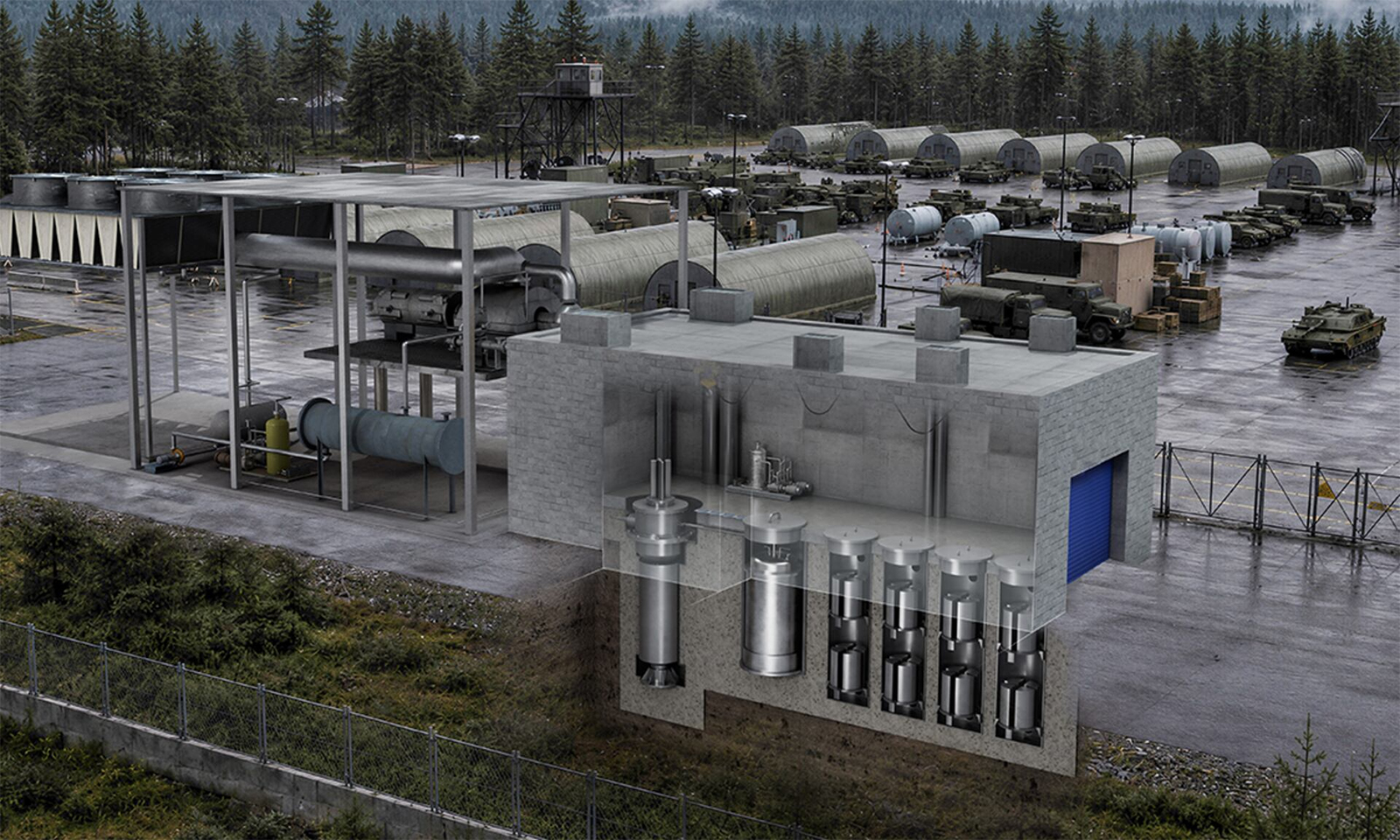 |
Simulation of a micro nuclear reactor at a US army base. Graphic: General Atomics |
According to Waksman, risks also exist outside US territory, as the country often relies on maritime transport to maintain its interests. "On many Pacific islands, we depend on fuel delivered by foreign ships and cannot be confident about this if conflict erupts", the Assistant Secretary of the Army acknowledged.
However, opponents of the program argue that building more micro nuclear reactors is too costly and poses more risks than other energy sources.
Alan J. Kuperman, an associate professor at the University of Texas's Lyndon B. Johnson School of Public Affairs, suggests that the US army "is leveraging the military's ample budget to quietly fund" companies that have failed to find private customers for their "theoretical and economically inefficient reactor types".
Nguyen Tien (According to Defense News, AP, Reuters)