During a conference in Alabama mid-week, when asked if the US military could counter an attack by a swarm of unmanned aerial vehicles (drones) originating from within the country's territory, USNORTHCOM Deputy Commander Joseph Jarrard responded definitively, "we cannot."
"We lack the necessary sensor systems. Detecting drone swarms depends on their target locations and whether we have the assets available to counter them," he explained.
USNORTHCOM, one of the 11 unified commands of the US military, is responsible for protecting the nation's territory and interests in the US, Puerto Rico, Canada, Mexico, the Bahamas, and Greenland, as well as adjacent areas. It serves as the primary defense agency in the event of an invasion of the US.
US soldiers practice shooting at simulated drone targets at Schofield base, Hawaii on 17/2. Video: US Army
General Jarrard added that the US military is not adequately equipped to handle such situations, even as drones are widely used in practice. "Drones appear daily worldwide. We must find ways to mitigate the threat, but we have not yet achieved that capability," he stated.
This appears to be the first time a senior US military leader has acknowledged a series of interconnected vulnerabilities, including a lack of situational awareness within the nation's own airspace.
General Jarrard also mentioned other concerns, such as a lack of suitable weapons to neutralize UAVs and drones, and the absence of necessary authority to deploy these assets when required.
A clear example of a drone swarm attack is Ukraine's "Spiderweb" operation in 6/2025, which targeted several strategic Russian airbases. More recently, an attack using first-person view (FPV) drones targeted surveillance radar and US helicopters at a base in Baghdad, Iraq on 25/3.
Iraqi militia drones attacked radar and US helicopters in a video released on 25/2. Video: IRI
"Such attacks highlight the risks faced by military infrastructure, critical facilities, and important personnel (VIPs) in the US. Sensitive domestic facilities have fewer defense systems and more limited surveillance capabilities than frontline areas, not to mention a lack of equivalent alert levels," noted Howard Altman, editor of the US military specialized publication War Zone.
General Jarrard stated that his units are applying lessons from Operation Noble Eagle, launched after the 11/9/2001 attacks, which completely altered the US air defense posture, while awaiting the completion of a legal framework permitting the use of anti-UAV systems.
"We are utilizing available resources such as radar and other equipment. However, this effort requires the involvement of local law enforcement, as the scope of protection extends beyond military bases, similar to the coordination used for World Cup security," he said.
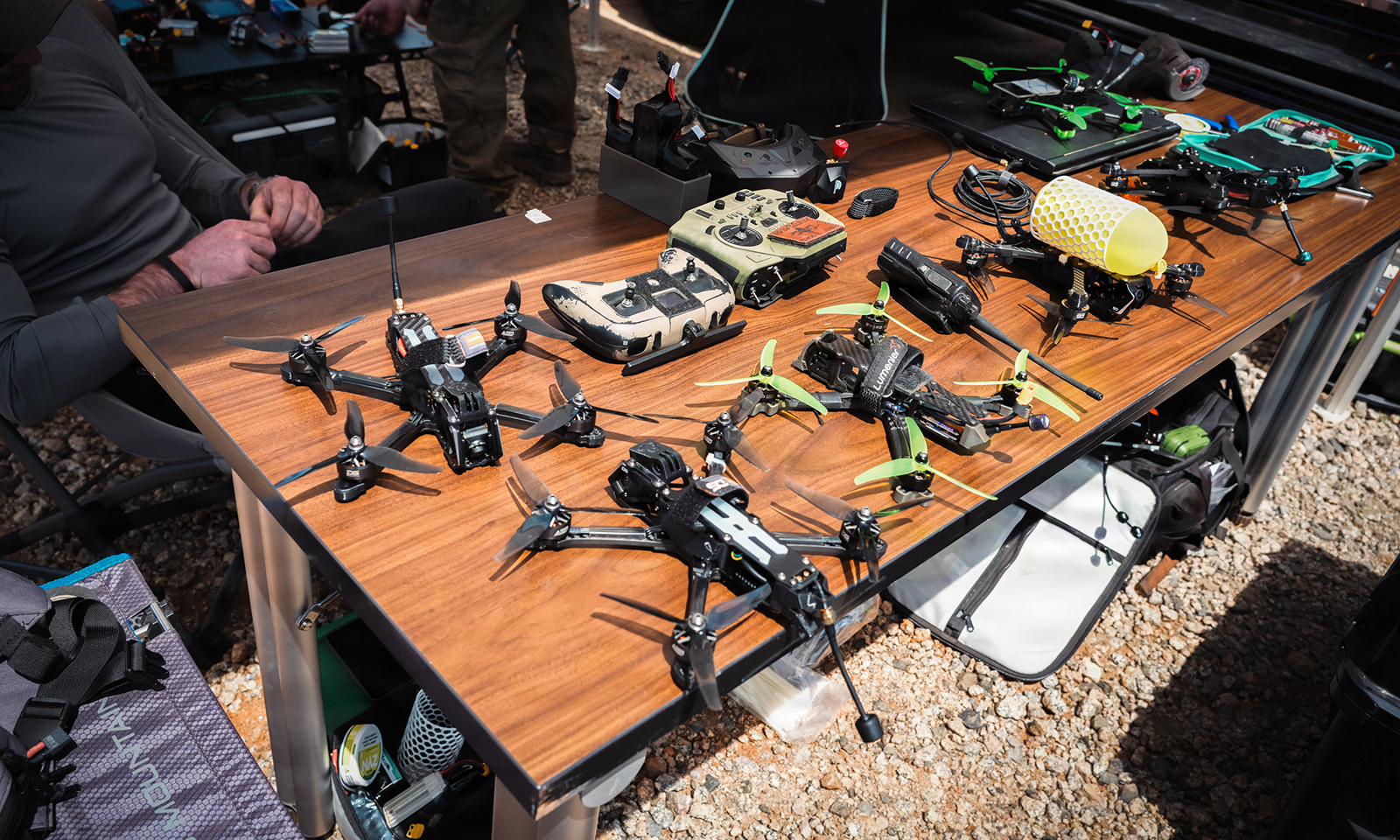 |
Drones during a test at a training ground in Ellerbe, North Carolina, US on 5/5. Photo: US Army
USNORTHCOM has deployed mobile anti-UAV/drone kits to help bases detect, identify, and neutralize small aerial vehicles they cannot independently counter.
However, these systems require complex authorization and transport processes before reaching the field. Their protection capabilities are also limited, especially against unannounced attacks like Ukraine's "Spiderweb" operation. This often means they arrive only after drones have already infiltrated a base.
Nguyen Tien (According to War Zone, AFP, AP)