"What's wrong with my leg?" The young US soldier looked down at the blood-soaked fake gauze wrapped around his knee, where his left leg was now "missing". Lying on a stretcher, eyes shut, head back, he groaned as he was rapidly evacuated from the front lines. A team of soldiers surrounded him, continuously reporting on his blood pressure, wounds, and vital signs.
Medical personnel were informed that the soldier and a service dog, lying a few meters away, were both injured by an improvised landmine. They immediately moved both into a nearby empty building, which had been converted into a makeshift emergency room. Less than one hour later, after the wounded soldier was sedated and stabilized, he was loaded into a Humvee for transport to a hospital established underground. The US hopes that these subterranean medical facilities will help them evade enemy unmanned aerial vehicles (drones) or missiles, threats that have become common on modern battlefields.
This was not a real situation but a drill at Fort Hood from 23/3 to 1/4, dubbed Operation Silver Lightning. The exercise focused on practicing new techniques derived primarily from observations of recent conflicts. The soldier was made up with realistic-looking wounds, and the injured service dog was actually a simulated robot.
This was a central part of last month's extended training organized by the 1st Medical Brigade of the III Armored Corps of the US Army. The objective was to place soldiers in a realistic scenario to prepare for future wars or even ongoing conflicts.
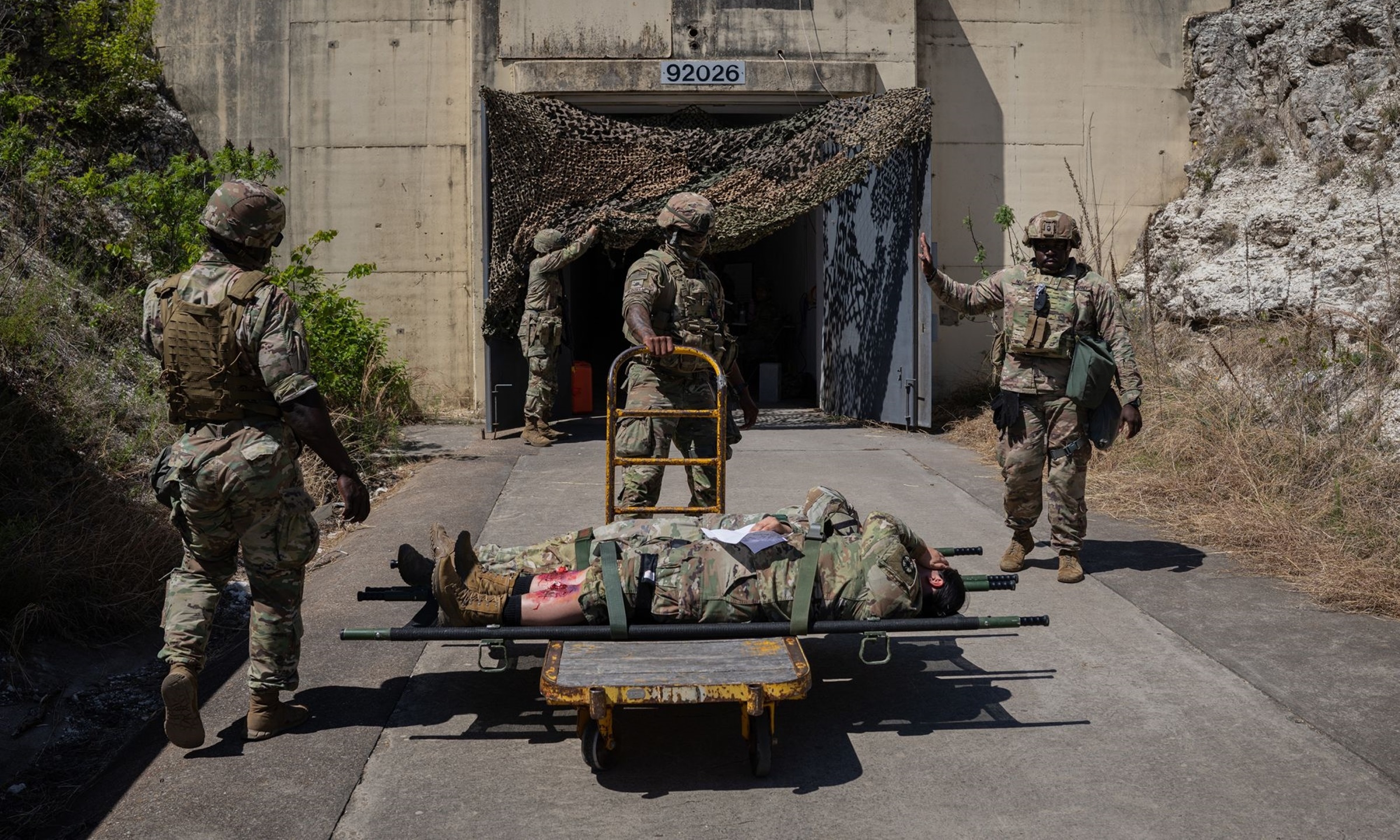 |
Soldiers from the 1st Medical Brigade use stretchers to transport simulated casualties into a simulated underground medical treatment facility at Fort Hood, Texas. Photo: CNN |
In past operations, the US military learned that rapid emergency care and evacuation from the front lines, treating soldiers within the "golden hour" immediately after injury, are critical. In Iraq and Afghanistan, large-scale field hospitals were established thanks to favorable evacuation conditions, as the US maintained near-total air superiority. This system saved countless service members, but with inexpensive drones becoming a constant threat and medical personnel increasingly targeted, the army must consider new rapid treatment methods.
During the 6-week offensive in Iran, US medical personnel had to move constantly to protect themselves and perform their life-saving duties, according to a source familiar with the matter.
"We are not going to have the advantages we had in the Middle East, primarily in Iraq and Afghanistan", said retired Major General Paul Friedrichs, who served as the command surgeon for the Joint Chiefs of Staff.
According to Colonel Werner Barden, commander of the 1st Medical Brigade, who directly oversaw the Fort Hood exercise, realities from conflicts in Ukraine and Iran show that battlefield medicine must change. Medical facilities need to be smaller and more dispersed, rather than maintaining large-scale field hospitals as before. Additionally, both soldiers and commanders must find ways to minimize electromagnetic and thermal signatures, signals emitted by machinery and human bodies that the enemy can easily track.
"In today's world, one person with one drone is enough to create a serious incident, disrupting all our operating methods", Barden said. "So, hide in plain sight".
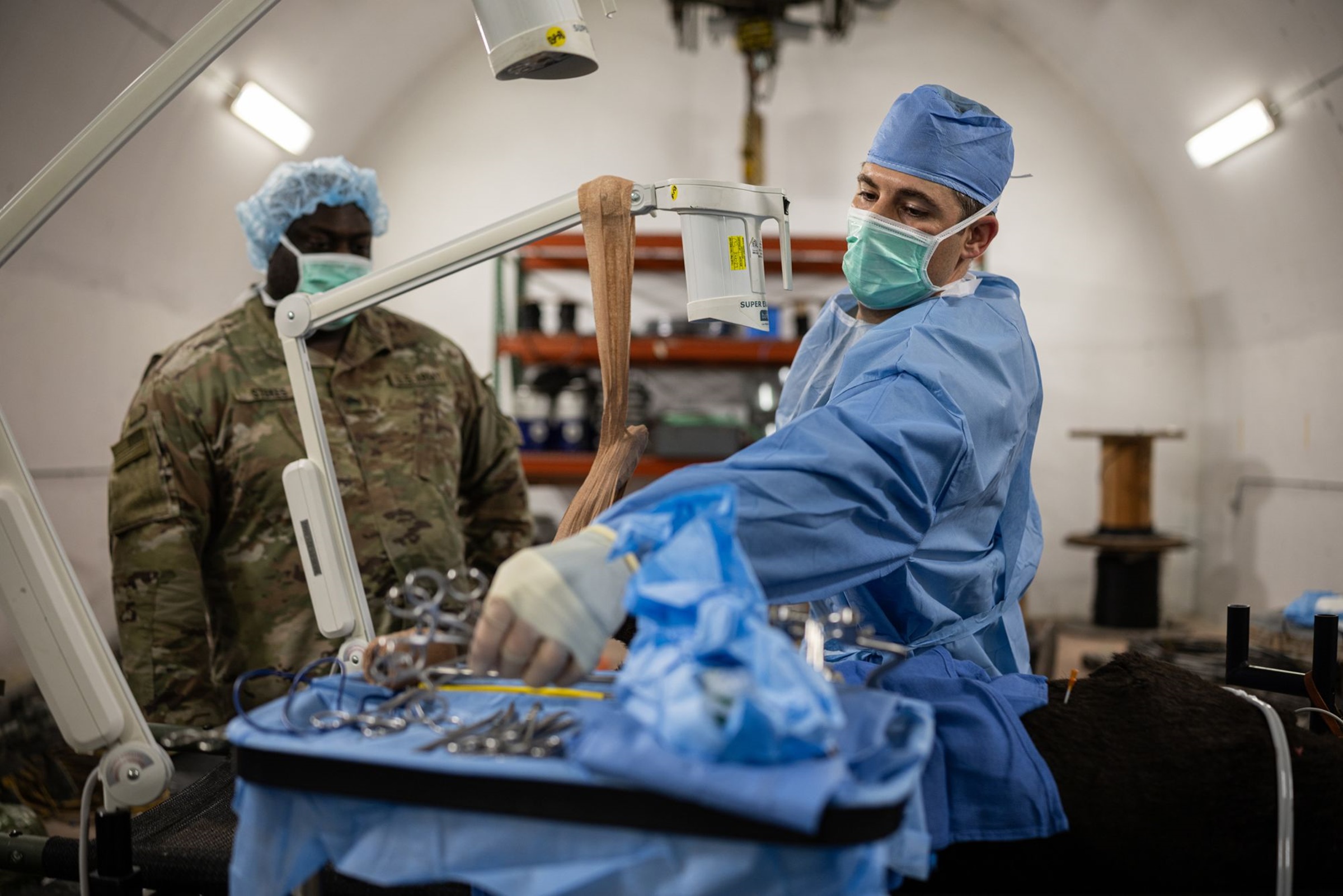 |
Members of the 1st Medical Brigade practice surgery on a simulated service dog at a simulated underground medical treatment facility at Fort Hood. Photo: CNN |
'Stealth' underground
The 555th Forward Resuscitative Surgical Detachment was the core component of the underground field hospital during the exercise, responsible for the entire emergency and operating room areas. These were not separate rooms but closely situated zones within a cramped tunnel filled with hospital beds and surgical equipment.
Lieutenant Colonel James Gragg, commander of the 555th Detachment and an emergency physician, was stationed by the operating table where volunteers playing casualties lay. Above them, a small tray held simulated organs, helping doctors practice handling trauma cases realistically.
As the medical soldiers, dressed in surgical scrubs and caps, performed a "surgery" on a patient, Gragg, with a pistol holstered at his hip, approached, holding a large syringe full of red liquid, which he injected directly into the organ tray to simulate internal bleeding.
"He's losing blood rapidly!" Gragg yelled, stepping back as the doctors rushed to respond.
The 555th Detachment is one of the army's surgical teams that typically deploy with other units to perform surgery and trauma emergency care close to the front lines during conflicts.
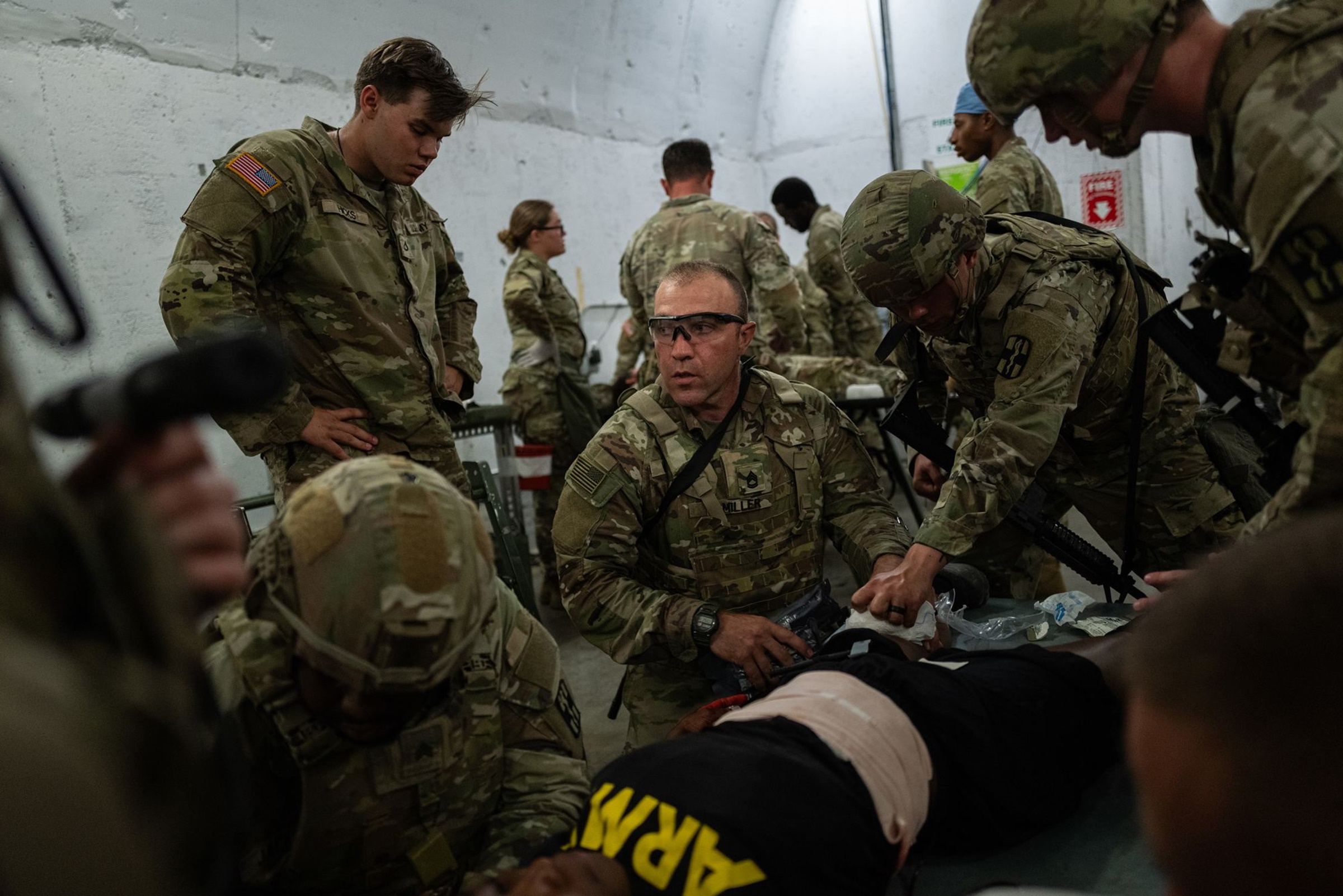 |
Members of the 1st Medical Brigade practice treating simulated casualties. Photo: CNN |
According to US military planners, unlike previous conflicts in Iraq and Afghanistan, where US aircraft could operate freely without significant risk, future conflicts will certainly face threats that make air evacuation of casualties difficult. In such scenarios, deploying units with timely medical capabilities, like the 555th Detachment, as close as possible to the front lines will be a matter of life or death.
However, this also risks turning medical forces into targets, making them even more vulnerable to continuous drone attacks. One solution the US Army is testing is to utilize makeshift underground spaces, similar to the model used in the exercise.
"In the current situation, once you deploy troops, you can encounter enemy forces anywhere", said George Barros, director of innovation and open-source operations at the Institute for the Study of War, based in Washington. "There will no longer be permanent 'green zones' of safety like during the global war on terror, because the enemy's continuous attack capabilities have evolved dramatically".
The drone threat became clear early in the conflict between the US and Iran, when an Iranian drone attacked an operational command center in Kuwait, killing six US soldiers. Although senior Pentagon officials at the time claimed the building was well-defended, a source familiar with the matter stated that the location only had concrete barriers, offering no protection against drones or missiles.
Protecting medical forces and casualties requires not only retreating underground in some cases but also minimizing electronic signatures. This poses a significant challenge in a treatment environment where soldiers need to use equipment like X-ray and computed tomography (CT) scanners. While operating underground helps limit such signals, the US Army is still working to improve this further.
US soldiers are also learning from how the Ukrainian military counters attacks from Russia.
According to estimates by the World Health Organization (WHO) in a 2025 report published by the US Army, from the start of the conflict in Ukraine in 2022 until 4/2025, there were nearly 2,000 attacks on Ukrainian medical infrastructure and 428 attacks targeting casualty transport vehicles.
"For the past 10-20 years, we've been accustomed to working in huge field hospitals. But through the most recent conflicts, it's clear we're becoming a big target", said Barden, commander of the 1st Medical Brigade of the US Army.
Moving field hospitals underground helps counter the threat from drones and missiles but also presents new challenges. At Fort Hood, soldiers tested rudimentary solutions such as using bicycles to move within tunnels to save space and old-fashioned field telephones, as cell and satellite signals cannot penetrate deep tunnel systems. However, for long-term success, the military needs to collaborate with the defense industry to invest in modern communication and medical equipment capable of suppressing electronic signals to avoid enemy tracking.
Despite the urgent need, the budget for US military medicine has stagnated for many years. In the complex budget allocation process, major assets like warships, fighter jets, or tanks are always prioritized for investment. Consequently, the development of medical capabilities is often overlooked and neglected, according to CNN.
Adjusting methods for protecting medical forces and casualties has become an urgent necessity on modern battlefields. A 2025 US report indicated that the danger from drones compels the military to prioritize the protection of medical resources.
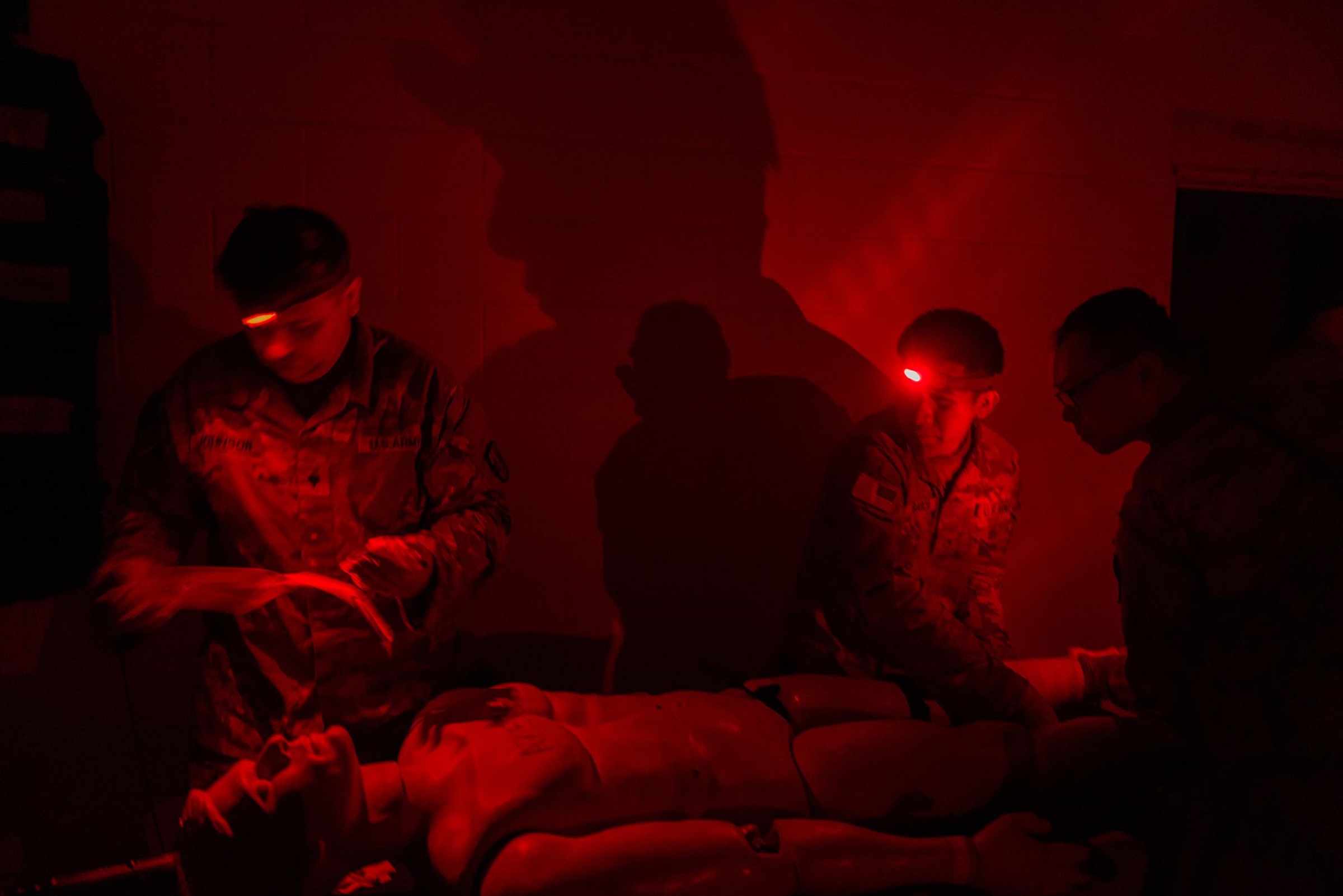 |
Soldiers practice treating casualties in the dark. Photo: CNN |
During the Fort Hood exercise, realism was paramount, with highly detailed simulated wounds, ranging from severed limbs to exposed internal organs. Those playing casualties were instructed to simulate sounds of painful groans to help medical personnel become accustomed to psychological pressure and the intensity of real-life situations.
"The more realistic training we give these medical teams, the more proficient they will be in real-world situations", said Major Kelly Wood, the officer overseeing simulated wound creation during the Fort Hood exercise.
In a training area simulating a village, soldiers from the 61st Multifunctional Medical Battalion performed casualty sorting and damage control surgery close to the front lines. In the dusty environment, everyone helped transport victims, and as night fell, they had to work under dim red lights to avoid enemy detection.
Instead of setting up open-air tents as before, the field hospital was deployed beneath an old nuclear bunker system to simulate future use of subways or basements. At the tunnel entrance, camouflage nets were strung to prevent drone intrusion.
Beyond professional skills, medical soldiers also trained psychologically to remain calm amidst the chaos of the underground tunnels. Each person had their own method to focus, from deep breathing, reminding themselves of treatment procedures, to silently singing a song to regain concentration before starting work.
"That's what I taught my subordinates, and it doesn't necessarily have to be a song", said Daniel Hurst, a combat medic and platoon sergeant with the 555th unit, who served in Iraq and Afghanistan. "Find something that helps you regain balance and clear your mind".
Vu Hoang (According to CNN, AFP, Reuters)