The Defense Innovation Unit (DIU) of the Pentagon launched the GBAM Challenge program on 27/7. This initiative aims to address the US military's over-reliance on costly long-range weapons, such as Tomahawk cruise missiles.
The GBAM Challenge seeks to develop affordable long-range precision strike weapons. Specifically, the program targets missiles with a range exceeding 1,100 km. Each product must be priced under 500,000 USD, with the complete manufacturing cost not exceeding 250,000 USD during large-scale production.
Participating companies must demonstrate the capability or a plan to achieve a production output of over 100 munitions per month. Participants are required to submit their ideas as presentations or technical documents before the 5/8 deadline.
Winners will be invited to participate in test demonstrations during giai doan 2 of the program in early November at a US government testing ground. They will have a 30-minute presentation and an opportunity to receive a cash prize of 250,000 USD.
Outstanding candidates in giai doan 2 may receive up to 5 million USD in funding to provide real-world test prototypes for the military. If eligible, they could secure additional budgets through prototype development agreements, production contracts, and grants from the Small Business Innovation Research (SBIR) program.
"The US government has allocated up to 250 million USD to support the competition, as well as subsequent activities and deployments related to the program," the DIU stated.
However, participants must also exert considerable effort to secure substantial funding, particularly given the extremely tight implementation schedule. "We seek low-cost, long-range precision strike weapons that are technologically mature, capable of demonstrating their capabilities within 60-90 days, certified, and mass-produced within 12-18 months," the DIU announced.
Beyond cost and range, GBAM must minimize logistical, training, and maintenance burdens. This implies a minimum payload of 16 kg, ideally 45 kg. The weapon also requires autonomous target identification and terminal guidance capabilities. The DIU highly values systems with proven real-world performance in GPS-denied or jammed environments. Furthermore, GBAM must not utilize specialized launchers, prioritizing remote launch capabilities and a minimal signature.
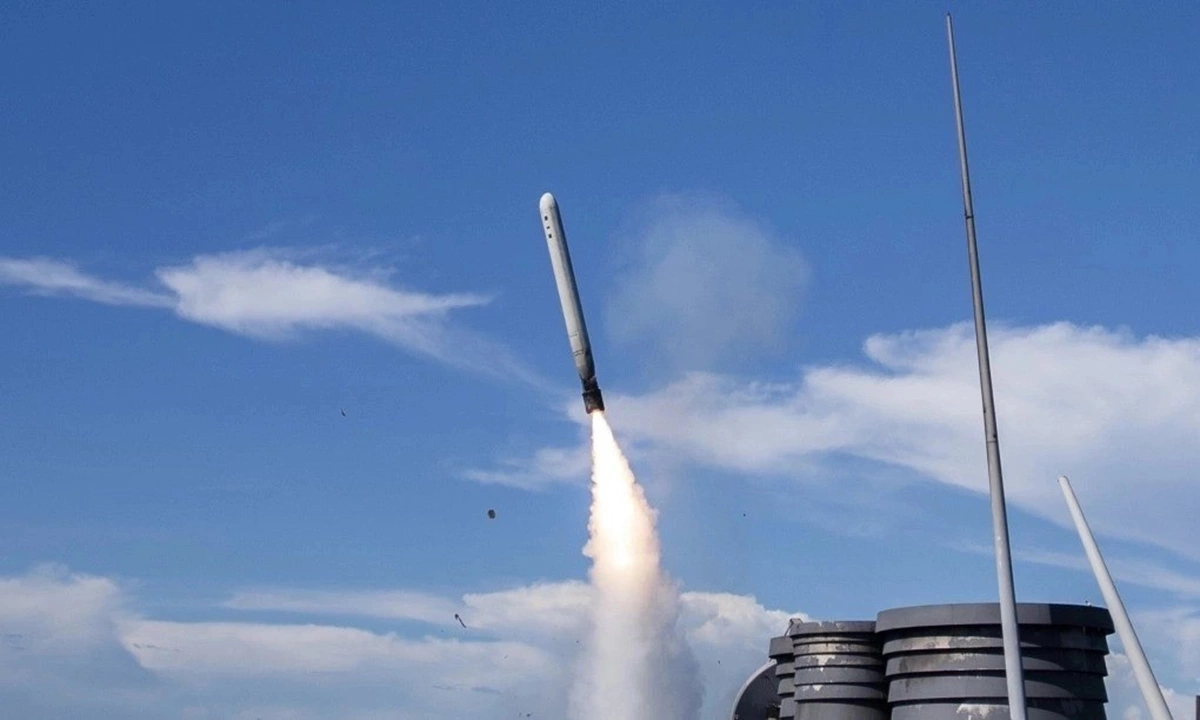 |
A Tomahawk missile launched from a US warship during an exercise in the Pacific in 2019. Photo: *US Navy* |
In addition to GBAM, the US military is developing other low-cost long-range weapons that can be mass-produced when needed. These include the FAMM-BAAR program, which aims to create cruise missiles launched from transport aircraft, and the LCCM project for containerized hypersonic weapons.
Nguyen Tien (According to AFP, Defense News, AP)