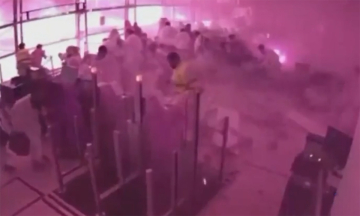
The Associated Press (AP) reported on 12/10, citing two unnamed officials in the Middle East, that initial investigation results indicate the Houthi armed group in Yemen launched a barrage of unmanned aerial vehicles (UAVs) to clear the way, then fired cruise and ballistic missiles in the attack on King Khalid International Airport in Riyadh, Saudi Arabia, on 10/10.
"The Houthis possess ballistic missiles and advanced systems equipped with warheads capable of in-flight redirection, making it difficult for patriot interceptor missiles and other systems used by Saudi Arabia," AP reported.
The investigation, beyond determining why the air defense grid failed against Houthi missiles and UAVs, also aims to understand why defense systems did not provide earlier warnings about the attack, even though the projectiles had to travel over 1,000 km to reach Riyadh.
The International Media Center, Saudi Arabia's foreign media watchdog, has not commented on the information.
King Khalid Airport has been repeatedly attacked by the Houthis over the past week, with the most severe being the attack on 10/10, which killed at least 13 people and injured over 300. This was the deadliest attack in Saudi Arabia in over a decade.
The incident exposed weaknesses in Saudi Arabia's air defense network and marked a dangerous turning point in the Middle East conflict. Hostilities erupted in the region in late February, when the United States and Israel attacked Iran, and have been expanding.
According to Asia Times, Saudi Arabia's ballistic missile defense network is primarily composed of patriot systems, with approximately 1,800 interceptors in reserve before the Middle East conflict erupted, along with a terminal high altitude area defense (thaad) system, which became operational in 2025.
At a lower tier are 10 KM-SAM Block-II batteries developed by South Korea, tasked with countering short-range ballistic missiles, cruise missiles, UAVs, and manned aircraft.
 |
A patriot air defense system launcher deployed in Mecca. Photo: Saudi Ministry of Defense |
The Saudi-led coalition announced it had intercepted Houthi ballistic missiles targeting Riyadh twice on 12/10. At least three explosions occurred in the city. Civil defense officials later stated the danger had ended.
The Yemeni armed group claimed responsibility for attacking King Khalid Airport on 12/10, warning international airlines that all airports in Saudi Arabia were unsafe, except for facilities in the two holy cities for Muslims: Mecca and Medina.
Pham Giang (According to AP)