Since receiving a batch of M1A1 Abrams tanks from Australia last year, crews from Ukraine's 425th Separate Assault Regiment "Skala" have deployed them in two operations near Pokrovsk, a key stronghold and logistics hub that Ukraine lost to Russia in December 2025.
In their first large-scale deployment, Ukraine's 425th Regiment used Abrams tanks to support units attacking Pokrovsk. A crew member, known by the callsign Kent, stated that his tank followed a mine-plowing tank, with two infantry fighting vehicles carrying troops trailing behind.
"Since tanks are priority targets, my mission was to draw enemy attention, allowing infantry to disembark. We also received orders to attack three targets along the route. We charged straight in, fired intensely, and quickly withdrew," Kent said.
The second major operation took place on 31/3, when Ukrainian forces attempted to advance and seize control of an industrial zone near Pokrovsk to prevent Russian units from reaching Grishino village, northwest of the city.
The Ukrainian army spent two weeks preparing for the operation, repeatedly using drones to scout the area and thoroughly survey difficult sections of the route, providing crews with detailed images and videos. "They knew every meter of the path," recalled a commander with the callsign Kubik.
Weather was a crucial factor, with Ukrainian soldiers waiting for fog and rain to limit the effectiveness of Russian drones. "If the weather wasn't favorable, we couldn't successfully execute operations of this type," Kubik stated.
However, four of the five Ukrainian tanks and armored vehicles were destroyed during the 31/3 operation. Kubik admitted that Russia might have had prior knowledge of the effort. "As soon as the fog cleared, Russian soldiers began using first-person view (FPV) drones to attack the Abrams tanks. We completed our mission before abandoning the vehicles," the Ukrainian commander said.
Despite the losses, which Ukrainian military experts criticized, the 425th Regiment crews defended their decision to deploy the Abrams tanks for the operation. They explained that the alternative would have been for soldiers to walk several kilometers, carrying weapons, ammunition, water, and supplies.
"That would take more time, and the enemy isn't standing still; they are advancing towards our soldiers. Drones and unmanned aerial vehicles (UAVs) operate above us every day; soldiers would be exposed in clear weather," Kubik noted.
In combined operations with infantry fighting vehicles, Abrams tanks often moved quickly to support troop transport and suppress enemy positions. Ukrainian tank crews believe this remains valuable, even if their vehicles might be destroyed afterward.
When asked if it was reasonable to use a USD 10 million tank, always at risk of destruction with each sortie, a Ukrainian commander affirmed, "Of course, it's reasonable; the most important thing is that it preserves the lives of the crew inside."
Kent believes the Abrams tank's greatest advantage is its accuracy, while its drawbacks are its bulky size and difficulty in camouflage. Kent recounted that his Abrams was once attacked by 20 Russian drones on the Pokrovsk front but survived due to additional protective measures.
"Simple improvements like rubber strips and steel cages mounted on the turret prevent drones from directly impacting the main armor, instead hitting the external auxiliary armor and detonating," the Ukrainian serviceman affirmed. Kent noted that Ukraine has not yet deployed "hedgehog armor" on Abrams tanks like Russia, but assessed that "they also protect the vehicle very well" and are an effective solution.
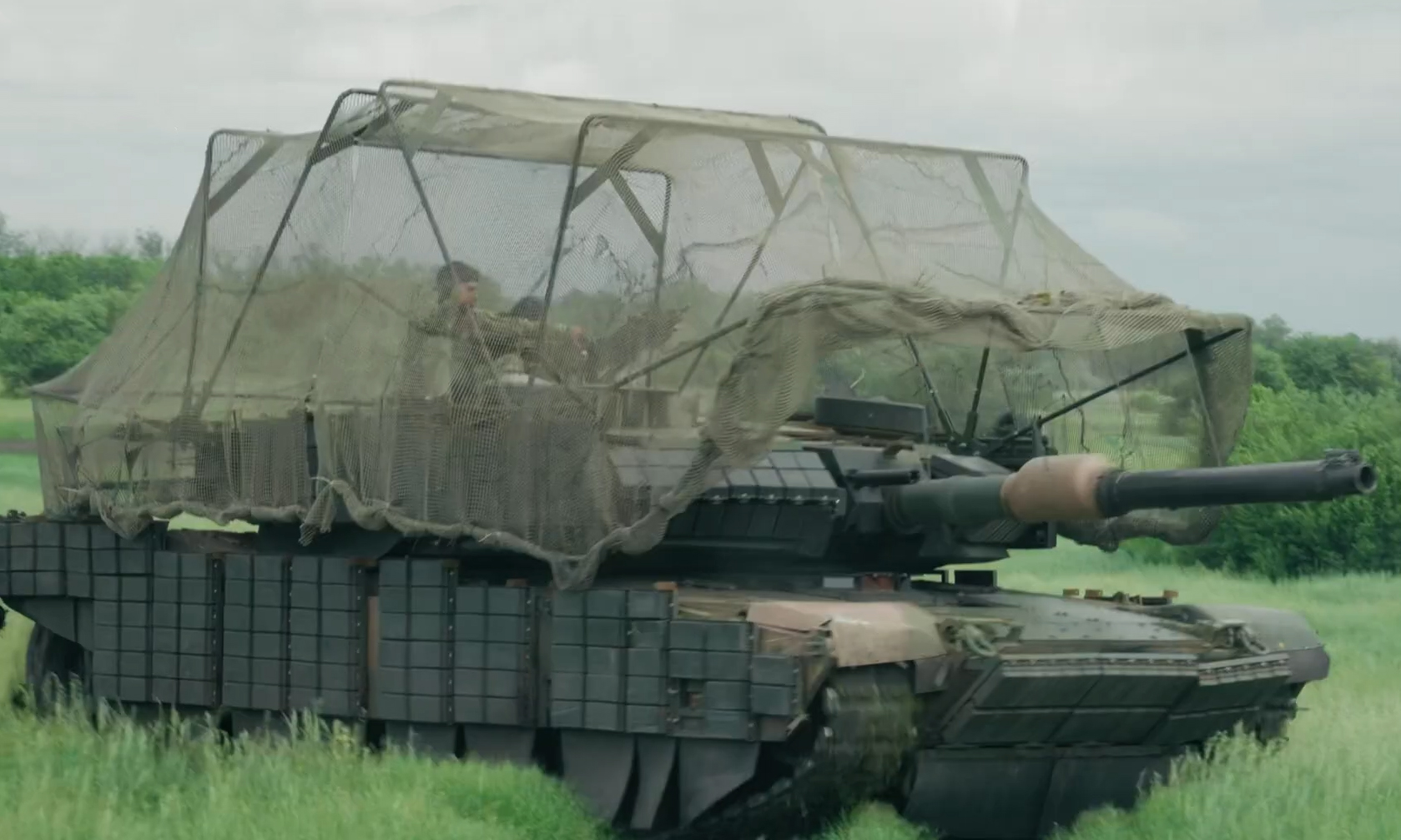 |
Ukraine's Abrams tank with anti-drone netting and Soviet-era explosive reactive armor in a photo released on 3/9. Photo: Hromadske |
One of the Abrams tank's significant drawbacks is its demanding maintenance requirements. The propulsion system is "particularly sensitive," requiring crews to inspect, lubricate, and replace components after each engagement.
The Abrams' fuel consumption is also a serious burden. Ukrainian soldiers stated that the vehicle typically consumes about 400-700 liters of fuel per engagement, depending on terrain and operating conditions. The gas turbine engine, with its strict logistics demands, is another frequently criticized feature of the Abrams series.
Ukrainian crews noted that Abrams can use various fuel types, but diesel provides the best operational efficiency per hour. The batch of Abrams tanks Australia transferred to Ukraine uses diesel instead of the standard JP-8 aviation kerosene.
The M1A1 Abrams tanks Ukraine received use older electronic systems, which are less modern than newer variants, and do not have depleted uranium armor like vehicles in the US army. However, Kubik asserted that "the current configuration is more than sufficient; the targeting system is excellent, and the cannon is also great."
Ukraine has received a total of 80 Abrams tanks, including 31 M1A1SA vehicles from the US and 49 used M1A1 vehicles from Australia.
Oryx, a Netherlands-based open-source intelligence tracker, estimates that at least 25 Ukrainian Abrams tanks have been destroyed, damaged, abandoned, or captured by Russia. The actual number may be higher, as Oryx only lists losses with visual verification.
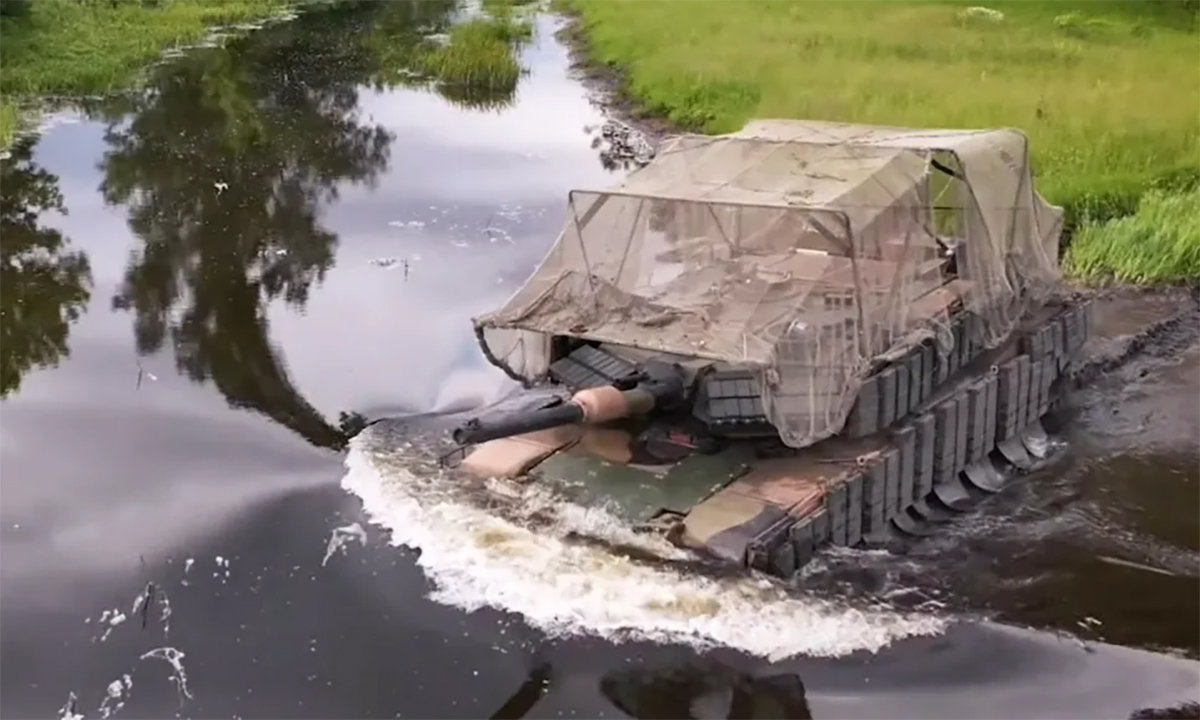 |
An M1A1 Abrams tank of Ukraine's 425th Regiment crosses a river. Photo: Ukrainian Army |
"We can no longer use them; there's no other way. Russia has developed a powerful drone warfare force, and Ukraine has no means to counter that threat," Kubik admitted.
Russian reconnaissance UAVs can quickly detect Abrams tanks on the battlefield, pinpointing them for FPV drone attacks. The constant battlefield surveillance makes camouflage efforts more difficult. This threat led the 425th Regiment to halt the deployment of Abrams tanks in combat.
However, Kubik believes the situation will change once Ukraine finds an optimal solution to counter UAVs and drones. When asked if the era of tanks has ended, Kubik definitively replied that "it has not ended." "We are lying low, waiting for the right time. Rushing to discard tanks would be foolish," he said.
Nguyen Tien (According to War Zone, Hromadske, AP)