This directive responds to a public interest matter, highlighting that while helmets are mandatory for both riders and pillion passengers on motorcycles, children often travel without suitable head protection. Child-sized helmets are rarely available in stores, leading many families to have children ride bare-headed or use oversized adult helmets, which offer inadequate protection.
Data presented to the court reveals that children account for approximately 15% of casualties in two-wheeler accidents. Many of these cases involve severe head injuries, such as traumatic brain injury. The court noted that these injuries are often linked to improper helmet use and that children are more vulnerable due to weaker neck muscles and developing bones.
Current regulations do not specify how manufacturers and retailers should address this requirement for children. Most helmet manufacturers focus on adult sizes, meaning parents willing to comply with the law often cannot find helmets that properly fit their children.
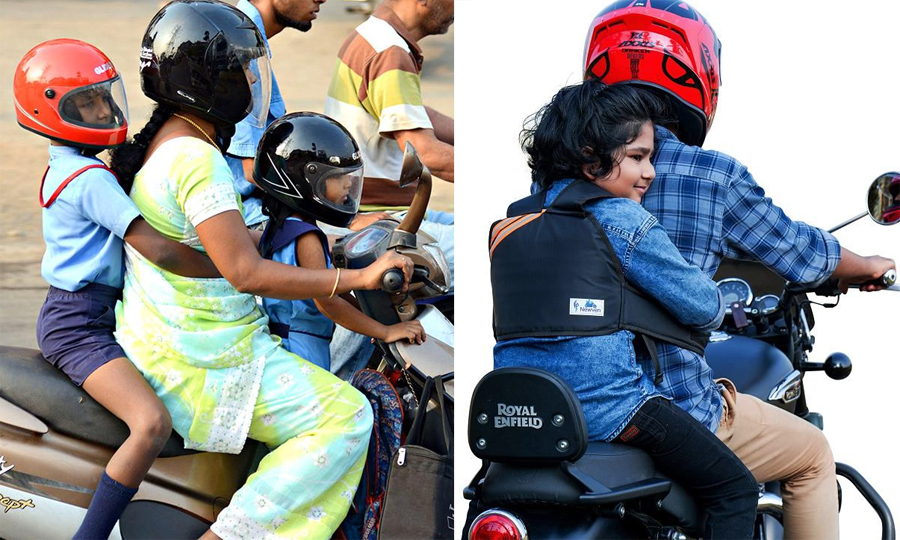 |
Appropriate helmets and specially designed safety harnesses are mandatory for children in Karnataka. *Cartoq* |
The court has instructed the state road transport authority to collaborate with helmet manufacturers, motorcycle dealers, and retail chains to ensure child-sized helmets are widely available across Karnataka. The government is also required to establish stock standards for stores, develop price guidelines to prevent speculation on safety gear, and organize awareness campaigns for parents.
The directive also mandates child-specific safety harnesses. These harnesses are designed to distribute impact forces across the body, reducing stress on the skull and spine during a collision. Unlike makeshift straps or homemade safety belts, specialized safety harnesses include: neck support, chest protection, and padding tailored to children's different body proportions compared to adults.
A significant concern raised in court was that even when child helmets are available, they tend to be more expensive than adult helmets. Specially designed helmets for children can cost 30-50% more per unit, primarily due to lower production volumes and the need for specialized tools. Consequently, the court has instructed authorities to ensure reasonable pricing. It also proposed measures such as sales subsidies or price ceilings to prevent low-income families from lacking essential safety equipment.
The directive also acknowledges that the mere availability of safety equipment will not fully resolve the issue. Long-standing parental misconceptions exist, including the belief that children seated on an adult's lap do not require a helmet or that helmets are uncomfortable for short journeys. Awareness campaigns must challenge these notions and emphasize that even low-speed falls can cause severe brain injuries in children whose skulls are not yet fully hardened.
According to *Cartoq*, enforcing this directive will require coordination among several government agencies, helmet manufacturers, dealers, and retailers. Clear enforcement mechanisms are necessary to ensure stores genuinely stock child helmets and that traffic police apply helmet-wearing regulations uniformly to both adults and children. Without clearly defined responsibilities, there is a risk that each agency will assume another is in charge.
The court referenced practices in countries such as Australia, Singapore, and several European nations, where laws mandate age-appropriate helmets for children and require stores to stock them. These examples demonstrate that such regulations can be effective when supported by proper guidelines and enforcement.
In India, Karnataka is not the first state to mandate helmets for children on two-wheelers. This regulation is part of a national directive from the Ministry of Road Transport and Highways (MoRTH), which came into effect in 2/2023. However, the Karnataka High Court's ruling addresses this issue by being the first to specifically direct that appropriate helmets for children must be made available in the market.
The court has not set a specific implementation deadline, raising questions about the pace of these changes. The long-term success of this directive will depend on the state's commitment to implementing stocking regulations, monitoring prices, raising awareness, and enforcing traffic laws. If these factors combine effectively, this ruling could significantly increase helmet use among child pillion passengers and reduce severe head injuries related to children riding motorcycles in Karnataka.
My Anh