Edmunds conducted its first series of rigorous tests on a Chinese vehicle, leading Editor-in-Chief Alistair Weaver to a notable conclusion: US automakers have valid reasons for concern.
Despite the de facto ban on Chinese vehicles in the US, Edmunds pursued testing a model due to growing US consumer interest in affordable, feature-rich cars. The Geely Galaxy M9, a long-range hybrid SUV starting at approximately 25,000 USD in China, underwent comprehensive tests by Edmunds to evaluate its driving range, acceleration, braking, and other performance attributes.
Many M9 features "surpass those found in cars we are driving in the US," Weaver stated after test driving the vehicle on Edmunds' Los Angeles track. He added, "The technology is amazing."
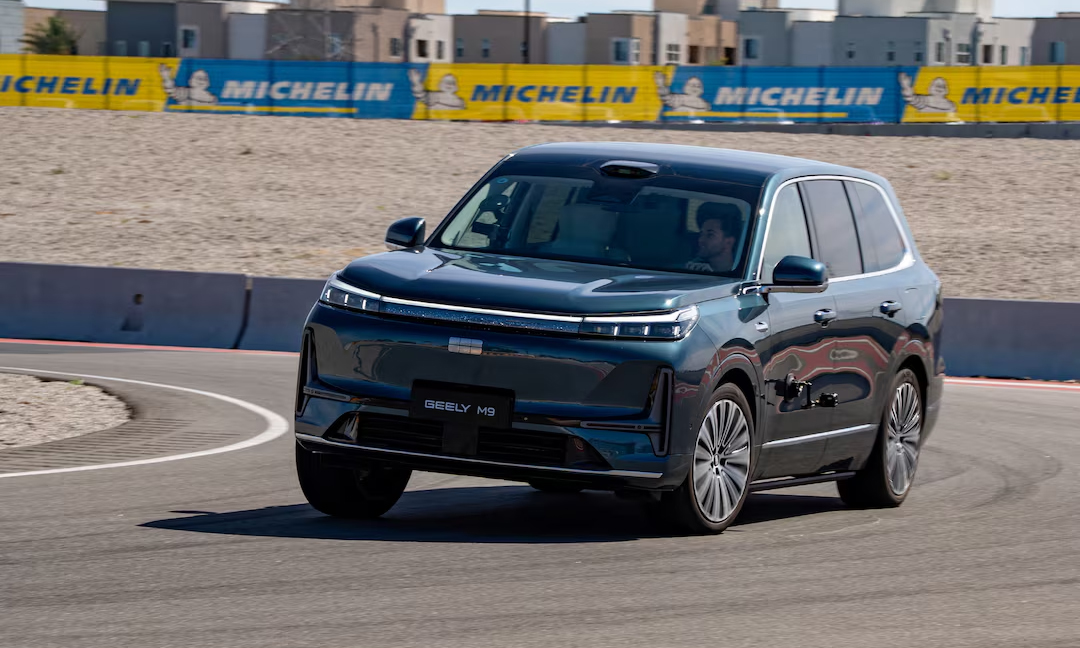 |
The Geely Galaxy M9 on Edmunds' test track. *Photo: Edmunds*
A recent Cox Automotive survey revealed increasing openness among US consumers toward Chinese-branded vehicles. These vehicles are currently excluded from the market due to regulations, lawmaker opposition, and tariffs nearing 100%. Some consumers are even considering importing Chinese models from Mexico, where they are popular, or Canada, where their presence may grow following eased trade barriers.
Geely stated it provided the vehicle to Edmunds to showcase its global technological prowess, not to facilitate US market entry.
Edmunds secured access to the vehicle after contacting Geely executives at CES earlier this year, Weaver noted. While new automobiles from Chinese brands cannot be legally imported and sold, Edmunds could lawfully borrow the car from Geely and operate it on US streets.
Edmunds staff test drove the model for approximately three weeks in daily scenarios, including supermarket runs, alongside a 227-point performance and functionality evaluation.
Research indicates the three-row Galaxy M9 SUV could rival vehicles costing twice as much, like fully-equipped Hyundai Palisade, Kia Telluride, or Toyota Grand Highlander models. While its US market price would undoubtedly be higher, Edmunds believes it would remain competitive even at double its current 25,000 USD starting price in China.
The Galaxy M9 boasts a 30-inch infotainment screen, which Edmunds found as responsive as those in Tesla vehicles. Beyond its core technology, the M9 includes conveniences often seen in Chinese cars: an integrated refrigerator, external speakers, and a fold-down entertainment screen for the second row.
The plug-in hybrid's estimated 1,300 km range significantly surpasses projections for similar products soon to be launched by US companies. Long-range hybrid models, such as the M9, feature large batteries that power them like an electric vehicle, with a small gasoline engine primarily acting as a generator to recharge the battery. Edmunds' tests showed the M9 could travel approximately 161 km on electric power alone before engaging the generator.
Chinese automakers have offered long-range hybrid models for years. Major manufacturers like Ford and Stellantis plan to introduce them in the US as an alternative to slower-selling electric vehicles.
China's fiercely competitive automotive market has compelled automakers to launch increasingly feature-rich models at low prices, according to Tu Le, founder of consulting firm Sino Auto Insights. He argues that removing these options from the US market, particularly amid rising prices, would disappoint buyers.
"We are seeing some of the most innovative products at the lowest prices, and consumers worldwide are benefiting," Le stated. He added, "Completely removing them from the market is what will upset people."
My Anh (according to Reuters)