Just one year ago, few would have predicted Toyota outselling Ford in electric vehicle (EV) sales in the US. In Quarter 1, Toyota's bZ model alone achieved sales of over 10,000 units, significantly more than Ford's total EV sales of 7,000 for the same period. The world's largest automaker currently offers four imported EV models in the US, with a fifth expected this month. US production of a new EV model will commence at its Kentucky plant later this year, followed by another model in 2027, bringing the company's total battery-electric vehicle lineup in the US to seven.
Demand for electric vehicles faced a sharp decline after the Donald Trump administration withdrew tax credits and other subsidies in 2025. However, Toyota observes a gradual recovery in sales as more buyers embrace plug-in models. The Iran conflict's impact on fuel costs also encourages consumers to consider EVs. This strategy reflects Toyota's effort to transition its dominance in gasoline-electric hybrids into a strong foothold in the EV market as it reconfigures its approach.
Toyota's aggressive rollout of a full range of EV models comes as the company grapples with robust demand for its hybrid vehicles and while many rival automakers scale back or abandon their EV ambitions. Recently, Honda scrapped plans to produce three EV models in the US and warned of a 2.5 trillion yen (15.7 billion USD) loss in its EV business. General Motors and Ford have also reduced their plans for this segment, with Tesla even discontinuing production of its Model X sport utility vehicle and Model S sedan. As others retreat, Toyota sees an opportunity.
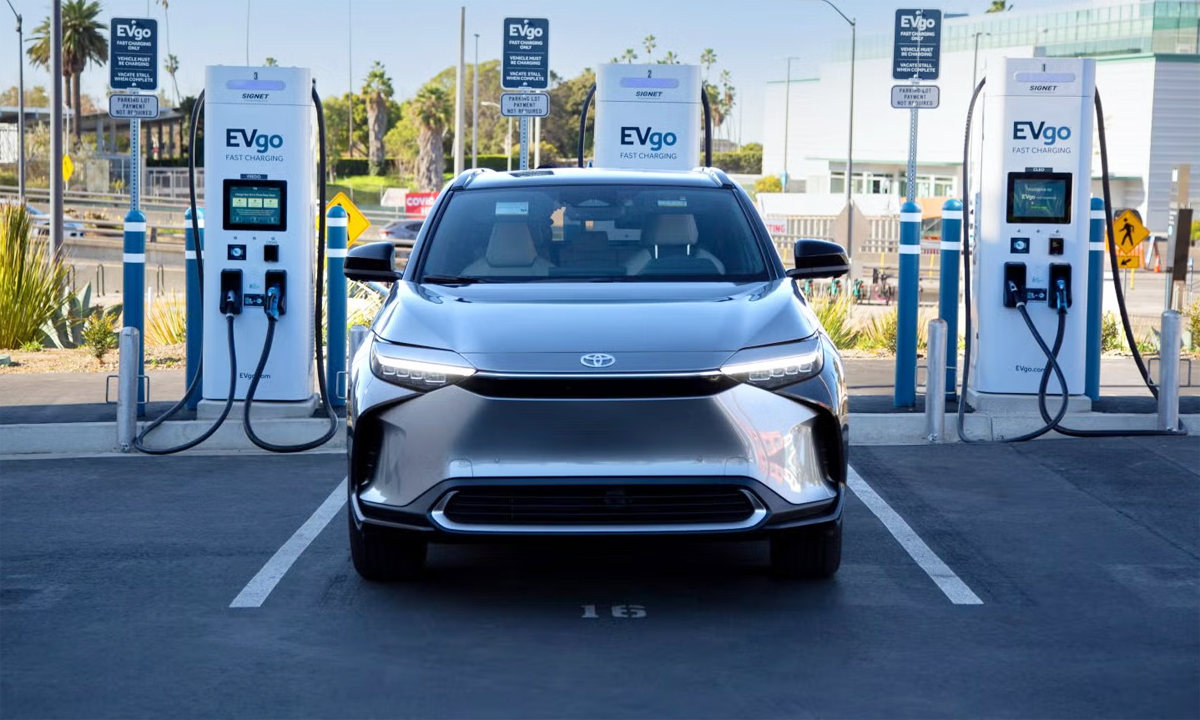 |
Toyota bZ electric vehicle at a charging station in the US. Photo: Toyota |
It remains uncertain whether demand will be robust enough to support a full EV lineup. After peaking at 10.5% of new car sales in the US in Quarter 3 2025, EVs accounted for only 5.8% of the market by the end of 2025, according to Cox Automotive. Toyota's initial venture into mass-market EV production faced challenges: the first-generation bZ4X experienced a recall in 2022 due to wheel detachment issues. Even after sales resumed, the vehicle languished in US showrooms while more popular hybrid models sold quickly. However, the latest version, rebranded as bZ in 2025, is gaining traction with buyers.
Sales of the bZ and its Lexus RZ sibling more than doubled last month, with the bZ outselling the Prius in the first three months of the year. Toyota dealers report increased demand and anticipate this momentum will continue as the company's EV lineup expands.
Long criticized for its slow adoption of EVs as part of a multi-directional approach, Toyota is accelerating its efforts. Beyond the two compact electric crossovers, the bZ and RZ, the company also sells the small electric C-HR, an off-road electric SUV named the bZ Woodland, and, starting this month, the electric Lexus ES mid-size sedan. For its first US-produced EV, Toyota is re-engineering a model previously sold as a gasoline or hybrid vehicle, the Highlander, into an electric version. This three-row, seven-seat SUV will begin production later this year at its existing plant in Georgetown, Kentucky, alongside other non-electric models. Its powertrain will be supplied by Toyota's new 14 billion USD lithium-ion battery manufacturing plant in North Carolina. A second, unnamed electric SUV will be added from 2027.
While the Japanese automaker anticipates growing demand for these vehicles, its most profitable and best-selling models remain those with gasoline-electric powertrains. Overall sales of electrified models — predominantly hybrids — accounted for 55% of Toyota's US sales in March, an increase from 49% in the same period of 2025. This proportion could be even higher if not for limits on the number of vehicles the company can supply to dealers. Buyers of some of its most popular hybrid models have faced waiting lists extending for months. Toyota, one of the automakers most affected by US tariffs on imported cars and parts, has pledged to spend approximately 10 billion USD on US manufacturing operations over the next five years. As part of this effort, it has invested billions of USD to expand several US production facilities, including its Kentucky plant, the largest facility globally.