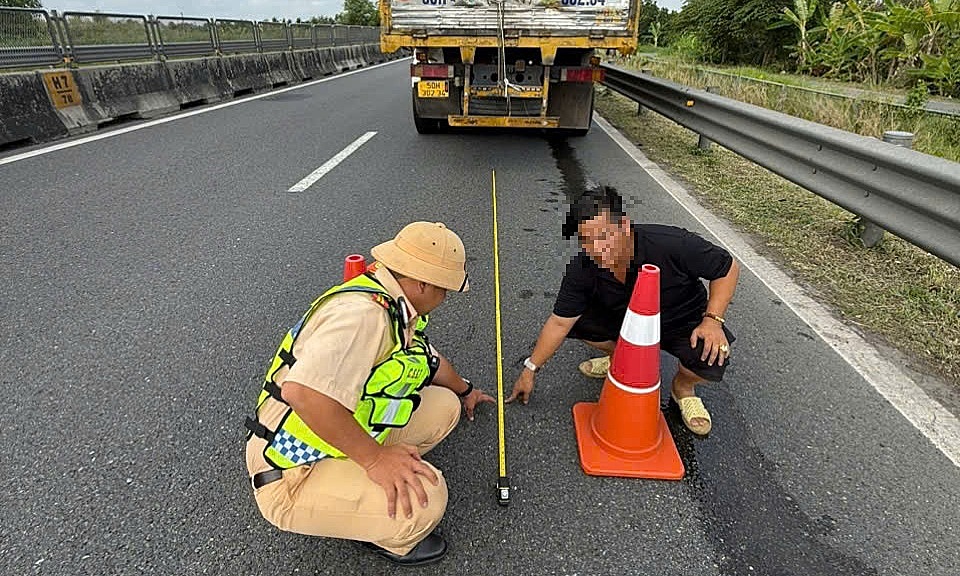
This figure, calculated up to March, is a direct result of a directive from India's National Green Tribunal (NGT), which completely bans the use of diesel vehicles over 10 years old and petrol vehicles over 15 years old.
Once these specific age thresholds are exceeded within the city, vehicles automatically lose their legal right to operate. The transport department proceeds with deregistration, making it illegal for them to be on public roads. These vehicles are then largely forced into the scrapping system or transferred to other states where age limits are not enforced.
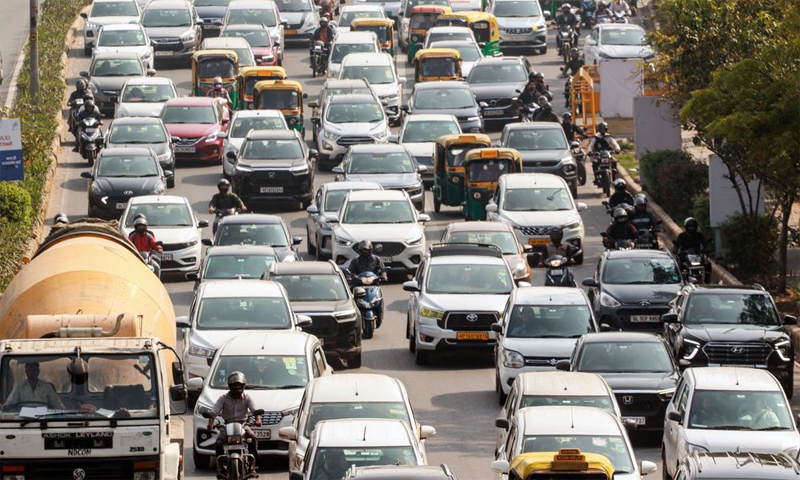 |
Cars line up across a road in Delhi. *Photo: Rashtra Press*
Despite the removal of over 6.6 million old vehicles, the actual number of vehicles circulating on Delhi's roads has not decreased. The removal of end-of-life cars and motorcycles simply cannot keep pace with the massive wave of new vehicle registrations. According to the latest survey data, the total number of operational motor vehicles in Delhi reached 8.76 million as of 19/3.
This represents a 7.9% growth compared to the 8.12 million operational vehicles recorded during the 2024-2025 period. The calculation is simple yet notable: for every old vehicle deregistered and sent to the scrapyard, more than one new vehicle is purchased and registered by consumers.
The rapid addition of these new vehicles has pushed the city's vehicle density to a record high. There are currently 522 motor vehicles per 1,000 residents, a significant leap from the 484 vehicles per 1,000 residents recorded just one year prior. This steady increase highlights a deepening reliance on personal transport.
A closer look at the 8.76 million operational vehicles reveals what residents are buying to replace their older vehicles. Two-wheelers remain the undeniable choice for the majority.
Motorcycles and scooters now account for nearly 68% of the total registered vehicles in the city. They offer the cheapest and quickest way to navigate congested traffic, becoming the default alternative for thousands of commuters.
Cars constitute a much smaller, but still significant, portion, at approximately 24% of the total vehicles. While private ownership continues to rise sharply in both two-wheeler and four-wheeler categories, the public transport sector presents a different picture.
Data shows very limited expansion in the number of buses and taxis. The lack of growth in shared transport forces many to rely on personal vehicles, fueling the cycle of new purchases.
A large-scale deregistration campaign temporarily reduced the total number of vehicles several years ago. During the 2021-2022 period, the combined impact of the pandemic and aggressive removal of old vehicle registrations caused the total vehicle count to drop to approximately 7.92 million.
However, the decline was short-lived. Vehicle numbers have steadily recovered throughout 2023 and 2024, peaking in early 2026. Data clearly indicates that strict vehicle age limits effectively remove older, more polluting engines, but do not prevent the increase in total vehicle numbers as long as the demand for personal vehicles remains unchecked.
My Anh (according to Cartoq)