The Road Traffic Order and Safety Law 2024 delineates two distinct scenarios for stopping or parking on expressways.
In the first case, if a vehicle experiences an issue but can still move into an emergency lane, drivers are permitted to stop there. They must activate their hazard warning lights. The law does not mandate placing a warning sign or device behind the vehicle in this situation.
Conversely, in the second case, if a vehicle cannot reach an emergency lane and must stop directly on a traffic lane, or if it stops on an expressway section without an emergency lane, drivers must activate hazard lights. Additionally, they are required to place a warning sign or device a minimum of 150 m behind the vehicle. Drivers must also promptly notify law enforcement or the expressway management unit about the incident.
Thus, reflective triangles, cones, and similar warning devices are mandatory when a vehicle stops on the main traffic lane. However, these devices are not required if the vehicle stops in an emergency lane.
Under Decree 168/2024 on road traffic violation penalties, drivers stopping on an expressway due to an incident without activating hazard lights, failing to place a warning sign, or placing it incorrectly (less than 150 m away) face fines of 12-14 million VND and a deduction of 6 license points.
Drivers should note that stopping or parking on an expressway, even with a warning device 150 m away and hazard lights activated, can still result in a fine. This occurs if authorities determine the stop was not a genuine emergency (e.g., vehicle breakdown or health issue). For instance, a driver could be fined for stopping in an emergency lane to sleep.
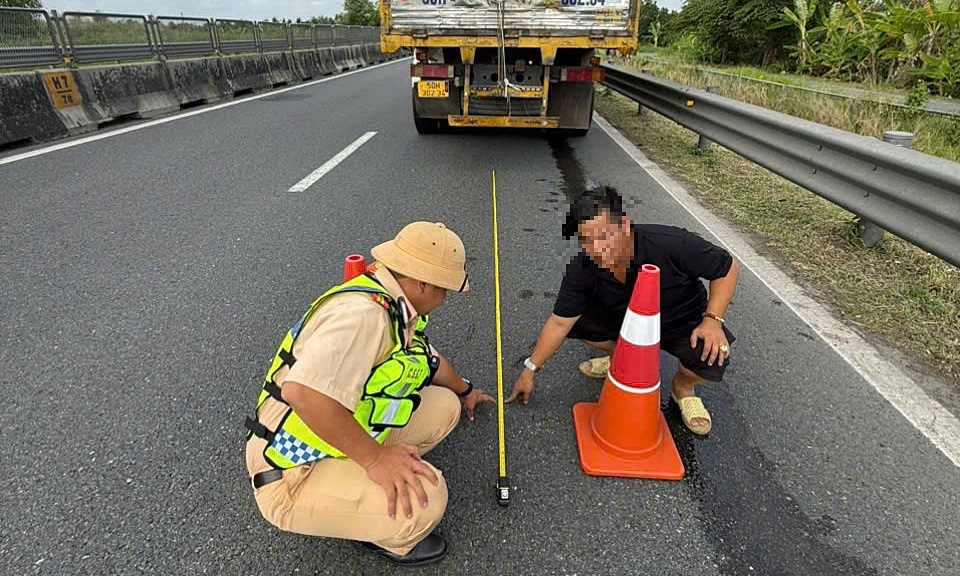 |
Authorities fine a driver for placing a warning cone 3,5 m from their vehicle after an incident required stopping on the Trung Luong - My Thuan expressway on March 19. Photo: CSGT |
Vigilance needed beyond legal compliance
In practice, merely activating hazard lights when stopped in an emergency lane is often insufficient for safety, especially at night, in adverse weather, or on curved sections with limited visibility. In such conditions, the detection distance for following vehicles significantly shortens. Given the high speeds on expressways, the risk of collision increases markedly without early warning.
Therefore, even when a vehicle is correctly stopped in an emergency lane and not legally required to place a warning sign, drivers should proactively set up an additional warning device behind their vehicle. An appropriate distance is around 150 m, equivalent to 180-220 adult paces. This allows following vehicles to detect the stopped vehicle sooner, particularly in situations of limited visibility or heavy traffic. An extra warning, though not mandatory, can significantly enhance safety and reduce risks for both the stopped driver and surrounding traffic.
Furthermore, if an emergency stop is necessary on an expressway, drivers must quickly exit their vehicle and move to a safe location, avoiding proximity to active traffic lanes. In low-light conditions, drivers should use reflective vests or luminous items (such as a phone's flashlight) to improve their visibility to other vehicles from a distance.
Pham Hai