Recently, the Vietnam Automobile Transport Association recommended that the Vietnam Register only apply up to half throttle, equivalent to 2,000-3,000 rpm, during emission inspections for older generation diesel vehicles. The association argued that this range is common in traffic. They also stated that older vehicles lack technology to limit idle rpm and are of lower quality than newer models, suggesting that full throttle could damage their engines.
Responding to this on 24/3, the Vietnam Register clarified a technical misunderstanding regarding two vehicle operating conditions: under load (on the road) and unloaded (during inspection). When a vehicle carries a heavy load or climbs a hill, even with only half throttle, the fuel injection system must significantly increase fuel delivery to overcome resistance, resulting in more black smoke.
Conversely, at an inspection station, the vehicle is unloaded, and the engine faces no resistance. Therefore, a small amount of fuel can achieve 2,000-3,000 rpm, leading to emissions that appear "cleaner" than they are in reality. Thus, using a half-throttle measurement method lacks scientific basis and is not applied by any international standards.
The Vietnam Register emphasized that the inspection's goal is to detect technical faults, including times when the engine emits the most. If the throttle is only held at a medium level, the high-pressure pump system will not operate at its maximum fuel delivery state, making the measurement results inaccurate for the vehicle's actual operating condition.
The regulatory agency also warned that if the inspection benchmark is set at a low rpm range, many vehicles with damaged injector systems or high-pressure pumps could be missed. This would skew results and impact environmental protection goals outlined in the Prime Minister's Decision 43/2025.
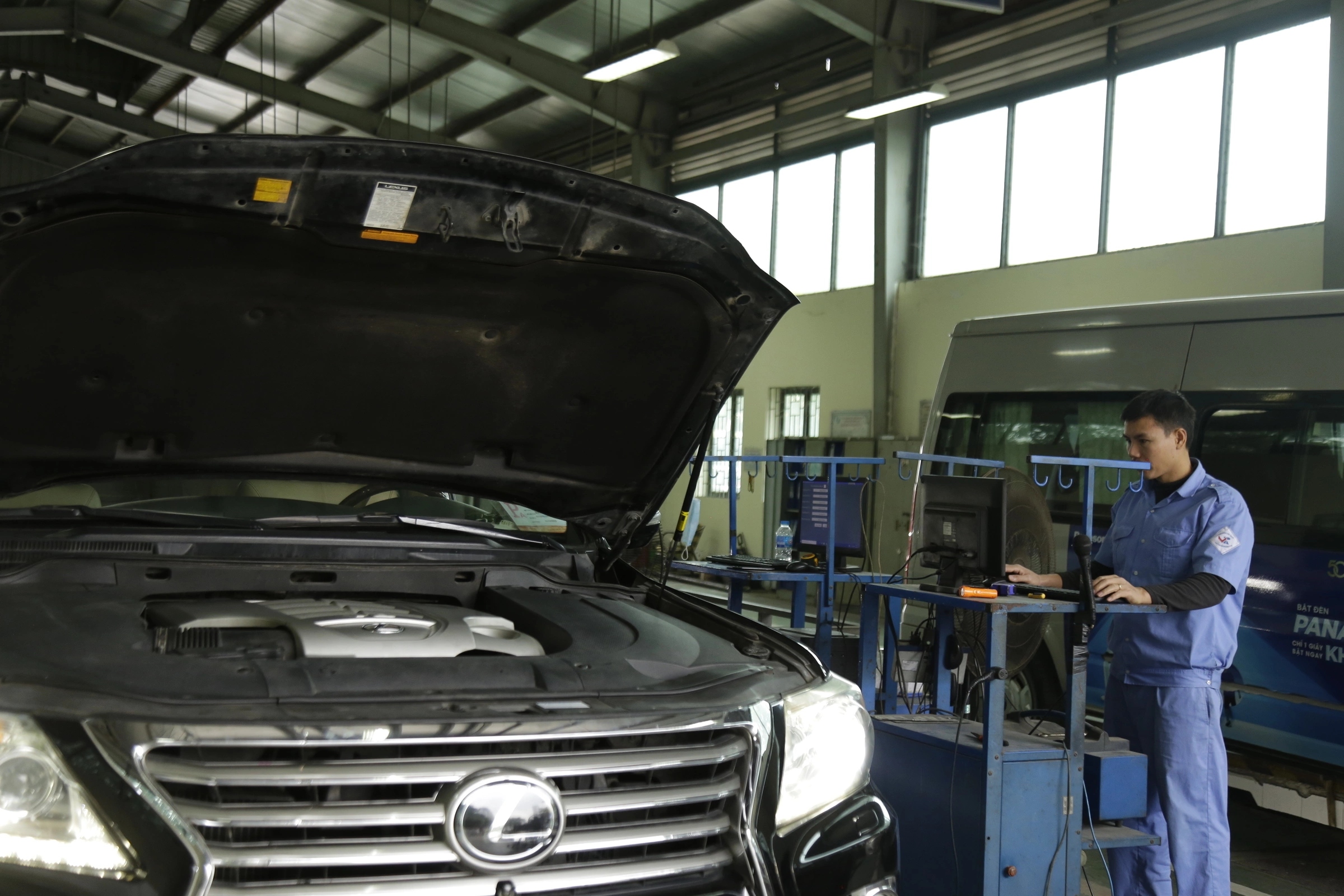 |
Vehicle inspection in Ha Noi. *Photo: Pham Chieu* |
Regarding the opinion that older diesel vehicles lack a speed limiting system, the Vietnam Register stated this assessment is inaccurate. A characteristic of all diesel engines is that speed is controlled by the amount of fuel injected, unlike gasoline engines which regulate speed via the throttle body (air volume).
All diesel engines are equipped with a governor. This component automatically adjusts and reduces fuel when the engine reaches its maximum rpm threshold, ensuring safety as per the manufacturer's design.
Concerning the requirement for vehicle owners to sign a commitment during emission inspections, the Vietnam Register stated this is not mandatory but voluntary for the owner and is only a temporary solution. It applies in cases where the actual engine rpm is suspected of exceeding design limits, and the inspection facility lacks sufficient comparison data from the manufacturer. If there is evidence that the actual rpm exceeds the design, the inspector will refuse emission inspection, even if the owner wishes to sign the commitment.
From 1/3, vehicle inspection centers have implemented stricter automobile emission inspection procedures under a new roadmap, requiring many vehicles, especially diesel cars, to meet higher standards.
Doan Loan