Instead of drivers searching for available charging spots in a station or parking lot, ceiling-mounted charging robots move directly to their vehicles. This innovative concept, already implemented in parking facilities across various cities in China, transforms every parking space into a potential charging point without the need for costly individual charger installations.
The tracks serve as both power conduits and movement paths, allowing the robots to glide to any parking spot along their route. When an EV owner requests a charge, typically via WeChat or by scanning a QR code, the device moves to their vehicle and lowers its connector.
The primary advantage of this system is infrastructure efficiency. Installing a dedicated charger for each parking space is expensive and complex in underground garages, where electrical upgrades can cost thousands of USD per spot. A single overhead track system, however, can serve an entire row of parking spaces from one electrical connection.
The main drawback is charging speed. Since the tracks double as the power transmission system, charging speed is limited compared to dedicated DC fast chargers. This is a level 2 AC solution, not a 1,000 kW BYD-style ultrafast charger. However, for vehicles parked for hours at offices, shopping centers, or overnight in apartment building garages, a slower, consistent charge is often sufficient.
Several Chinese companies are actively competing to commercialize track-based electric vehicle charging systems, with a few notable players emerging.
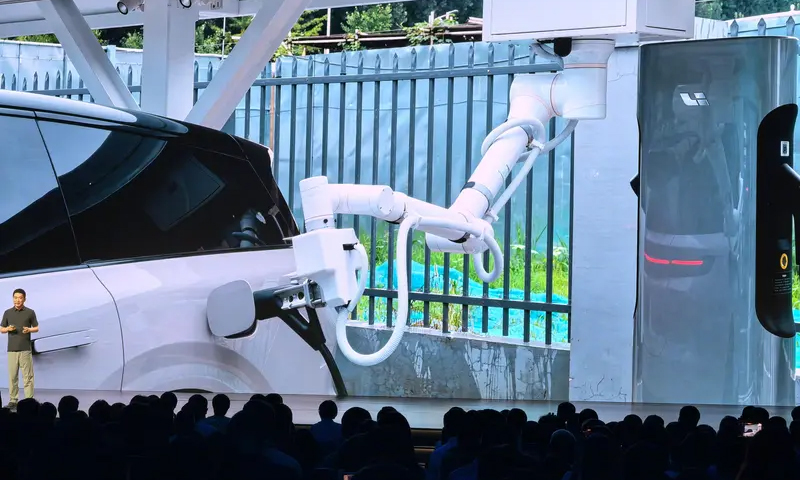 |
Model of a robotic arm for EV charging at a Li Auto presentation. Photo: Li Auto |
Li Auto and CGXi are developing what they describe as the world's first automatic track-based robotic EV charging arm. Li Auto CEO, Li Xiang, confirmed during the Li i8 model launch in 7/2025 that the system is undergoing active testing. The robot moves along sliding tracks and integrates sensors and vision systems to identify the location and orientation of the charging port on any vehicle.
Wawa Charging Station utilizes a system called Robot HAVA, a flexible robotic arm with 18 degrees of freedom that moves on overhead H-shaped tracks. The company claims one device can serve 8 or more parking spaces and describes it as the world's first commercial automatic charging robot.
Meanwhile, a system named SkyvoltRobot, documented in a 2024 ScienceDirect article, provides the technical framework for overhead track-mounted charging robots, offering the theoretical foundation upon which commercial deployments are based.
Track-based mobile charging systems represent just a segment of the rapid expansion of mobile charging robots in China. Ground-based charging robots from companies such as CharGo (a CATL subsidiary), NaaS Technology, GGSN, and VMR are also rapidly advancing. CharGo's CEO predicts that 20% of all new energy vehicles will be charged by robots by 2030. Separately, Beijing plans to deploy 1,000 mobile charging robots across 150 parking lots.
My Anh (according to Electrek)