Amidst the snow-covered mountains of northern Slovakia, inside a massive factory, a lifting system gently lowers steel car bodies onto the assembly line. These frames have just been welded by 690 industrial robots before moving to the manual assembly stage.
Here, thousands of workers in red trousers and white t-shirts meticulously complete each detail, transforming steel shells into finished automobiles. Every minute, a car rolls off the line, headlights flashing to signal completion.
This is Kia's factory near Zilina, northern Slovakia, which also serves as the company's largest production facility in Europe. Kia reports a total investment of 2,5 billion EUR, equivalent to over 2,9 billion USD, in this complex.
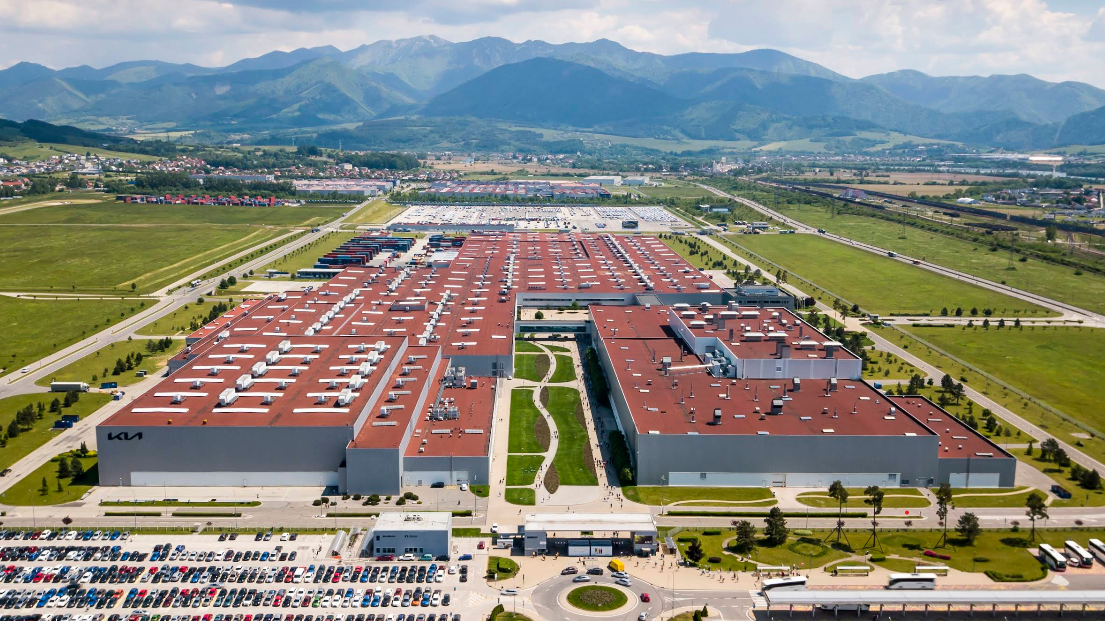 |
Kia's large-scale factory in Slovakia is the company's main production facility in Europe, located in Zilina. Photo: Kia
Beyond Kia, Slovakia hosts factories for major automotive brands such as Volkswagen, Stellantis, and Jaguar Land Rover. Volvo also plans to commence operations at an electric vehicle plant here from 2027. With a population of approximately 5,4 million people but an output of nearly one million vehicles each year, Slovakia currently holds the distinction of being the world's largest automobile producer per capita.
Inside the Kia factory, about 3.700 employees work on the assembly line. Marcel Pukhon, 48, shared that he has been passionate about automobiles since childhood and lived in the UK and Northern Ireland before returning to Slovakia for work. "Now I directly participate in creating these cars. For me, this is a dream job," he stated.
While not everyone considers this an ideal job, for many young workers, an automobile factory offers a steady income and stability. Simona Krnova, 23, who works in the door soundproofing department, stated her current monthly salary is 1.300 EUR (over 1.500 USD). According to Kia, the average per capita income at the factory reaches approximately 2.400 EUR (over 2.800 USD).
This figure is considerably higher than Slovakia's national average income in 2023, which was 1.403 EUR (over 1.600 USD), yet it remains below the EU average. This disparity is one of the reasons Slovakia has become an attractive destination for global automotive manufacturers.
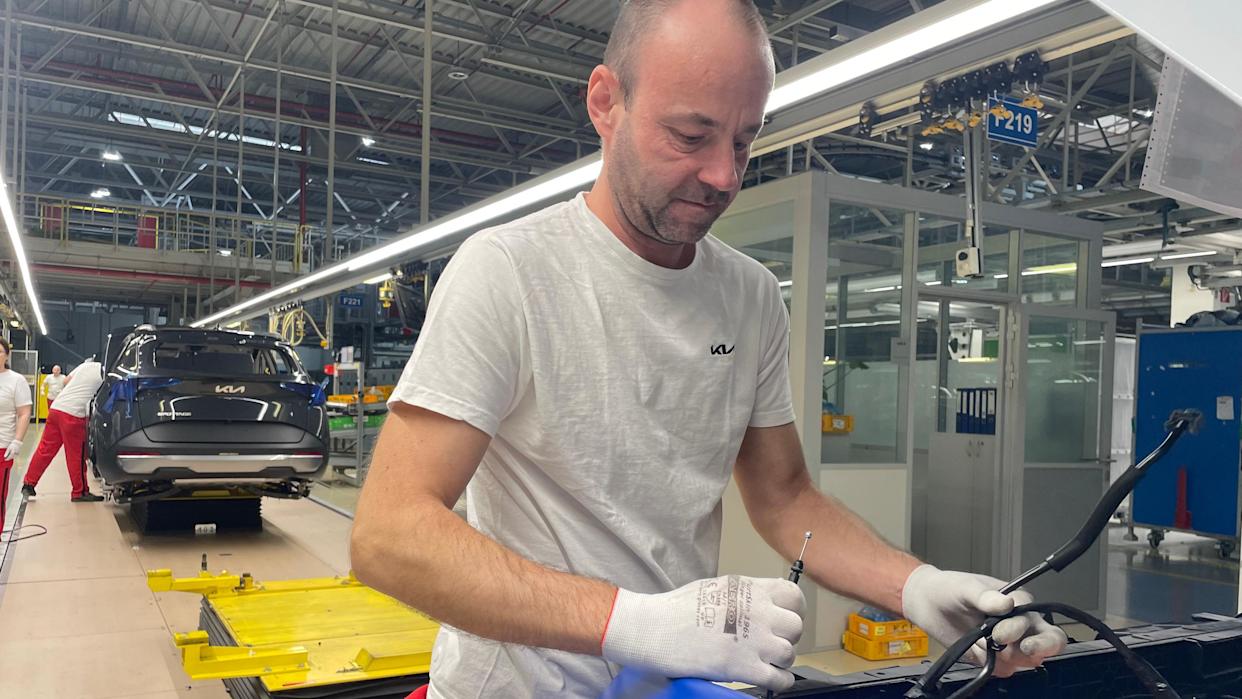 |
Kia assembly line worker, Marcel Pukhon, states he has a "dream job." Photo: BBC
According to automotive expert Peter Prokop, labor costs in Slovakia are currently about 60% compared to Western Europe, while labor productivity remains high. "Low costs combined with good production efficiency represent a significant competitive advantage," he noted.
Slovakia's automotive industry accelerated after 1989, when the country transitioned to a market economy. Previously, during the socialist era, vehicles produced here were considered to have low quality by Western standards. A turning point occurred when Volkswagen invested in Skoda in the early 1990s, paving the way for a wave of investment from European and Asian car manufacturers into Central Europe.
In addition to labor costs, Slovakia benefits from its central geographic location in Europe, facilitating convenient transport to major markets such as the UK, Germany, Italy, and Spain. Furthermore, it boasts a network of approximately 360 ancillary industrial enterprises, forming a complete supply chain for the automotive sector.
Another factor is the energy structure, with a high proportion derived from hydropower and nuclear power, which helps electric vehicles manufactured in Slovakia qualify for incentives in many European countries. Kia confirmed receiving a 29 million EUR (nearly 33,9 USD) tax credit to convert its production line to electric vehicle manufacturing, out of a total investment of 108 million EUR (over 126 million USD).
According to the Zilina city government, Kia's operations and related businesses currently generate over 20.000 direct and indirect jobs in the region, while significantly contributing to the local economy.
Slovakia also prioritizes workforce training for the automotive industry. At the Zilina technical school, students pursue work-study programs at businesses. Each year, approximately 400 University of Zilina students enter fields related to automobile production.
Slovakia is not the only country benefiting from the shift in automotive production. Many other Eastern European nations have also attracted Western and Asian car manufacturers. In the Czech Republic, Hyundai, Toyota, and Volkswagen all operate production plants. In Poland, Toyota, Stellantis, and Volkswagen have a large presence. Hungary hosts production facilities for Audi, Mercedes, and Suzuki, while Romania has Ford and Renault, and Serbia is also a stronghold for Ford.
These countries share common advantages: lower labor costs than Western Europe, a long-standing industrial tradition, and a well-trained workforce, all of which foster the development of the automotive manufacturing sector.
Ho Tan (via BBC)