Eyesea and EVI Safety Technologies recently announced an artificial intelligence (AI) system designed to detect containers falling from ships and automatically report these incidents.
This announcement comes as new mandatory International Maritime Organization (IMO) regulations for reporting containers lost at sea are set to take effect from 1/1/2026.
According to the developers, the system utilizes standard cameras installed on the bridge and ship decks. It has undergone testing and refinement in simulated environments and is now ready for real-world operational trials on active vessels.
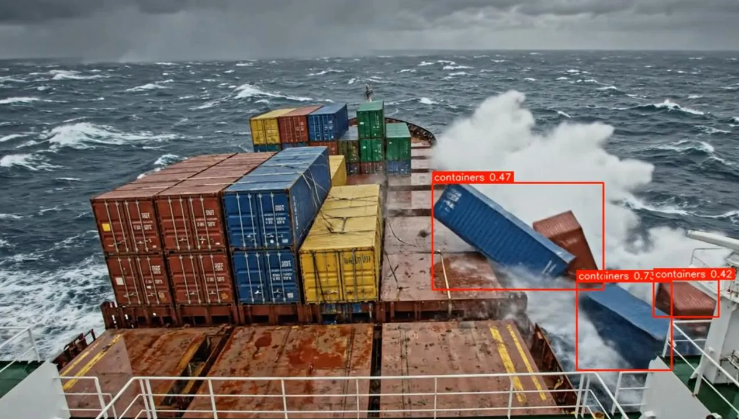 |
The AI system by Eyesea and EVI Safety Technologies is ready for real-world trials on active vessels. Photo: Eyesea |
The AI system by Eyesea and EVI Safety Technologies is ready for real-world trials on active vessels. Photo: Eyesea
The system can automatically identify containers falling from a ship or containers adrift at sea. Upon detection, data is immediately sent to relevant parties, including the registered ship owner, flag state, and coastal authorities. Additionally, vessels operating nearby can receive warnings about potential maritime safety hazards.
Representatives from Eyesea and EVI Safety Technologies stated that the system is designed to help shipping companies comply with IMO regulations. It achieves this by generating georeferenced images and structured incident data at the exact moment a container is lost or drifts away.
Graeme Somerville-Ryan, founder of Eyesea, stated that reporting containers lost at sea is one of the initial functions integrated into the platform. "This is a specific issue within the maritime industry. Bringing this technology from simulated environments to real-world detection is a significant step, contributing to the protection of the marine environment", he said.
Vladimir Ponomarfev, CEO of EVI Safety Technologies, assessed that applying machine learning and AI in the maritime sector addresses a safety and environmental challenge that has been largely overlooked for decades. "This is precisely the kind of practical application technology should aim for", he shared.
According to relevant parties, the widespread deployment of the system will occur after trials confirm its effectiveness in real-world operating conditions.
The annual Containers Lost at Sea report by the World Shipping Council (WSC) indicates that 576 containers were lost at sea in 2024, a sharp increase from the record low of 221 containers in 2023. This rise is primarily due to vessels having to reroute around the Cape of Good Hope, an area consistently identified as a hotspot for container loss incidents throughout 2025.
By Ngoc Minh (according to Seatrade Maritime News)