While both invest in AI, some enterprises only help employees work faster, while others significantly shorten decision-making time and change how departments collaborate. According to FPT Digital’s observations, this disparity is not due to the number of AI models or investment budgets, but rather how enterprises perceive AI’s role: as a direct participant in value creation or merely a series of personal support tools.
Dr. Le Hung Cuong, general director of FPT Digital, a member of FPT Corporation, stated that the AI challenge is shifting from technology application to management model redesign. "When AI can act, not just suggest, the question is no longer what AI can do, but who is responsible when AI acts, and that question must be answered before deployment, not after the first incident", Dr. Le Hung Cuong said.
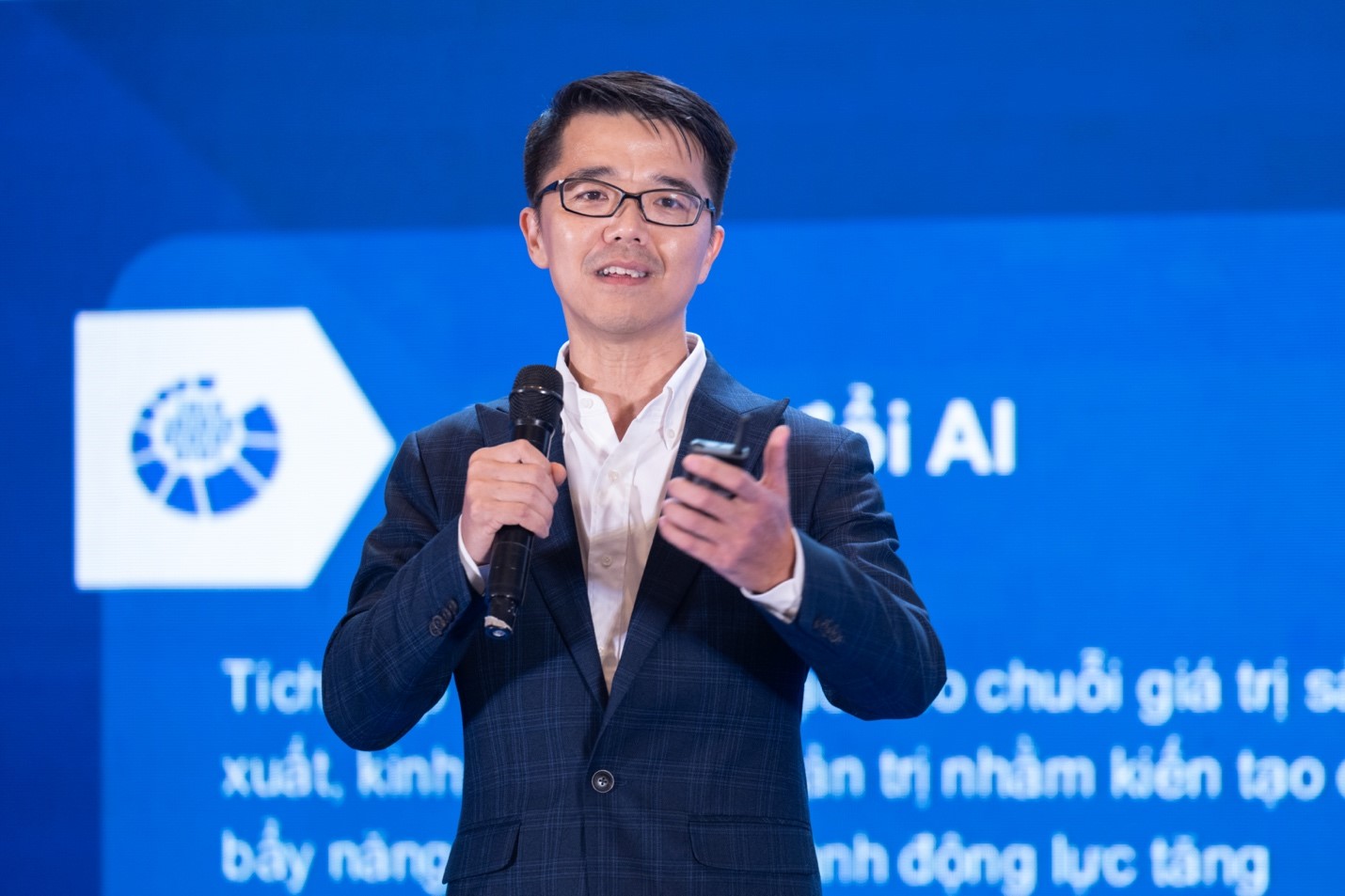 |
Dr. Le Hung Cuong, general director of FPT Digital, a member of FPT Corporation, at a digital transformation and AI conference. Photo: FPT Digital
AI works across departments
For many decades, whenever new technology emerged, enterprises typically asked how to apply it to increase efficiency. Enterprise resource planning (ERP) software standardized processes, customer relationship management (CRM) software managed customer relations, and business intelligence supported data analysis. All were based on a common premise: humans still directly performed tasks, with technology merely providing support.
AI agents are now breaking that premise. An AI system can now receive objectives, plan autonomously, coordinate multiple applications, and execute parts of business processes that previously always required human involvement. US-based information technology research and consulting firm Gartner estimates that by the end of 2026, about 40% of enterprise applications will integrate task-specific AI agents, compared to under 5% just one year prior. Enterprises are therefore gaining a new type of "labor" that directly participates in the value chain. Experts refer to this as a shift from AI as a tool to AI as a direct workforce.
Dr. Le Hung Cuong noted that during surveys at many enterprises, he observed AI was still being deployed in the old digital transformation manner: each department selected tools for its specific needs. For example, marketing used AI to write content, sales used AI to draft proposals, and human resources used AI for recruitment. This approach improved productivity, but its value remained isolated to individuals and departments. More importantly, responsibility remained clear because AI only suggested, and humans were still the final decision-makers.
Problems arise when AI agents begin to act autonomously instead of just making suggestions. A typical situation occurs in manufacturing enterprises, where approval processes are designed for human decision-making. Here, there are no predefined steps for when AI is permitted to make adjustments without confirmation, and when human approval is mandatory. When an incident occurs, enterprises realize this gap. The solution is not to limit AI’s authority, but to clearly stratify risk levels: changes below a certain threshold allow AI to decide independently to maintain response speed, while others require human approval.
A similar situation also appears in retail, where decisions like launching promotions or transferring goods previously required multiple rounds of discussions among business, marketing, supply chain, and finance departments, taking many working days. When an AI agent is empowered to propose and implement within a pre-approved budget and price range, decision-making time can be significantly shortened. However, the question the executive board must answer before deployment is: if an AI-driven program incurs greater losses than expected, is it a normal business risk or an operational error requiring accountability? Many enterprises have chosen to differentiate from the outset: one type of decision allows AI full autonomy within budget limits, while another type requires human approval due to exceeding financial risk thresholds.
The common thread in both scenarios is that AI does not replace managers, but changes the nature of management work. As information synthesis and daily operational coordination are increasingly automated, the management role shifts from operational oversight to system design, team development, and handling exceptional situations.
AI drives operational model redesign
As AI integrates into every operational stage, management questions begin to emerge: should key performance indicators (KPIs) continue to be designed by department or across the entire value chain? When AI participates in a decision, who bears the ultimate responsibility? If AI can seamlessly connect business, finance, and production, is the traditional functional organizational model still optimal? These questions relate to the organizational model, not just technology. Competitive advantage will belong to the enterprise that answers them first, not the one with the most AI tools.
Gartner's 2026 global chief information officer (CIO) survey shows that 17% of organizations have actually deployed AI agents, while over 60% expect to do so within two years. Many enterprises know they need to change but do not know where to start. This is why FPT introduced the five-level CASAN AI maturity framework, from Curious, Augmented, Standard, Automatic, to Native, to help leaders identify their current position.
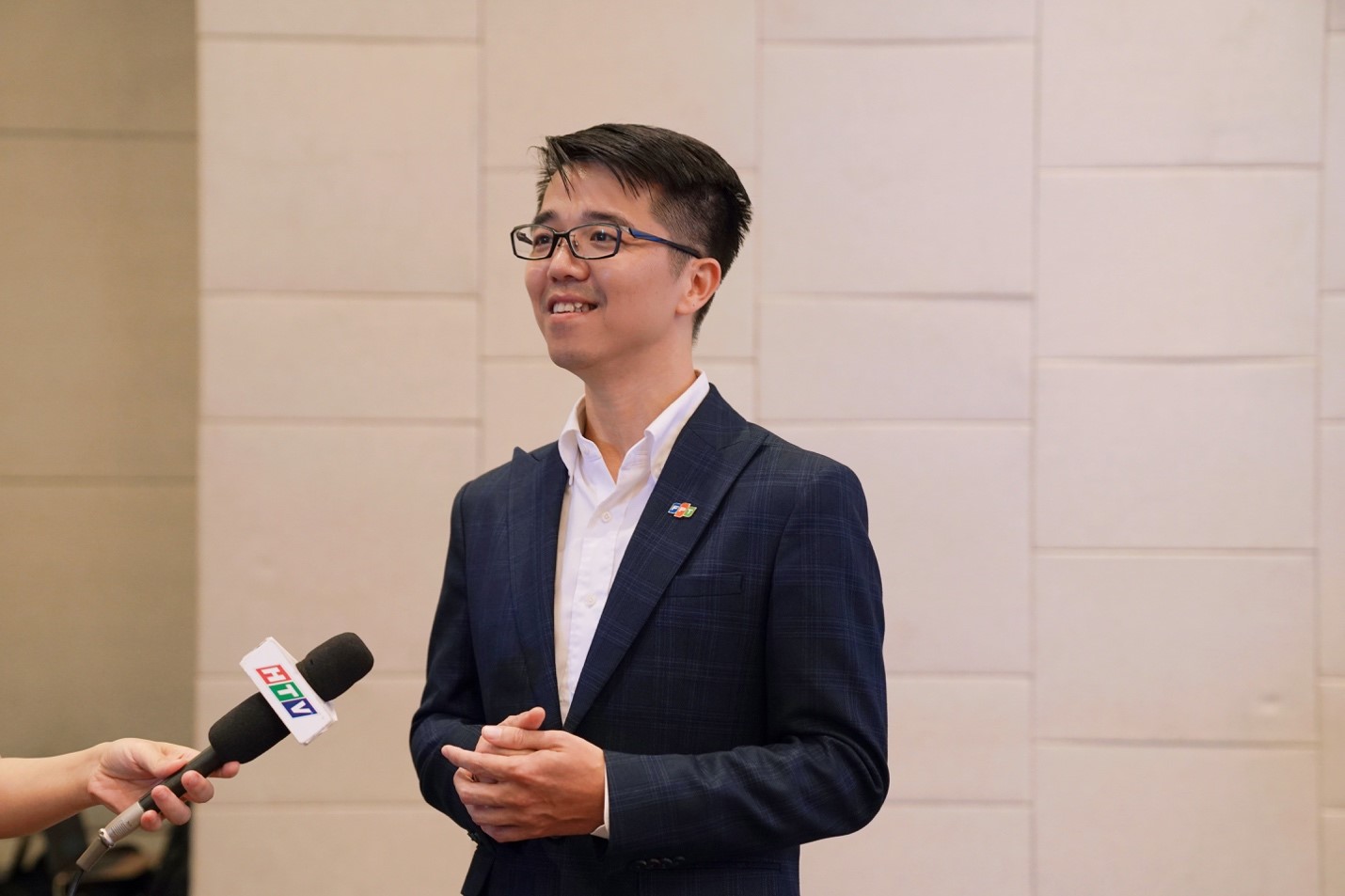 |
Dr. Le Hung Cuong discusses the operational model evolving with each level of AI maturity in enterprises. Photo: FPT Digital
However, according to Dr. Le Hung Cuong, most enterprises do not struggle to assess their "AI maturity" level. What perplexes them is that they still do not know how to change their organizational structure, processes, or human roles to advance to the next level.
This is the gap FPT aims to address with CASAN Enterprise Operating System (CASAN OS) – an operational model that transforms each maturity level, redesigning the enterprise so that humans, AI agents, data, and processes collaborate as a unified system, rather than having AI deployed disparately across departments.
"The hardest part of AI transformation is not deploying an additional AI agent. The hardest part is that many enterprise processes today are still designed with the assumption that only humans are involved in performing tasks", Dr. Le Hung Cuong said. He believes that when AI also participates in performing tasks, the entire way enterprises are organized needs to be re-evaluated.
In the initial phase, enterprises can differentiate themselves by early AI adoption. As AI gradually becomes a common capability, owning the technology is no longer a barrier. The greater challenge is transforming that technology into a truly differentiated operational model with lower marginal costs, faster decisions, and scalable operations without a corresponding increase in human resources. This is the economic differentiation many chief executive officers (CEOs) are pursuing.
"The factor determining competitive advantage in the next few years may not be which enterprise adopts AI earlier, but which enterprise redesigns its operational model around AI faster. Because AI can be purchased, but organizational capability cannot", Dr. Le Hung Cuong concluded.
(Source: FPT Digital)