In New York City, it is not difficult to hear the roar of gas-powered generators providing electricity to tens of thousands of food carts. But William Arevalo's family cart is different. This cart, selling hot dogs, empanadas, and fried shrimp, operates on rechargeable batteries, thanks to its participation in a city pilot program aimed at cutting down on noise and air pollution.
"I cannot believe it. The noise is gone, and all the equipment still works normally," Arevalo, 59, told AFP.
Arevalo is one of ten street vendors participating in the trial, which aims to see if they can abandon gas-powered generators to reduce noise, greenhouse gas emissions, and health risks from exhaust fumes.
This is a massive undertaking. Most of the city's 20,500 licensed food carts use generators to power their stoves, freezers, and ventilation systems.
According to the New York City Council, if all these carts switch to electric power, the emissions reduction would be equivalent to removing about 30,000 automobiles from the streets each year. However, costs and infrastructure remain significant challenges.
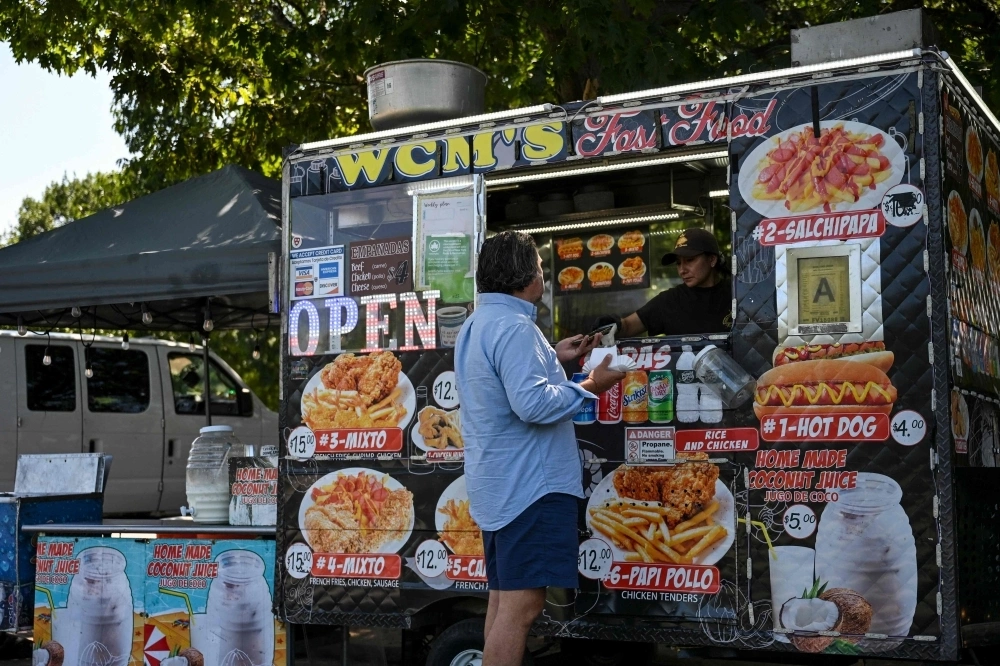 |
Customers buy food at William Arevalo's family cart in New York City on 23/7. Photo: AFP |
Arevalo's family has been operating food carts for over 20 years. He has noticed many benefits since replacing the gas-powered generator.
"The exhaust from the previous generator often blew into the cart. This was truly unhealthy. Many times, I could not even hear what customers were saying because the generator was too loud. Now, everything has completely reversed," he said.
During the hot days of July, using batteries is also safer, as gas-powered generators are prone to overheating and shutting down in the summer.
Behind Arevalo's food cart is an inverter system that can hold up to 6 batteries, each about 30 cm long. He stated that these batteries are sufficient to power the freezer for storing fries and the cooling fan, provided they are replaced every 5 hours.
New York's 6-month pilot program, which started in July, uses batteries similar to those found in many electric bicycles. PopWheels, a startup in the city, supplies and charges the batteries at nearby fire-resistant lockers.
Previously, the city had implemented similar trial programs, but they were short-lived. In 2013, New York connected some food carts in Manhattan to the city's power grid. This solution reduced emissions and noise but could not be scaled up.
Another pilot program, implemented by the nonprofit Street Vendor Project, also used batteries for food carts. However, a lack of charging infrastructure became a barrier.
This time, the city council expects things to be different, moving towards a subscription model where vendors pay a fee to use batteries and charging stations.
"We believe the costs will be competitive, lower than or at least equivalent to what vendors currently spend on generator fuel," said Isabela Brown, senior policy advisor at the New York Mayor's Office of Climate.
"For vendors, the biggest cost is installing the inverter system. We are exploring financial solutions such as loans and other forms of support that the city can provide," she said.
Inverter systems can cost up to several thousand USD, comparable to gas-powered generators, depending on their capacity. However, proponents argue that long-term operating costs will be lower.
Currently, Arevalo is actively showcasing his electric food cart to other vendors who still use gas-powered generators. "I show it to my friends, and they are all very surprised. Everything works, it really does," he said.
By Ha Thu (AFP)